
Introduction
If you run a small or medium business in Australia, you’re probably hearing a lot about AI – but far less about how to make it actually work inside your systems, with your team, and on your budget. That’s where an AI agency comes in.
This guide explains what an AI agency does, how it differs from strategy consultants and implementation partners, what typical pricing looks like in Australia, and how SMBs can evaluate whether hiring one makes sense.
We’ll walk through common services and team skills, a simple implementation path from first workshop to live use case, options like in‑house vs agency, and a checklist you can use to compare providers. The aim is to help you make a confident, commercially grounded decision – not just experiment with AI for the sake of it.
What Is An AI Agency?
Core role and services
An AI agency is a specialist partner that helps businesses identify, design, and deliver AI‑powered solutions end‑to‑end – from early opportunity discovery through to deployment and ongoing optimisation.
For Australian SMBs, the core services usually include:
- Opportunity assessment – mapping your processes, pain points, and data to find where AI and automation can add real value (e.g. quoting, support, scheduling, reconciliations).
- Data readiness – checking whether you have the right data, where it lives (CRMs, accounting systems, email, files), and what needs cleaning or restructuring.
- Solution design – defining user journeys, workflows, guardrails, and how AI will fit into existing roles rather than replace them overnight.
- Model selection or configuration – choosing and configuring suitable models and tools (often via trusted cloud AI APIs) instead of inventing new algorithms from scratch.
- Integration with existing systems – wiring AI into your CRM, accounting package, operations tools, databases, and communication platforms so work actually flows.
- Training staff – helping your team understand new workflows, escalation paths, and where humans stay firmly in control.
- Monitoring and support – measuring performance, tuning prompts and rules, and keeping workflows reliable as your business changes.
Fewer SMB projects involve building brand‑new AI models in a research lab style. Instead, agencies like Sync Stream blend proven, off‑the‑shelf components (chatbots, orchestration tools like n8n, document search, analytics, APIs) with careful configuration and workflow design to solve concrete business problems.
Strategy advisors vs implementation partners
Not every firm that talks about AI does the same work.
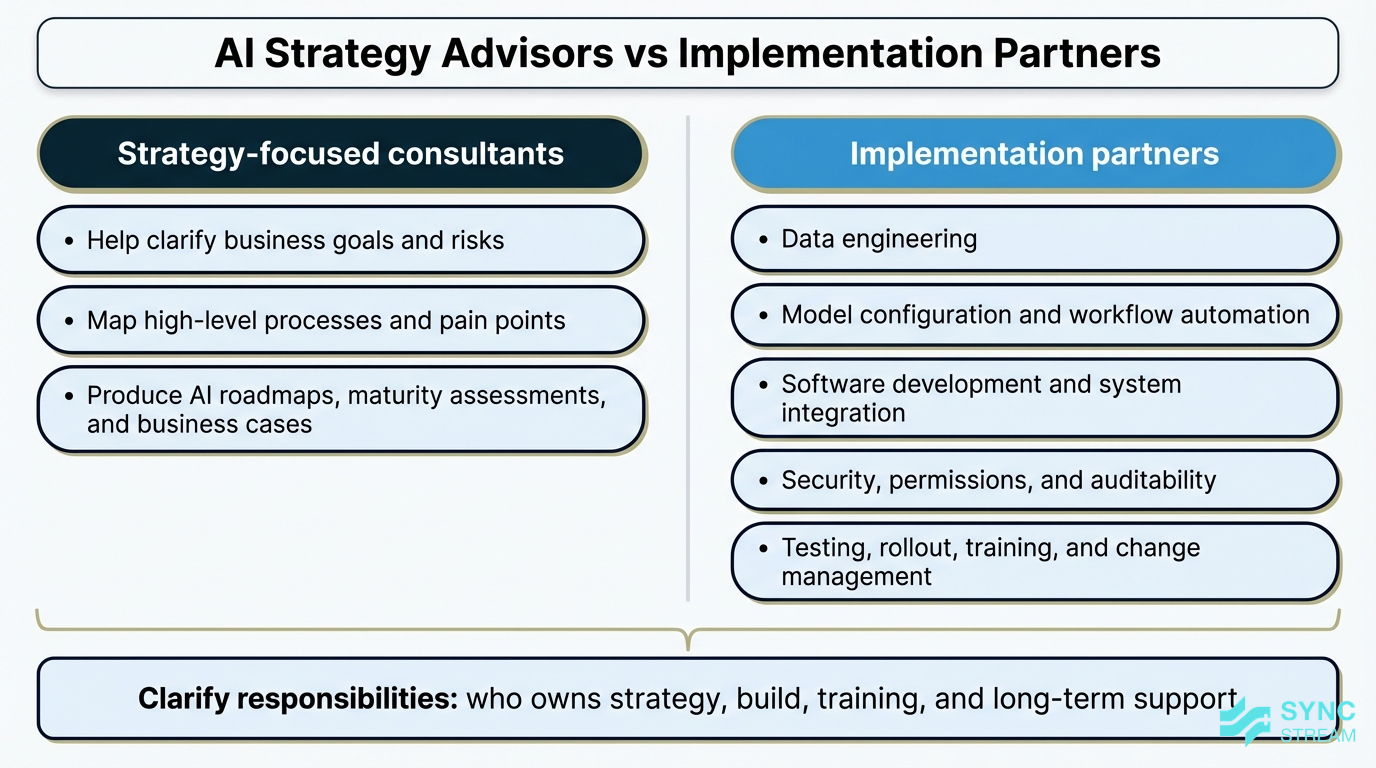
Strategy‑focused consultants typically:
- Help clarify business goals and risks.
- Map high‑level processes and pain points.
- Produce AI roadmaps, maturity assessments, and business cases.
They may not actually build or integrate the technology. Their output is usually documents and recommendations.
Implementation partners focus on delivery inside your business. That includes:
- Data engineering: connecting to your systems, cleaning and structuring data.
- Model configuration and workflow automation.
- Software development and system integration.
- Security, permissions, and auditability.
- Testing, rollout, training, and change management.
Many modern AI agencies combine both roles, but in practice, responsibilities can still fall through the gaps. As an SMB owner you should explicitly confirm:
- Who is responsible for strategy and use‑case selection.
- Who is doing the hands‑on build and integration work.
- Who trains your staff and documents the workflows.
- Who owns long‑term support and optimisation.
Sync Stream positions itself primarily as an implementation partner that also supports pragmatic strategy – always tied to a clear business case and ROI, not abstract AI commentary.
Why It Matters For Australian SMBs
Where Australian businesses use AI today
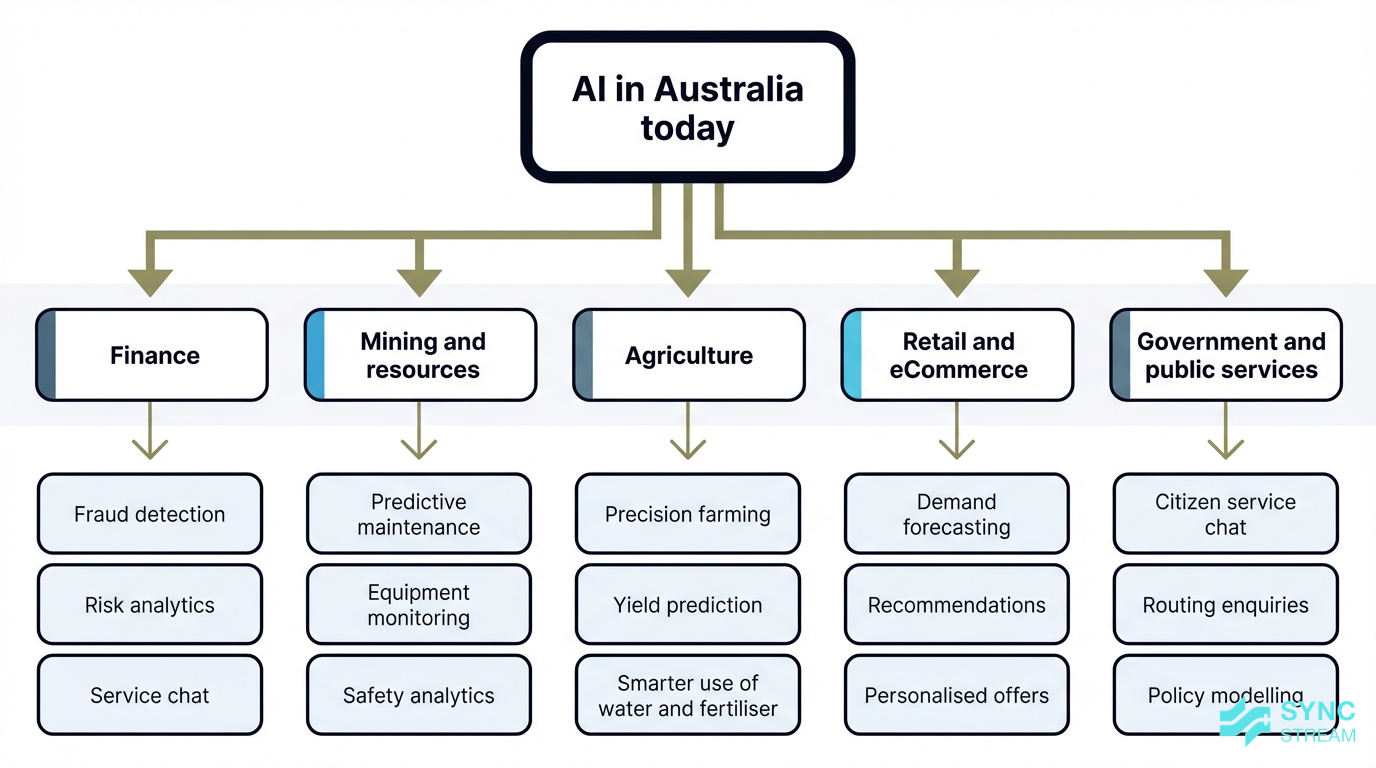
A hierarchical view of key Australian industries and the types of AI use cases commonly adopted in each.
Across Australia, AI is already embedded in many sectors:
- Finance – fraud detection, risk analytics, and service chat that triages and answers routine questions.
- Mining and resources – predictive maintenance, equipment monitoring, and safety analytics.
- Agriculture – precision farming, yield prediction, and smarter use of water and fertiliser.
- Retail and eCommerce – demand forecasting, recommendations, and personalised offers.
- Government and public services – citizen service chat, routing enquiries, and policy modelling.
The same underlying capabilities – prediction, classification, automation, and natural language processing – can be applied at SMB scale, for example:
- Faster, more accurate quoting and proposals.
- Lead scoring and follow‑up workflows in your CRM.
- Smarter inventory and purchasing suggestions.
- Automated customer support for common questions.
- Basic revenue and capacity forecasting.
AI‑related hiring demand in Australia has more than tripled since 2015, and there are now over 1,500 AI‑related organisations in the country. That’s a strong signal that AI is mainstream, and that SMBs that ignore it risk gradually falling behind more efficient competitors.
SMB advantages from working with an agency
Most SMBs don’t have the budget or appetite to assemble a full internal AI team. An AI agency lets you:
- Tap into scarce skills on demand – data engineering, automation, and AI expertise you couldn’t justify hiring full‑time.
- Move faster – proven implementation patterns shorten experimentation and avoid dead‑end projects.
- Focus on use cases with clear payback – labour savings, higher conversion, fewer errors, and better margin control.
A local Australian agency also brings:
- Understanding of privacy and data obligations, including industry‑specific regulations.
- Familiarity with tools common to Australian SMBs (e.g. Xero, MYOB, local CRMs, job management and field service platforms).
- Time‑zone alignment for workshops, support, and training.
Sync Stream, for example, works inside your existing systems so you retain control of data, security, and infrastructure, and every workflow is documented to minimise vendor lock‑in.
Key Components And Capabilities
Typical service offerings
For SMBs, an AI agency’s services usually fall into a few practical buckets:
- AI readiness assessments – reviewing your processes, systems, and data to see where AI and automation can actually help.
- Use‑case prioritisation – ranking ideas by expected impact, ease of implementation, and data availability.
- Proof‑of‑concept (POC) builds – small experiments to test a single use case in a controlled way.
- Production deployments – hardening a successful POC with proper security, monitoring, and change management.
- System integration – connecting CRMs, accounting platforms, operations tools, and communication channels.
- Training and enablement – helping your team adopt new workflows and manage exceptions.
- Ongoing optimisation – monitoring performance and incrementally expanding the solution.
Services often span both:
- Generative AI – chatbots, document search and summarisation, content drafting, internal knowledge assistants for policies and procedures.
- Predictive/analytic AI – demand and revenue forecasting, churn or non‑payment risk, quality checks, anomaly detection in operations data.
Many SMBs sensibly start with a small pilot – such as an internal assistant that helps staff find answers in procedures and policies – and then expand once the ROI and operational reliability are proven.
Team skills and tools
Behind the scenes, an AI agency typically brings a mix of roles, translated into plain English:
- Business consultants – understand your model, margins, and workflows; translate problems into projects.
- Data scientists/ML engineers – configure models, tune prompts, and design evaluation methods.
- Data engineers – connect to your systems, prepare and move data reliably.
- Software developers/integration specialists – build APIs, automation workflows, and user interfaces.
- UX designers – ensure tools are simple enough that staff actually use them.
- Change and training specialists – help teams adopt new workflows and handle resistance.
On the tooling side, agencies mix:
- Major cloud platforms for hosting and AI services.
- Open‑source tools and orchestration engines like n8n for workflow automation.
- Commercial AI APIs for language, vision, and speech capabilities.
For SMBs, the priority is usually reliable, supported platforms over cutting‑edge experimental tech. Just as important as the tools is the agency’s ability to understand your business, speak in plain language, and design systems that work with your people and processes. At Sync Stream, that translation layer – from business constraints to robust workflows – is a core capability.
Implementation Strategy For SMB Owners
Define business problems worth automating
Start with problems, not with AI features.
Look for pain points such as:
- Long response times to customer enquiries.
- Heavy manual data entry between systems.
- Frequent forecast or scheduling errors.
- Compliance and audit admin that chews up senior time.
Use a simple filter for opportunities:
- Volume/frequency – does this happen often enough to matter?
- Cost or risk impact – how much time, money, or risk is tied up in this work?
- Clear success metric – can you measure improvement (e.g. hours saved, fewer errors)?
- Data practicality – can you access reasonably clean data from your systems?
A quick way to apply this in practice:
- Inputs: A list of 10–20 recurring tasks across your team. Action: Ask staff which tasks feel most frustrating or manual. Expected output: A short list of high‑friction tasks worth assessing.
- Inputs: The short‑listed tasks. Action: Rate each task 1–5 on frequency and cost/risk impact. Expected output: A ranked set of 3–5 priority candidates.
- Inputs: Top 3–5 tasks and access to your systems. Action: For each, confirm what data is available and how you would tell if the task was done well (the success metric). Expected output: A simple one‑line problem statement per task, e.g. “Reduce average quote turnaround time from 3 days to 1 day.”
- Inputs: Problem statements and ratings. Action: Choose 1–2 tasks that score well on impact and practicality as candidates for an initial AI/automation project. Expected output: A clearly defined starting use case you can take to an AI agency like Sync Stream.
Example scenarios:
- 20‑person accounting firm – automate client data collection, proposal drafting, and routine email follow‑ups.
- Regional retailer – use demand forecasting to guide re‑orders and an FAQ assistant to cut basic support calls.
- Small manufacturer – introduce predictive alerts on machine downtime and automate purchase order processing.
An AI agency like Sync Stream will usually facilitate this discovery, then narrow in on one or two high‑value, realistic use cases for a first project.
From scoping to first live use case
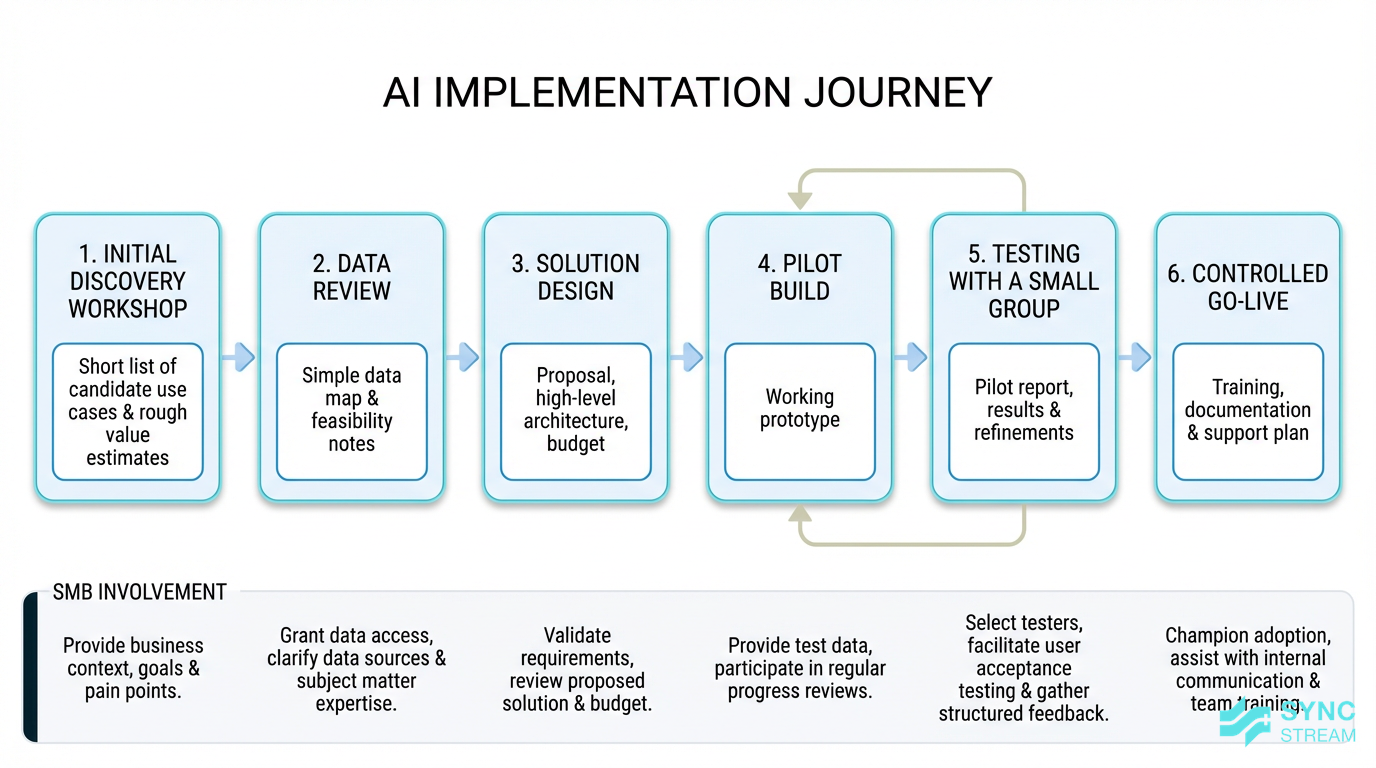
A step-by-step process flow showing the typical journey from AI scoping workshop to first live use case for an SMB.
A typical path from idea to live solution can be broken into clear, testable stages:
- Initial discovery workshop
- Inputs: 1–3 priority processes, access to owners of those processes, system list.
- Action: 60–90 minute session to map workflows, pain points, and current tools.
- Expected output: Short list of candidate use cases with rough value estimates and risks.
- Data review
- Inputs: Access (read‑only where possible) to CRMs, accounting, operations, and file stores.
- Action: Agency checks where required data lives, its quality, and access constraints.
- Expected output: Simple data map, feasibility notes, and any pre‑work needed (e.g. data cleanup).
- Solution design
- Inputs: Chosen priority use case, data map, success metrics.
- Action: Define workflow, roles, guardrails, and integration points; select tools and models.
- Expected output: Concise proposal with high‑level architecture, implementation plan, and fixed or capped pilot budget.
- Pilot build
- Inputs: Approved proposal, system access, test data, pilot user group.
- Action: Configure models and workflows, build integrations, set up logging and basic monitoring.
- Expected output: Working prototype that handles the core workflow end‑to‑end in a test environment.
- Testing with a small group
- Inputs: Prototype, 3–10 real users, sample real‑world cases.
- Action: Run the pilot, capture issues and feedback, refine prompts, rules, and UX.
- Expected output: Short pilot report with measured results against success metrics and a go/no‑go recommendation.
- Controlled go‑live
- Inputs: Refined solution, agreed rollout plan, training materials.
- Action: Enable production access, train users, confirm support and escalation paths.
- Expected output: Live use case in day‑to‑day use, with a documented support and optimisation plan.
For Australian SMBs, a first pilot often runs 4–12 weeks, depending on complexity. You’ll need internal time for workshops, access to systems, and a small group of engaged users. To avoid scope creep, agree on:
- A narrow, well‑defined first use case.
- Clear “nice to have later” items.
- A simple change process if new ideas emerge mid‑project.
Setting success metrics and ROI
AI projects should be held to the same standard as other investments.
Useful metrics include:
- Hours saved per week in specific teams.
- Reduction in error rates or rework.
- Faster response times to customers.
- Higher conversion rates on quotes or leads.
- Fewer support tickets or escalations.
A simple ROI framing:
- Estimate benefits in dollars – labour saved, extra sales, avoided losses or penalties.
- Add up total project costs – agency fees, internal time, and any ongoing platform charges.
- Calculate payback period – how long before benefits exceed costs.
For SMB‑scale initiatives, a sensible target is projects that can pay back within 6–18 months and can be expanded if they prove themselves. Sync Stream scopes every system against a defined business case and ROI, so you can have a commercial discussion rather than a purely technical one.
Options Comparison
In-house team vs AI agency
When considering AI, many SMBs ask whether to hire internally or work with an agency.
Building an in‑house team means:
- Recruiting data scientists, data engineers, and developers – roles that are in high demand in Sydney, Melbourne, Brisbane, Perth and other centres.
- Carrying ongoing salary, tooling, and training costs, even when there isn’t a large backlog of AI projects.
- Slower time‑to‑value while a new team learns your business and builds out foundational infrastructure.
This path can make sense for larger organisations with steady, long‑term AI needs and sufficient scale.
Engaging an AI agency offers:
- Speed – access to a ready‑made team and proven patterns.
- Flexibility – project‑based engagements and adjustable support levels.
- Lower upfront cost – you pay for defined outcomes rather than full‑time headcount.
A popular hybrid approach is to start with an agency to launch your first few use cases while upskilling one or two internal "AI champions". Over time, those staff can own day‑to‑day operations (e.g. monitoring, basic tweaks), with the agency focusing on new initiatives and complex changes. This is the model Sync Stream often supports: deep initial implementation, then a gradual handover where it makes sense.
Pricing For Australian AI Services
Typical pricing models and ranges
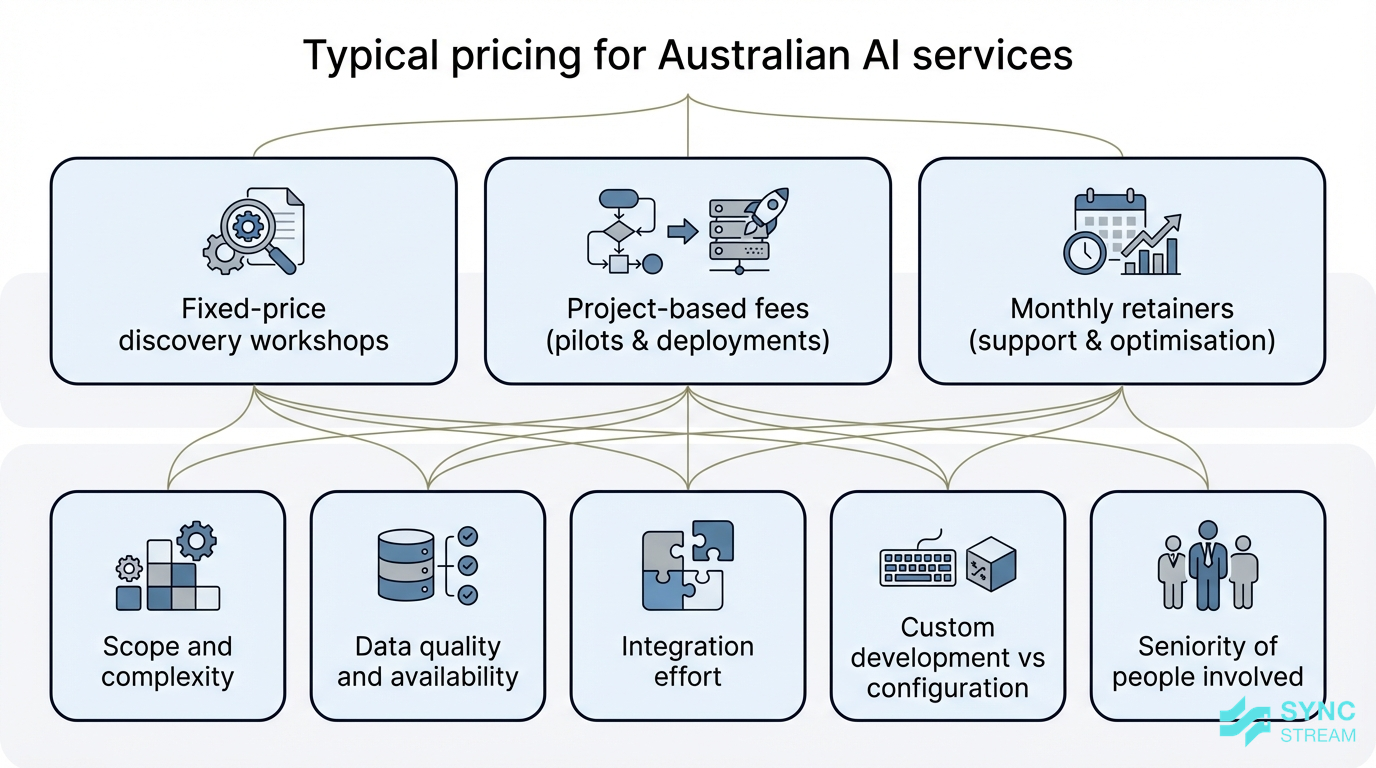
A framework showing typical AI agency pricing models for Australian SMBs and the main factors that influence cost.
Pricing varies by provider and project, but Australian SMBs will typically see a few common structures:
- Fixed‑price discovery workshops – usually in the low thousands of AUD, covering process mapping, opportunity assessment, and a short list of recommended use cases.
- Project‑based fees for pilots and deployments – scoped around a specific outcome (e.g. an internal assistant, an automated workflow, or a forecasting model). A focused pilot will often fall in the tens of thousands of AUD, depending on complexity and integrations.
- Monthly retainers for support and optimisation – scaled to company size and system complexity, covering monitoring, tweaks, and incremental improvements.
Key cost drivers include:
- Scope and complexity – number of workflows, user groups, and edge cases.
- Data quality and availability – clean, accessible data is cheaper to work with than fragmented, inconsistent data.
- Integration effort – how many systems must be connected (e.g. CRM, accounting, job management, communications).
- Custom development vs configuration – the more custom code and interfaces needed, the higher the cost.
- Seniority of people involved – complex, high‑risk projects require more senior time.
Sync Stream keeps costs tied to specific, documented workflows, using orchestration tools like n8n where possible to reduce custom development and make ongoing improvements more affordable.
Choosing The Right AI Partner
Evaluation checklist for SMB decision-makers
When comparing providers, use a simple checklist:
- Experience with similar‑sized Australian clients – ask for examples from businesses with comparable headcount and complexity.
- Relevant industry experience – especially if you’re in regulated or operations‑heavy sectors like construction, logistics, or field services.
- Clear methodology – can they explain, step by step, how they go from discovery to live solution, and what you need to provide at each step?
- Security and privacy practices – including how data is stored, who has access, and how audit trails are maintained.
- Support model – what happens after go‑live? Who do your staff contact? What are response times?
Assess cultural fit and communication style:
- Do they explain concepts in plain English?
- Are they responsive and transparent about trade‑offs?
- Will they challenge unrealistic expectations rather than over‑promise?
Before committing, request:
- A simple phased plan with clear milestones.
- Transparent pricing and assumptions.
- Clear statements about ownership of IP and data.
- References or case‑style stories grounded in real projects.
As an implementation‑led partner, Sync Stream emphasises documented workflows, real‑world constraints, and ongoing maintainability so you’re not dependent on a black‑box system.
Common Pitfalls
SMBs exploring AI often stumble into similar traps:
- Starting with vague goals – "use AI somewhere" instead of solving a specific, measurable problem.
- Over‑focusing on novelty – flashy demos that don’t integrate with your real systems or processes.
- Ignoring data quality – underestimating the effort to access, clean, and standardise data across tools.
- Under‑investing in change management – launching new tools without proper training, leading to low adoption.
- No owner after go‑live – nobody is responsible for monitoring performance, handling exceptions, or iterating.
Working with an implementation‑focused AI agency like Sync Stream helps avoid these pitfalls by tying every project to a defined workflow, business metric, and support model.
Conclusion
AI is no longer experimental territory reserved for big corporates. With the right AI agency, Australian SMBs can reduce manual admin, improve margins, and increase service quality using tools that fit within existing systems and budgets.
The key is to start from real business problems, choose a focused first use case, and work with a partner who can both design and deliver – not just produce decks. For many SMBs, a small, well‑scoped project that pays back within 6–18 months is the best way to build confidence and capability.
If you’re considering where to begin, Sync Stream can help you identify high‑value automation and AI opportunities inside your current tech stack, design a practical roadmap, and implement documented, reliable workflows that your team can own over time.
FAQ
What does an AI agency actually do for a small business?
It helps you identify high‑value use cases, design workflows, configure AI and automation tools, integrate them with your existing systems (such as CRM and accounting platforms), train your staff, and then monitor and optimise performance over time.
How long does it take to see results from an AI project?
For a focused SMB pilot, you can often reach a first live use case in 4–12 weeks, with measurable benefits (like time saved or faster response times) becoming clear soon after go‑live if success metrics are defined up front.
Do I need clean data before talking to an AI agency?
No. An agency will help assess your current data, identify gaps, and prioritise what needs cleaning. However, being honest about where your data lives and how messy it is will lead to more accurate scoping and cost estimates.
Is AI suitable for very small teams (under 20 people)?
Yes, provided you pick the right use cases. For smaller teams, the focus is usually on high‑friction tasks that absorb a lot of time – like manual reporting, customer enquiries, scheduling, or compliance admin – rather than large‑scale analytics.
How does Sync Stream differ from general IT support providers?
General IT support focuses on keeping your hardware, networks, and core software running. Sync Stream focuses specifically on AI and workflow automation inside your existing business systems, with every project scoped against a clear commercial use case, documented workflows, and long‑term operational reliability.