

Introduction
If you’re looking at hiring an ai automation agency, you’re probably not interested in buzzwords—you want fewer manual tasks, fewer mistakes, and clearer numbers in your P&L.
For Australian small and medium businesses, AI and automation are now a practical way to grow without endlessly adding headcount. The challenge is turning scattered tools (Xero or MYOB, job management, spreadsheets, inboxes) into joined-up, reliable workflows. That’s where a specialist implementation partner like Sync Stream fits.
This article explains what an AI automation agency actually delivers, common workflow automation use cases, how deep integrations can go, and how to think about ROI. By the end, you’ll know what to ask for, what “good” looks like, and how to decide whether an agency is the right option for your business.
What is an AI Automation Agency
Core role and services
An AI automation agency designs, builds, and maintains AI-powered workflows that remove manual, repetitive tasks across operations, customer service, marketing, finance, and admin. Instead of staff copying data between systems or chasing information by email, automations trigger actions and move data for you.
Core service areas typically include:
- Process mapping: Understanding how work currently flows across your team, where the friction and errors occur, and which systems are involved.
- Tool selection and integration: Choosing and connecting systems such as CRMs, accounting platforms, job management tools, booking systems, email, chat, and internal databases.
- Building automations and AI assistants: Implementing rule-based workflows and AI-driven components (like document readers or customer-facing assistants) using orchestration tools such as n8n.
- Testing and optimisation: Checking edge cases, error handling, and performance, then refining to make workflows more robust.
- Ongoing support and change management: Updating workflows as your business, staff, and tools change.
For Australian SMBs, agencies like Sync Stream operate as a done-for-you partner. We combine practical strategy, technical build, and on-the-ground change support, instead of just installing another piece of software and leaving you to figure it out.
How engagements usually work
Most AI automation agency engagements follow a structured lifecycle:
- Initial consultation
- Inputs: Your business model, main pain points, and goals (e.g., faster quoting, fewer invoice errors, better reporting).
- Action: Short discussion to clarify priorities and whether automation is a good fit.
- Expected output: High-level opportunity list and a go/no-go for deeper discovery.
- Discovery and process mapping
- Inputs: Access to systems, example documents, and key staff.
- Action: Workshops and interviews to map current workflows, systems, data sources, and failure points; quantify time spent and error impact.
- Expected output: Documented “as-is” processes and a shortlist of candidate workflows for automation.
- Proposal with scope and ROI estimate
- Inputs: Discovery findings and your budget/constraints.
- Action: Define which workflows will be automated, required integrations, guardrails, timelines, and pricing.
- Expected output: Written proposal with scope, implementation plan, and estimated payback period.
- Implementation phases
- Inputs: Approved scope and access to relevant systems.
- Action: Configure tools, build workflows, connect APIs, and set up AI components in staged releases rather than a big-bang change.
- Expected output: Working automations progressively rolled out to test groups or business units.
- Staff training and handover
- Inputs: Finalised workflows and internal procedures.
- Action: Show frontline and admin staff how the new workflows run, what to monitor, and how to escalate issues.
- Expected output: Trained team, updated SOPs, and clear ownership for day-to-day use.
- Continuous improvement
- Inputs: Usage data, error logs, and staff feedback.
- Action: Review performance, refine automations, widen coverage to more processes, and keep everything aligned with business changes.
- Expected output: Stable, documented workflows that evolve with your business.
Common commercial models include fixed-price projects for clear scopes, monthly retainers for ongoing optimisation and support, and occasionally performance-linked elements tied to agreed savings or revenue uplift.
The relationship is collaborative: you bring process knowledge and commercial goals, while the agency brings AI expertise, integration skills, and governance around security, compliance, and quality control.
Why it Matters for Australian SMBs
Current challenges facing Australian SMBs

A framework summarising labour, compliance, customer, and system pressures facing Australian SMBs.
Australian SMBs face a specific mix of pressures:
- High wages and labour shortages, especially in trades, logistics, and care sectors.
- Growing compliance and reporting requirements, from safety documentation to financial and industry reporting.
- Customer expectations for fast digital responses, often outside standard business hours and across multiple channels.
On top of this, many businesses are running fragmented systems: Xero or MYOB for accounts, e‑commerce tools, job management software, spreadsheets, and various email inboxes that don’t talk to each other. This leads to double-handling, copy-paste errors, and slow turnaround.
AI automation provides a practical way to increase output and service levels without scaling headcount at the same rate. By letting workflows handle repetitive admin, your team can focus on higher-value work, helping you stay competitive against larger or overseas operators with more resources.
Business gains you can realistically expect
From a well-scoped automation project, realistic outcomes for an Australian SMB often include:
- Hours saved each week on manual admin, data entry, and reconciliations.
- Faster response times to customer enquiries and quote requests.
- Fewer data errors, especially in invoicing, job details, and reporting.
- Improved cash flow through automated invoicing and payment reminders.
- Better visibility via up-to-date dashboards and automated reporting.
For many small to medium projects, a 3–12 month payback window is a sensible expectation, depending on the complexity of your processes and volumes. Gains show up through reduced labour and rework, plus increased revenue from handling more leads, jobs, or bookings without additional staff.
Examples:
- Trades business: Lead capture from the website flows straight into the CRM, triggers an SMS acknowledgment, generates a quote template, and, once accepted, automatically creates a job, purchase orders, and an invoice.
- Clinic or practice: Online enquiries and calls are captured in one place, appointment slots are suggested automatically, and reminders go out by SMS and email, reducing no-shows and phone time.
These are the kinds of grounded, operational wins that an implementation-focused ai automation agency like Sync Stream targets.
Key Components and Capabilities
Workflow and process automation
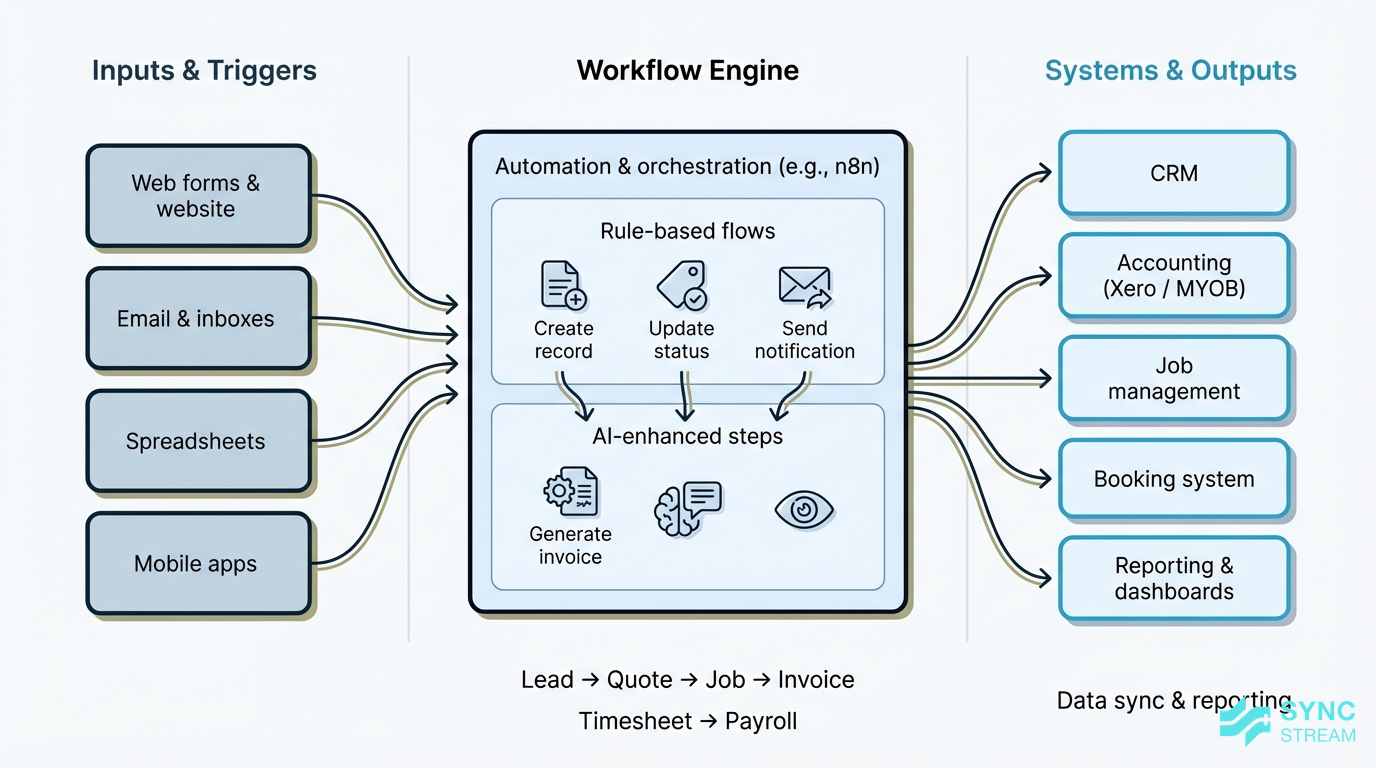
An architecture view of automated workflows stitching together CRMs, accounting, booking, and communication tools.
At the heart of most projects is stitching together your existing tools—for example Xero/MYOB, CRMs, booking systems, inventory platforms, email, and spreadsheets—so data flows automatically and triggers actions without manual intervention.
Typical workflows automated for SMBs include:
- Lead capture through to quote and follow-up
- Customer and supplier onboarding
- Job creation and scheduling
- Purchase order creation and approvals
- Invoicing and payment follow-up
- Timesheet and expense capture
- Routine reporting to management or regulators
There are two main layers:
- Rule-based automations: If-this-then-that logic (e.g., “When a quote is accepted, create a job and draft invoice”). These are highly reliable and transparent.
- AI-enhanced workflows: Using AI to classify emails, read documents, extract data, or route tasks intelligently (e.g., directing service requests by suburb or priority).
A capable AI automation agency usually combines both: rules for predictable, critical steps and AI where judgement or unstructured data is involved, giving you reliability with flexibility.
Customer-facing AI and chat
Customer-facing AI includes chatbots and virtual assistants on your website, SMS, WhatsApp, or social channels. These can:
- Answer common FAQs
- Triage and categorise enquiries
- Capture and qualify leads
- Book or reschedule appointments
- Provide order or job status updates
The real value comes when these assistants are connected to live business data—your CRM, booking system, inventory, or job management platform—so responses are accurate and personalised, not generic.
Service quality improves because customers can get answers 24/7 instead of waiting in a phone queue or inbox. At the same time, pressure on reception and support teams drops. A well-designed system also includes clear escalation paths to humans when questions are complex, high-value, or sensitive.
Data, analytics and decision support
Beyond automating tasks, agencies can set up AI and automation to improve decision-making by:
- Reading and summarising documents such as invoices, contracts, emails, and site reports.
- Cleaning and combining data from multiple systems into a single view.
- Surfacing key metrics in dashboards or automated email reports.
In an SMB context, predictive and analytical capabilities might be used to:
- Flag customers at risk of churn based on behaviour.
- Identify high-value or high-margin customers and jobs.
- Spot recurring late-payer patterns.
- Forecast demand based on historical bookings or orders.
Part of an agency’s value is designing guardrails and checks. For example, you might require human approval on large discounts, unusual payment terms, or bulk communications. That way, AI-assisted decisions support your business without creating compliance or quality problems.
Implementation Strategy
Prioritising processes and defining scope
To decide where to start, identify processes that are:
- High-volume and repetitive
- Largely rule-based
- Causing delays, errors, or staff frustration
Map out the current steps for each candidate process: who does what, in which system, and where the hand-offs happen. Even a simple whiteboard or spreadsheet map is enough.
Then estimate potential ROI with a quick, structured pass:
- Quantify time spent today
- Inputs: Rough weekly hours per role on the process.
- Action: Multiply hours by loaded hourly wage (including on-costs).
- Expected output: Weekly labour cost baseline for that process.
- Estimate error and rework impact
- Inputs: Typical error rates, write-offs, re-do jobs, and customer churn from delays.
- Action: Put conservative dollar values on these issues per month or per job.
- Expected output: Approximate monthly cost of errors and rework.
- Roughly size implementation and software costs
- Inputs: Ballpark quotes from an AI automation agency or internal estimate, plus likely software subscriptions.
- Action: Spread those costs over 6–12 months.
- Expected output: Monthly cost of implementing and running the automation.
- Compare the two sides
- Action: Set the “savings + upside” figure against the “implementation + software” figure.
- Expected output: Simple payback estimate and a ranked shortlist of candidate processes.
For initial scope, focus on 1–3 high-impact, low-complexity workflows, such as lead capture to quote, invoice and reminder flows, or appointment handling. You can always expand later once those are stable.
Delivering automation in manageable phases
A robust implementation should move in clear, manageable phases:
- Discovery and mapping
- Agency: Runs workshops, interviews staff, documents existing workflows, systems, and edge cases.
- Business: Shares access to systems, explains real-world exceptions, and highlights pain points.
- Expected output: Agreed list of target workflows and a clear picture of the current state.
- Solution design
- Agency: Proposes target workflows, integration points, data flows, and guardrails.
- Business: Reviews and confirms what “good” looks like, including approval rules and reporting needs.
- Expected output: Design document or diagrams that everyone signs off on.
- Prototype / MVP build
- Agency: Builds a first version in a controlled environment, connecting a subset of systems and users.
- Business: Provides sample data and scenarios to ensure the prototype matches day-to-day reality.
- Expected output: Working prototype that demonstrates the end-to-end flow for a limited set of cases.
- Testing and refinement
- Agency: Sets up test scripts, logging, and alerts; tunes performance and error handling.
- Business: Staff deliberately try to “break” the automation, testing unusual cases and agreeing when humans must review or override.
- Expected output: Tested workflows with known limits, documented exception handling, and clear escalation paths.
- Rollout
- Agency: Moves workflows into production, manages change communication, and monitors the first weeks closely.
- Business: Trains staff, updates internal procedures, and provides quick feedback on any issues.
- Expected output: Live automation in day-to-day use with staff trained and support channels in place.
- Monitoring and optimisation
- Agency: Tracks metrics, error logs, and user feedback to iterate and extend automations.
- Business: Assigns an internal owner for the workflows and regularly reviews performance and new opportunities.
- Expected output: Continuous improvement cycle, with additional processes added once the core is stable.
Throughout these phases, integration depth increases gradually. Systems are connected via APIs or no-code connectors, data sync rules and permissions are refined, and logging is tightened before scaling automations across more teams or departments.
Options Comparison
In-house, freelancers, tools, or agency
You have several paths to automation:
- DIY with off-the-shelf tools: Low direct cost and quick to start for simple tasks (e.g., basic email automations). However, staff must learn the tools, and solutions can become fragile if the “automation person” leaves.
- Hiring internal staff (developer or operations technologist): Strong for long-term capability but higher fixed cost and typically slower to ramp up. One person may struggle to cover process design, integrations, AI, and governance.
- Freelancers: Useful for one-off, isolated tasks or small projects. Risk comes from limited context, inconsistent quality, and lack of ongoing support.
- Specialist agency like Sync Stream: Higher upfront investment than pure DIY but faster to value for complex, business-critical workflows. Agencies bring architectural thinking, integration depth, governance, and continuity.
DIY and freelancers can work well for simple, low-risk automations. Once workflows touch cash flow, compliance, or core customer experiences, the risk of errors, downtime, and technical debt increases, making a robust agency partner more attractive.
Hidden costs to factor in include staff time spent experimenting, dependency on a single internal “tech person,” and the impact of failures when automations send invoices, handle personal data, or update key systems.
Evaluating which option fits your business
A practical mini-checklist for choosing your approach:
- Budget range: How much can you realistically invest over the next 3–6 months?
- Urgency: Do you need results within weeks or can you afford a longer build-up?
- Process complexity: Are workflows simple and contained, or cross-team and multi-system?
- Integration needs: Do you need deep connections into CRMs, accounting, operations tools, and APIs?
- Internal skills: Do you have people with time and capability to design, build, and maintain automations?
- Risk tolerance: How critical are accuracy, uptime, and compliance in the processes you’re targeting?
- Strategic importance: Is automation central to your growth or a side experiment?
When assessing a potential AI automation agency, look for:
- Case studies or examples in businesses similar to yours
- Understanding of Australian tools, regulations, and accounting practices
- A clear implementation process and documentation standards
- Transparency on pricing, scope, and change management
- Defined post-go-live support and optimisation
Useful questions to ask agencies include:
- How do you measure and report on ROI for projects like ours?
- Which systems have you integrated before that are similar to ours?
- How do you handle data security, privacy, and access control?
- What happens if a workflow fails—how will we know and what’s the fallback?
- How do you ensure we’re not locked in to a single vendor or platform?
Concrete answers to these questions help move the conversation from sales talk to a realistic delivery plan.
Common Pitfalls
Missteps that reduce impact
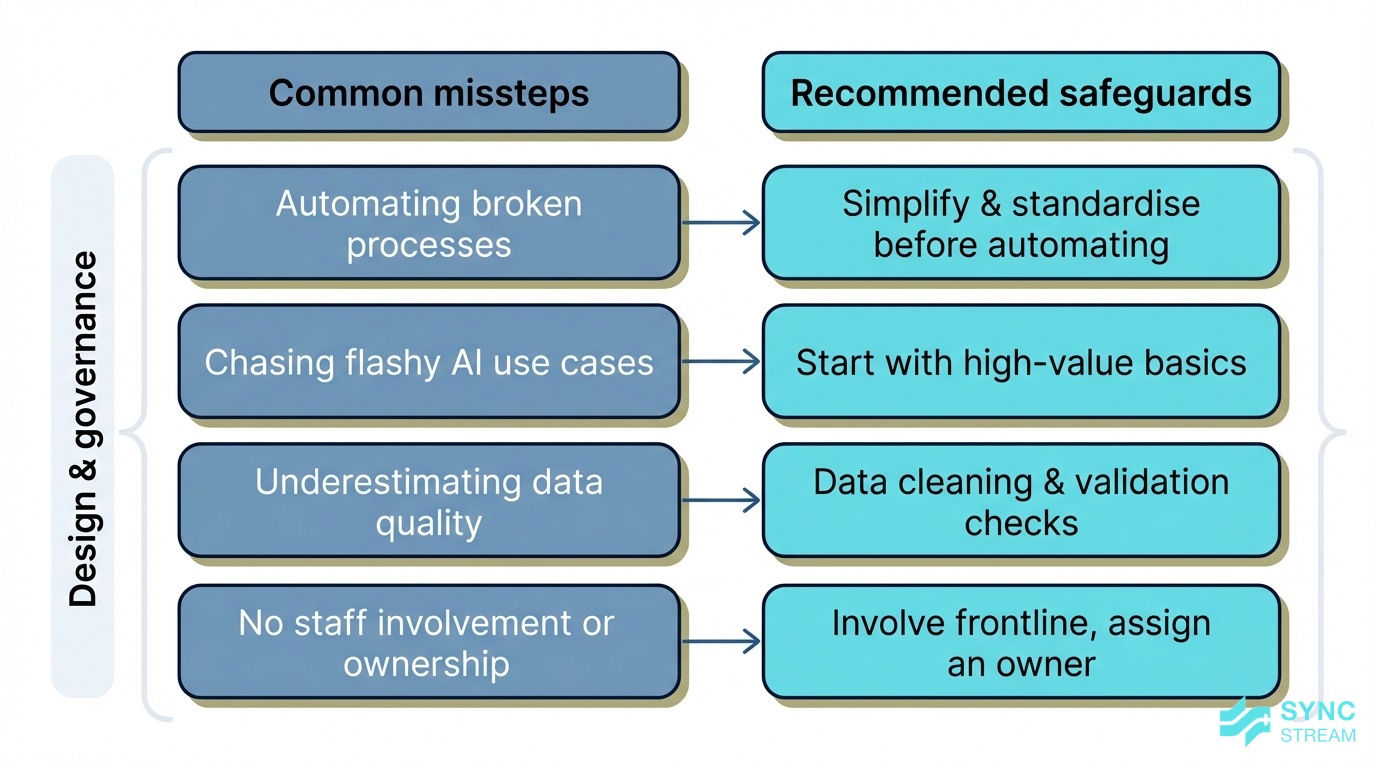
A framework highlighting common automation missteps and the safeguards a mature agency should design.
Common mistakes that reduce the impact of automation projects include:
- Automating broken processes: If the underlying process is unclear or inefficient, automating it simply speeds up the pain. Processes should be simplified before they’re automated.
- Chasing flashy AI use cases: It’s tempting to start with complex AI features instead of high-value basics like invoice flows, job scheduling, or reporting.
- Underestimating data quality: Inconsistent customer names, missing fields, or messy product codes can quickly derail even well-designed workflows.
Cultural and operational issues also matter:
- Not involving frontline staff in design and testing, leading to pushback or workarounds.
- Failing to document new processes, so knowledge lives only in a few people’s heads.
- Not assigning an internal owner for automation, meaning no one is accountable for ongoing success.
There are risks in over-relying on AI without checks, such as:
- Chatbots inventing or guessing answers instead of escalating.
- Automations sending incorrect invoices, reminders, or updates.
- Compliance or privacy breaches if data access is not well controlled.
A mature AI automation agency will design safeguards—like approval steps, audit logs, and clear escalation paths—to minimise these risks.
Conclusion
For Australian SMBs, the question is less "Should we use AI and automation?" and more "Where should we start, and who should help us do it properly?" An experienced ai automation agency can turn messy, manual workflows into reliable, documented systems that reduce admin, improve service, and increase control over margins and compliance.
By understanding what an agency delivers, how engagements work, the realistic business gains, and how to evaluate your options, you can make a clear, commercially grounded decision.
If you’re an Australian service or operations-focused business and want to explore what’s realistic for your situation, consider speaking with Sync Stream about a focused discovery process to map opportunities, estimate ROI, and prioritise the first 1–3 workflows that will make a tangible difference.
FAQ
How much does it cost to work with an AI automation agency?
Costs vary with scope and complexity. Many SMB projects start with a defined discovery and implementation phase at a fixed price, followed by optional monthly support. A reputable agency will align costs with an expected payback period and provide clarity upfront.
How long does it take to see results from automation?
For a small, well-scoped workflow (such as invoice reminders or lead capture to quote), you can often see benefits within a few weeks of starting implementation. Larger, cross-business projects may take a few months to design, build, and stabilise.
Do we need to replace our existing systems first?
Not usually. Agencies like Sync Stream specialise in building on top of your existing CRMs, accounting platforms, job management tools, and communication channels. In some cases, small tooling changes may be recommended, but the goal is to work within your current environment where possible.
Will automation replace my staff?
In most SMBs, automation reduces low-value admin and error-prone work rather than removing roles entirely. The usual outcome is that staff can focus more on customers, higher-margin work, and growth projects instead of repetitive tasks.
How is data security and privacy handled?
A serious implementation partner will work inside your existing systems, with clear access controls, audit logs, and adherence to Australian privacy requirements. You should expect a discussion about where data is stored, who can see it, and how credentials are managed.
What should we prepare before speaking with an agency?
List your most painful processes, estimate how much time they consume, identify the core systems involved, and clarify your primary objectives (e.g., faster cash flow, fewer errors, better reporting). Even rough notes will help an agency quickly assess where automation can have the biggest impact.