

Introduction
Running a logistics or fleet-based business in Australia has never been harder. Fuel, labour, tolls, maintenance, and compliance costs keep rising, while customers now expect live ETAs, accurate deliveries, and fast invoicing as standard.
That’s why more Australian operators are exploring AI in logistics examples that are practical, not theoretical. Not as sci‑fi robots, but as tools that quietly optimise routes, flag vehicle issues early, and clear the backlog of paperwork in the back office.
This article walks through what AI in logistics really means for Australian small and medium businesses, and then dives into concrete examples: route optimisation, predictive maintenance, and automated documentation. We’ll look at how companies like Toll Group, Chemist Warehouse, Adiona Tech, and Fresho are using AI today, and how you can adopt similar capabilities without rebuilding your entire tech stack.
What is AI in logistics
Core concept of AI in logistics
In logistics, AI is best thought of as software that learns from your data and makes or recommends decisions like a skilled dispatcher or planner.
Instead of someone manually working through route sheets, truck capacities, delivery windows, and vehicle issues, AI systems:
- Analyse historical routes, loads, and delivery times
- Read live telematics data from trucks, vans, and forklifts
- Monitor order volumes, product mix, and customer patterns
- Learn which combinations usually work best
From there, they propose actions: the most efficient run plan, which load to put on which vehicle, which truck should go to the workshop next week, or how to interpret a messy email order.
This is not about humanoid robots driving trucks. In practice, AI is embedded into:
- Routing and fleet optimisation systems
- Telematics and vehicle health platforms
- Warehouse management and inventory software
- Admin and accounting workflows
For Australian SMBs, AI is usually accessed via cloud platforms or add‑ons to systems you already use—TMS, WMS, telematics, or accounting tools—not custom-built technology. Partners like Sync Stream then integrate and orchestrate these tools so they work reliably with your existing stack.
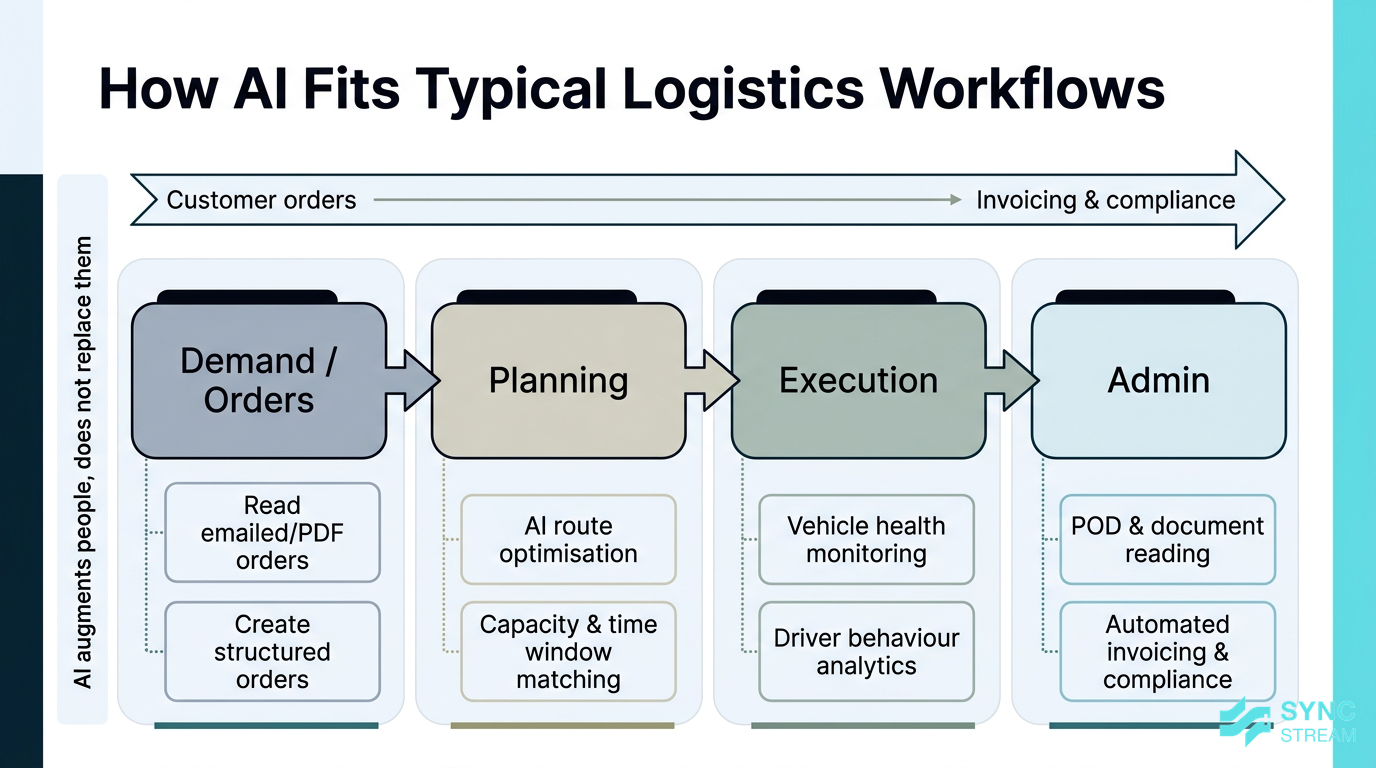
How AI fits typical logistics workflows
Most logistics operations, whether you’re running five vehicles or fifty, follow a similar flow:
- Demand / Orders – Customers place orders via portals, email, phone, EDI, or apps.
- Planning – You plan routes, loads, driver rosters, dock times, and cut-offs.
- Execution – Drivers run deliveries or pickups, warehouse teams pick and pack.
- Admin – PODs are chased, invoices raised, compliance documents filed.
AI can plug into each stage:
- Demand / Orders: Tools can auto‑read emailed orders or PDFs and convert them into structured orders ready for your TMS or accounting system.
- Planning: Route optimisation engines suggest the best daily run plan based on orders, capacities, traffic, and time windows.
- Execution: Telematics plus AI can flag vehicles likely to break down, suggest better departure times, or highlight risky driving behaviour.
- Admin: AI can read consignment notes or POD images, validate data, and push it straight into your invoicing or compliance systems.
Crucially, AI augments your people rather than replacing them:
- Dispatchers still make final calls on routes and priorities.
- Drivers still decide how to handle edge cases on the road.
- Warehouse staff still manage exceptions and physical handling.
- Admin teams still oversee customers and commercial nuances.
For SMEs, this is important for change management. You’re not telling staff a robot is taking their job—you’re giving them tools to remove repetitive work and reduce errors, so they can focus on higher‑value tasks.
Why it matters for Australian SMBs
Impact on costs and margins
Australian logistics SMBs operate under intense cost pressure:
- Fuel and tolls on long metro and regional runs
- Labour costs for drivers, warehouse staff, and admin
- Maintenance and tyres, especially on heavier or regional routes
- Penalties for missed delivery windows or service level failures
AI connects directly to these line items:
- Route optimisation can reduce kilometres driven and idle time, saving fuel and tolls.
- Better vehicle utilisation means fewer vehicles or shifts for the same volume.
- Predictive maintenance reduces unplanned breakdowns and costly roadside repairs.
- Automated documentation cuts manual admin hours and speeds up invoicing.
Some Australian platforms, like Adiona Tech, report meaningful fuel and dollar savings when applied across large delivery volumes. Even if your fleet is much smaller, a few percent improvement across hundreds of runs per month can materially improve your margin.
AI is especially valuable in Australia because of:
- Long distances between depots and customers
- Regional and remote routes with limited backup options
- Rising fuel and labour costs compared to many other markets
If you can run slightly tighter routes, reduce one overtime shift, avoid even a handful of breakdowns, and get invoices out a few days faster, the financial impact compounds quickly.
Service quality and customer expectations
Customer expectations have shifted. Large players now routinely offer:
- Accurate ETAs and live tracking
- Fewer late deliveries
- High fulfilment accuracy and low mis-picks
AI is a big part of how they do it.
- AI-driven routing reduces late deliveries by better matching runs to traffic, capacity, and time windows.
- Smart warehousing tools reduce stockouts and mis-picks through better visibility and guided picking.
For example:
- Toll Group uses AI to optimise routes across long-distance and metro deliveries.
- Chemist Warehouse uses AI-powered SmartBadges and spatial analytics to maintain live inventory visibility and guide pick tasks.
These examples show that fast, reliable, and transparent service is now the benchmark. The good news is SMBs don’t need enterprise budgets to match many of these capabilities. Cloud-based routing engines, WMS add-ons, and AI-powered order capture are increasingly affordable for smaller fleets and warehouses.
Australian market and compliance context
Australia adds its own complexity to logistics:
- Long, isolated stretches of road
- Harsh conditions (heat, dust, rough roads)
- Fatigue management rules and logbook requirements
- Chain of Responsibility obligations across the supply chain
AI can support this environment in practical ways:
- Predictive maintenance helps avoid breakdowns on remote routes where recovery is slow and expensive.
- Driver behaviour analytics can highlight fatigue risks and harsh driving.
- Automated documentation reduces errors in compliance paperwork (e.g., dangerous goods, CoR records, service logs).
Many AI tools already integrate with common fleet management, TMS, and WMS solutions used by Australian SMBs. That lowers the barrier to entry: you can often extend what you already have rather than start again.
Partners like Sync Stream specialise in working on top of your existing CRMs, accounting platforms, and operations tools so your data, security, and infrastructure stay under your control.
Key components and use cases
Route optimisation and fleet planning
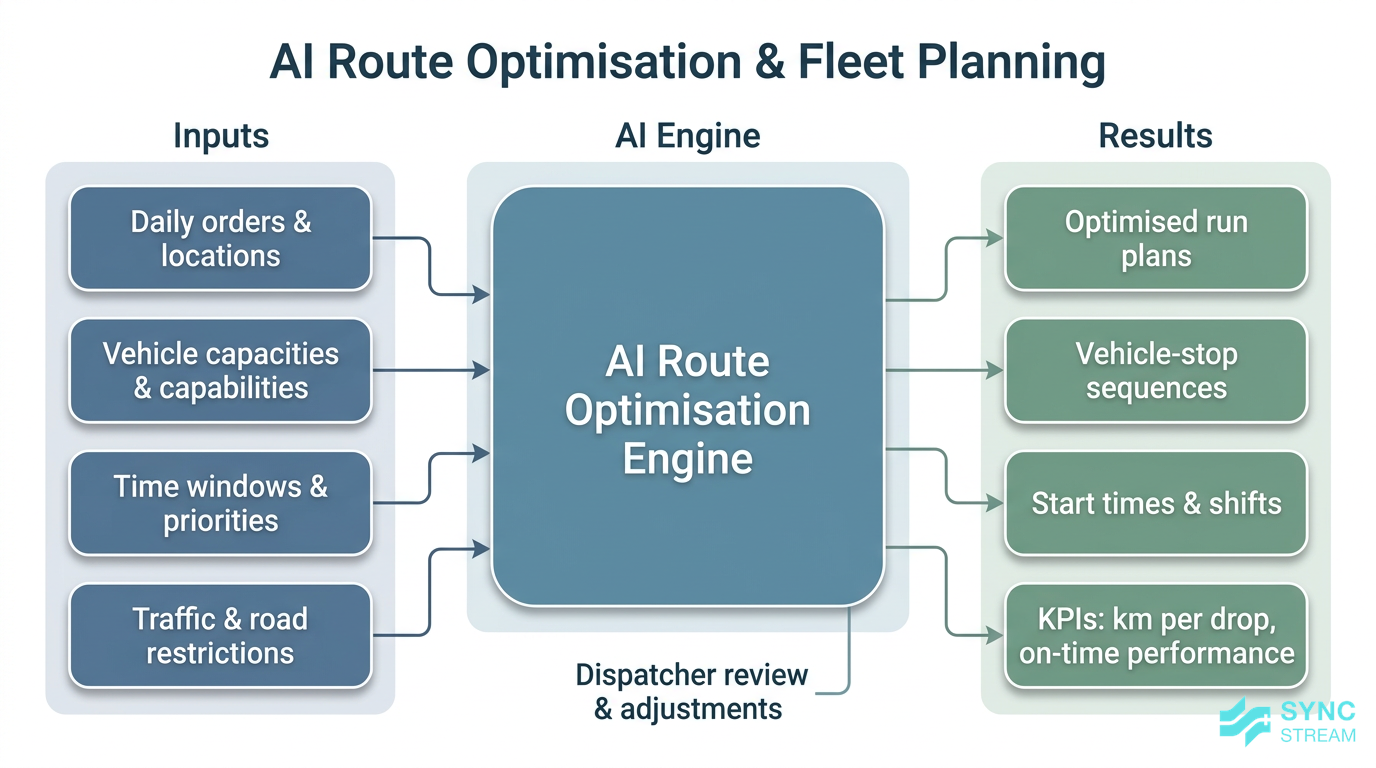
Inputs and outputs of an AI-powered route optimisation and fleet planning engine.
AI route optimisation engines take in:
- Daily orders and delivery locations
- Vehicle capacities, capabilities (e.g., tail lift, refrigeration), and depots
- Delivery time windows and priorities
- Traffic patterns, road restrictions, and driver shifts
From there, they generate recommended run plans: which vehicle should service which stops, in what sequence, starting at what time.
At enterprise scale, Toll Group uses this type of AI for both long-haul and metro deliveries, factoring in traffic, weather, capacity, and service windows. Adiona Tech’s FlexOps platform has executed millions of deliveries with reported fuel and cost savings by optimising these parameters.
For SMBs, the same logic applies on a smaller scale:
- A metro courier fleet can reduce unnecessary criss-crossing and better hit tight CBD windows.
- A regional freight operator can balance long rural legs with town deliveries to minimise backtracking.
Tangible benefits typically include:
- Reduced kilometres per drop and lower fuel usage
- Better utilisation per vehicle, sometimes allowing you to delay additional vehicle purchases
- Fewer overtime hours, as runs are planned more realistically
- Improved on-time performance and fewer failed deliveries
Predictive maintenance and asset health
Predictive maintenance uses AI to analyse telematics and historical maintenance data to predict which vehicles or equipment are likely to fail, and when.
Instead of relying solely on fixed intervals (e.g., every 20,000 km), the system looks at:
- Engine performance and fault codes
- Fuel consumption and idling patterns
- Temperatures, pressures, and vibration data where available
- Historical breakdowns and repairs
Platforms like Adiona Tech already factor vehicle health and fuel data into planning. Many common telematics units used on trucks, vans, forklifts, and cold chain equipment expose similar data that AI tools can learn from.
For SMBs, the practical gains are:
- Fewer on-road breakdowns, especially costly on regional and remote routes
- Planned workshop time, scheduled around depot peaks and driver availability
- Longer life from tyres and components through earlier detection of issues
- Improved safety and compliance, with cleaner records of inspections and repairs
You still keep your mechanic and maintenance provider. AI simply helps you decide which unit to pull in next and when, based on real-world usage.
Automated documentation and admin
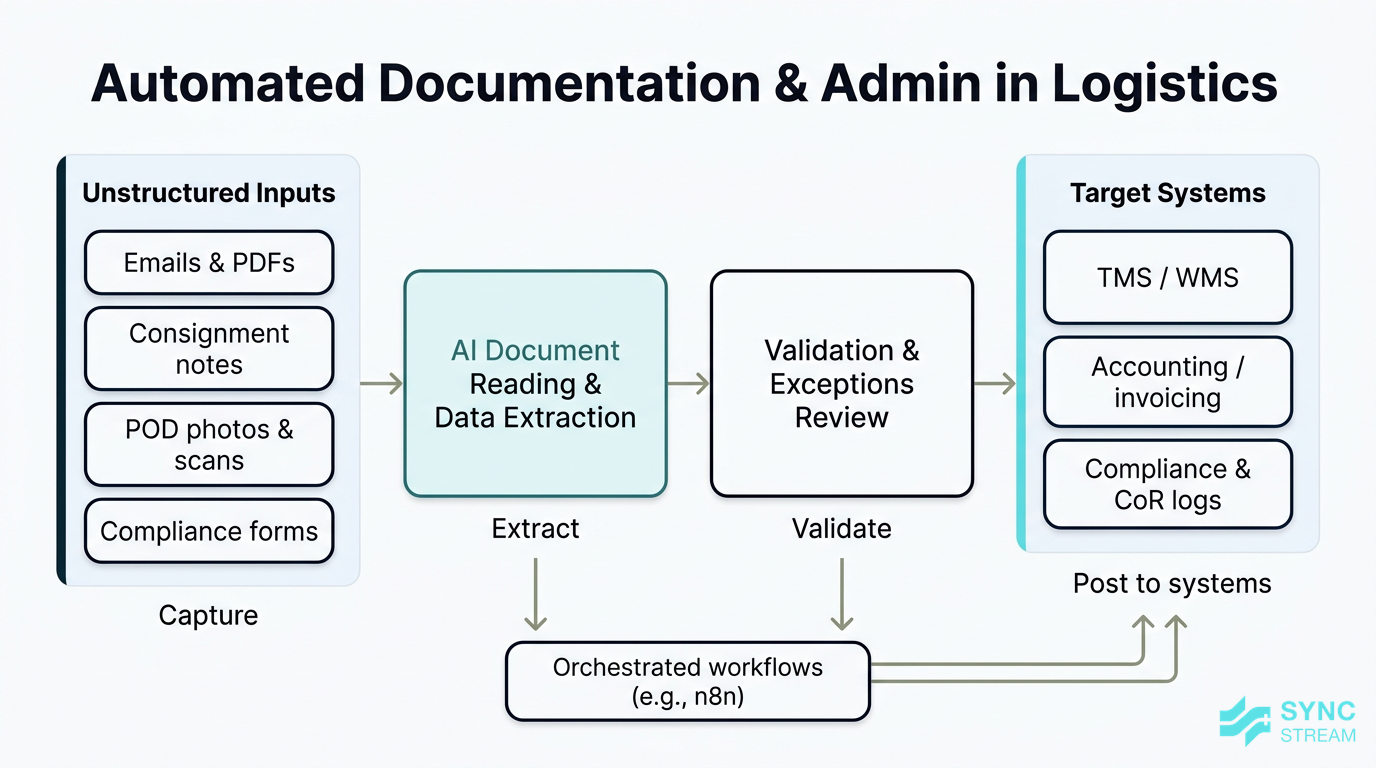
End-to-end flow of AI-driven document capture into TMS and accounting systems.
Logistics generates a heavy paperwork load:
- Emailed orders
- Consignment notes and manifests
- PODs (photos, scans, electronic signatures)
- Invoices and credit notes
- Compliance forms and checklists
Fresho’s AI-powered order entry is a strong example in fresh food logistics. It turns:
- Email, voice, text, and PDF orders
into structured sales orders ready for review and processing, removing hours of manual keying each day.
The same concept extends to broader logistics paperwork. AI tools can:
- Read consignment notes from scans or photos, extract key fields, and validate them.
- Match PODs to jobs and flag missing or incomplete documentation.
- Auto-generate invoices once certain fields or milestones are met.
- Populate compliance forms (e.g., CoR checklists) from data already captured in telematics or apps.
For SMBs, this can:
- Free up back-office staff from repetitive data entry
- Reduce data entry errors that cause disputes or rework
- Speed up invoicing and reduce days sales outstanding (DSO)
- Improve audit readiness, because workflows are better documented and more consistent
Sync Stream often implements this type of workflow using orchestration tools like n8n: AI reads and structures the data, then automated workflows push it into your TMS, accounting, or compliance systems with full traceability.
Real-world Australian examples
Toll Group: routing at enterprise scale
Toll Group uses AI to plan routes across complex networks of long-distance and metro deliveries. Their systems:
- Analyse real-time traffic, weather, and incident data
- Consider vehicle capacities, depot locations, and delivery windows
- Apply business rules around service levels, cut-offs, and priorities
The system then generates route plans that dispatchers review and adjust where needed.
Key takeaways for SMBs:
- Real-time data matters. Even a simple feed of traffic conditions or telematics data can improve your routing quality.
- Consistent rules are critical. Clearly defined time windows, priorities, and constraints allow AI to make better suggestions.
- Small savings compound. Saving a few kilometres or minutes per run, across many runs, adds up quickly.
Similar capabilities are now accessible via SaaS platforms aimed at smaller fleets. You don’t need enterprise infrastructure—just a clear use case, decent data, and an implementation plan.
Chemist Warehouse: smart warehousing
Chemist Warehouse has deployed spatial-AI and SmartBadges to improve live inventory visibility and guide tasks in their warehouses.
Their approach enables:
- Live shelf-level inventory visibility, reducing overstocking and understocking
- Guided pick tasks on the warehouse floor, telling staff where to go next
- Compliance tracking, helping ensure procedures are followed
For SMBs running smaller DCs or combined store/warehouse setups, the same principles apply with more modest tools:
- Handhelds or scanners that show exact stock locations and quantities
- Simple wearables or mobile apps that guide picks in the most efficient sequence
- Real-time alerts when counts are off or picks are missed
Practical outcomes include:
- Fewer mis-picks and returns
- Faster pick/pack times with less walking and searching
- Better shelf accuracy and fewer out-of-stocks
Many WMS platforms now offer AI-assisted features that can be switched on and integrated into your existing processes with targeted support from partners like Sync Stream.
Fresho and fresh food logistics
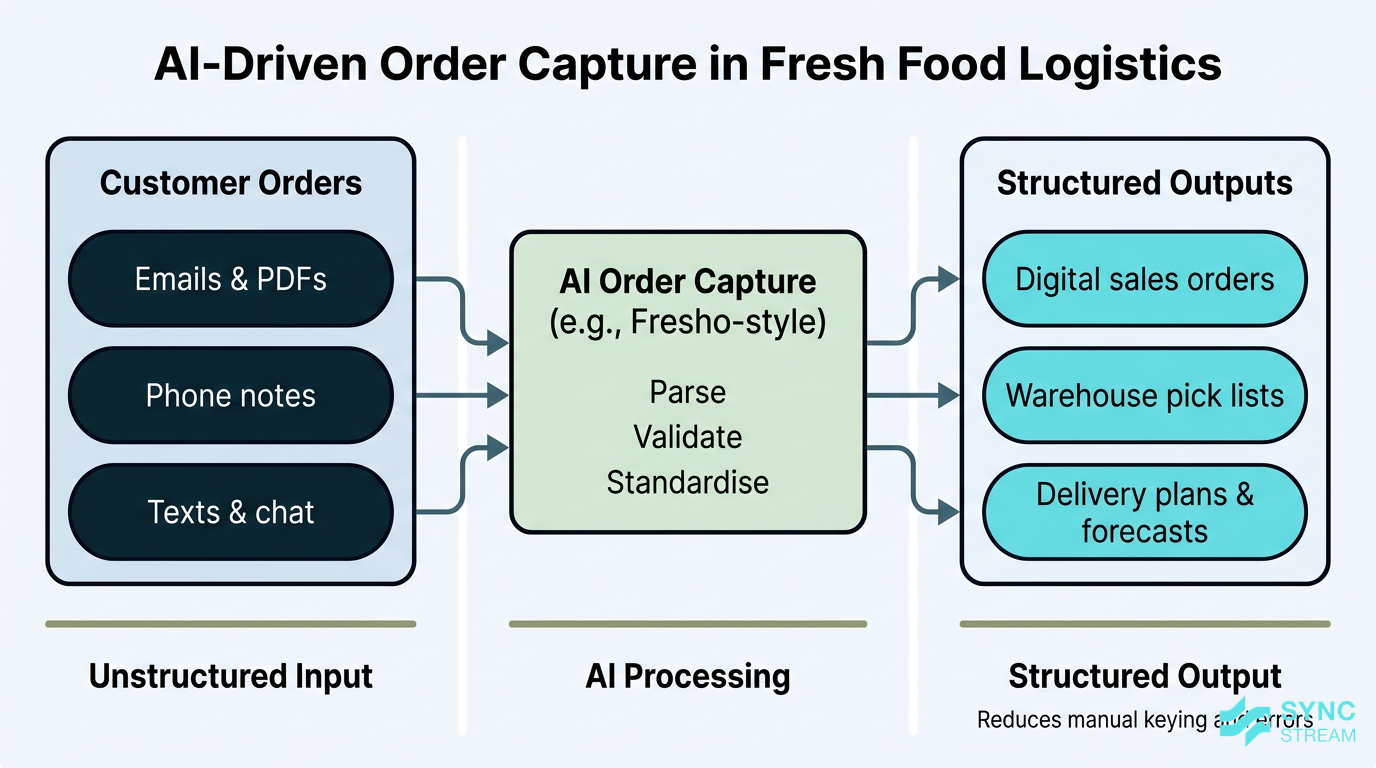
How AI turns unstructured fresh food orders into structured data for warehouse and delivery planning.
Fresh food logistics in Australia faces unique challenges:
- Short shelf life and strict temperature requirements
- Just-in-time processing for cafes, restaurants, and retailers
- Highly variable demand and frequent last-minute changes
- High risk of waste if orders or forecasts are wrong
Fresho’s AI-powered platform helps wholesalers by turning disorganised customer orders (email, phone notes, PDFs) into structured digital data.
This enables:
- Faster, more accurate order capture
- Better warehouse planning and picking
- Improved forecasting of demand and waste
The pattern here is powerful: AI is used to tackle a very specific, high-friction workflow, not to magically “fix logistics”.
You can apply the same thinking to other verticals:
- Construction materials: Auto-reading site delivery dockets, matching them to jobs and approvals.
- Medical supplies: Capturing complex order requirements and compliance data accurately, first time.
Sync Stream’s work often starts exactly here—identifying one or two painful workflows (like order capture or POD processing) and designing AI-enabled automations that slot into your existing systems.
Implementation strategy for SMBs
Assessing your readiness and priorities
Before buying tools, it helps to run a quick internal audit:
- List your current systems – TMS, WMS, telematics, accounting, CRM, spreadsheets.
- Assess data quality – Are addresses clean? Are SKUs consistent? Are PODs complete?
- Identify manual pain points – Routing done in spreadsheets, orders re-keyed from email, warehouse bottlenecks, compliance paperwork.
- Note compliance needs – Fatigue rules, CoR, dangerous goods, customer SLAs.
Then prioritise use cases that offer clear, near-term ROI with minimal disruption, for example:
- Route optimisation for a specific depot or region
- Automated order entry from email into your TMS or accounting system
- Automated matching of PODs to jobs and invoices
Involve dispatchers, drivers, warehouse, and admin staff early. They will surface on-the-ground constraints—like customer preferences, site access issues, or specific paperwork quirks—that an AI tool needs to respect.
Practical rollout sequence for AI tools
A simple, low-risk implementation flow looks like this:
- Define one clear use case
- Input: Current pain points and one target area (e.g., “morning metro deliveries from main depot”).
- Action: Write a one-sentence problem statement and a one-sentence success measure.
- Output: Agreed pilot use case with a defined operational scope.
- Select 1–2 vendors or platforms
- Input: Your systems list and pilot use case.
- Action: Shortlist tools that integrate with your TMS/WMS/telematics or accounting, and review demos focused on your use case.
- Output: One preferred tool plus a backup option that technically fits your stack.
- Run a limited pilot
- Input: Selected tool, pilot depot/route, small group of staff.
- Action: Configure the tool for that depot or route, train the specific team, and run it for an agreed period (e.g., 4–6 weeks).
- Output: Live use of AI on a contained part of your operation, with staff feedback captured.
- Measure specific metrics
- Input: Before-and-after data for the pilot period.
- Action: Compare kilometres per drop, admin hours, late deliveries, and error rates before vs during the pilot.
- Output: Simple results summary showing whether the AI use case is commercially worthwhile.
- Refine and scale gradually
- Input: Pilot results and staff feedback.
- Action: Tweak rules and workflows, document the “new way of working”, then expand to another depot, run type, or document set.
- Output: A tested, documented workflow that can be rolled out more widely with lower risk.
Allocate a clear internal owner for the project—often an operations or continuous improvement lead—and schedule time for staff training and process tweaks. AI tools fail when they’re dropped in without ownership or follow-through.
Change management and staff adoption
AI projects succeed or fail on staff adoption.
To bring people with you:
- Explain the “why” in practical terms – fewer manual phone calls, clearer run sheets, less double-handling of paperwork, fewer breakdowns.
- Position AI as support, not replacement – emphasise that dispatchers and drivers still have final say.
Provide simple, hands-on training:
- Short sessions on how to view and adjust AI-suggested routes
- Clear instructions for correcting auto-entered orders or documents
- Quick reference SOPs for the new workflows
Address scepticism by:
- Sharing relevant success examples (e.g., routing improvements similar to Adiona-style tools, or order entry wins like Fresho’s customers)
- Running pilots where frontline staff can provide feedback and see their suggestions implemented
Partners like Sync Stream typically build feedback loops into early phases so drivers, dispatchers, and admin staff can flag issues and improvements quickly.
Comparing options for AI adoption
Off-the-shelf platforms vs add-ons
When adopting AI, SMBs usually face a choice between:
- Standalone AI logistics platforms – dedicated routing, order capture, or warehouse optimisation tools.
- AI modules built into existing systems – features baked into your TMS, WMS, telematics, or accounting software.
For SMBs, the trade-offs look like this:
- Off-the-shelf platforms
- Pros: Richer AI features, faster innovation, often more configuration options.
- Cons: Need integration to your current stack; two systems to manage; staff may need to learn a new interface.
- Add-ons / built-in modules
- Pros: Quicker to adopt, usually familiar UI, less integration work.
- Cons: May be less flexible; might not cover complex or niche workflows.
A sensible first step is to map what you already pay for and ask current providers:
- What AI or automation capabilities they already offer
- How those features integrate with your other systems
- What’s on their roadmap that might help your specific use cases
If gaps remain, then look at specialist platforms and plan integrations accordingly.
Build vs partner with specialists
For Australian SMBs, building custom AI in-house is rarely viable. It requires:
- Data science and machine learning skills
- Ongoing infrastructure, monitoring, and security management
- Continuous model tuning as your operations change
Instead, most operators are better off partnering with specialist providers who:
- Configure and integrate AI tools into your existing systems
- Design workflows that reflect real-world constraints (drivers, customers, depots)
- Document everything so you’re not locked into a black box
Sync Stream, for example, focuses on implementing AI and automation on top of your existing CRMs, operations tools, databases, and communication platforms. This approach shortens time-to-value and reduces the risk of choosing complex technology that staff won’t use.
Evaluating vendors and proposals
When assessing vendors or partners, look for:
- Australian logistics experience, especially with fleets or warehouses similar to yours
- Integration capability with your current stack – TMS, WMS, telematics, accounting, CRM
- Data security and governance – how data is stored, who owns it, and how access is controlled
- Local support and responsiveness, including clear escalation paths
- Transparent pricing linked to outcomes – ideally tied to usage or measurable improvements, not just seats
Ask for case studies that include:
- Fleet or warehouse size and sector similar to yours
- Specific numbers on savings, error reduction, or on-time performance
- Implementation timelines and any lessons learned
You can also prepare a simple checklist or RFP focused on must-have capabilities, such as:
- Handles delivery time windows and priorities
- Supports fatigue rules and driver rostering constraints
- Works with limited connectivity or offline modes for remote areas
- Provides audit trails for changes to routes, maintenance decisions, or documents
Challenges and trade-offs for SMBs
Data quality and integration hurdles
AI is only as effective as the data it receives.
Common issues for SMBs include:
- Messy or inconsistent addresses
- Inaccurate planned or actual times
- Multiple SKU codes for the same item
- Disconnected systems and spreadsheets
These issues don’t make AI impossible, but they limit initial results.
Practical steps:
- Do a light clean-up of the worst data offenders (e.g., standardise top delivery addresses, key SKUs).
- Choose tools—and partners—that can tolerate some mess while offering features to improve data over time (e.g., address validation, duplicate detection).
- Plan integrations carefully between legacy systems, telematics, and new AI tools so data flows reliably.
Sync Stream typically tackles this by building orchestrated workflows around your existing systems, with validation and logging at each step so you can see and fix data issues as they surface.
Cost, scale, and complexity
AI tools come with costs:
- Subscriptions or licences
- Devices (e.g., tablets, scanners, wearables)
- Implementation and integrations
These need to be weighed against potential savings in fuel, labour, maintenance, and admin.
Consider that:
- Some tools are overkill for very small fleets; you may only need basic routing and simple automation.
- Over-configuring systems can create complexity that staff resist using.
A phased investment approach works best:
- Prove value on one use case with a small pilot.
- Refine processes and training based on real-world experience.
- Only then layer on additional AI capabilities.
Human oversight and accountability
AI doesn’t remove human responsibility, especially in areas of safety and compliance.
Potential risks of blind trust include:
- A route that minimises kilometres but ignores driver fatigue limits.
- A plan that sends a large vehicle to a site with restricted access.
- An auto-parsed order that misinterprets a quantity or special instructions.
To manage this:
- Define clear rules where humans must review or can override AI suggestions (e.g., high-risk routes, VIP customers, dangerous goods).
- Ensure your systems maintain an audit trail of key decisions—who approved what and when.
- Provide staff with clear escalation paths if they see AI-generated outputs that don’t make sense.
In most successful deployments, AI handles the 80–90% of routine decisions, while humans focus on exceptions and ensure compliance.
Conclusion
AI in logistics is no longer experimental or reserved for the biggest carriers. Australian AI in logistics examples like Toll Group’s routing, Chemist Warehouse’s smart warehousing, Adiona Tech’s fleet optimisation, and Fresho’s automated order entry show how practical and impactful it can be.
For SMBs, the real opportunity lies in targeted use cases:
- Smarter route optimisation and fleet planning
- Predictive maintenance to avoid breakdowns and improve safety
- Automated documentation to clear admin bottlenecks and speed up cash flow
You don’t need to rip out your systems or build AI from scratch. You do need a clear business case, the right integrations, and a rollout plan that brings your team along.
If you want to explore how AI and automation could streamline your specific logistics workflows—within your existing systems and with a clear ROI—book a discovery call with Sync Stream.
FAQ
How is AI in logistics different from standard software?
Standard software follows fixed rules you configure. AI learns from historical and live data to make smarter recommendations over time—for example, adjusting routes based on how long deliveries actually take, not just planned times.
Do I need to replace my TMS or telematics system to use AI?
Usually not. Many AI tools integrate with common TMS, WMS, and telematics platforms, or can sit alongside them. Partners like Sync Stream specialise in adding AI and automation on top of what you already have.
Is AI worth it for a small fleet (e.g., under 20 vehicles)?
It can be. If you’re doing regular runs with recurring customers, even small improvements in routing, admin time, or breakdown avoidance can pay for the tools. The key is to focus on one or two high-impact use cases, not a big-bang transformation.
How long does an AI logistics pilot usually take?
For a focused use case, many SMBs can run a meaningful pilot in 4–12 weeks. That includes scoping, integration, training, and a period of live use to gather data.
Will drivers and staff lose their jobs to AI?
In SMBs, AI is typically used to reduce manual admin and errors, not headcount. Drivers, dispatchers, and warehouse staff are still essential; AI just removes low-value tasks and helps them make better decisions.
What data do I need to get started?
At minimum, you’ll need reasonably clean addresses, basic order information, and access to telematics or operational data. You can start small and improve data quality as you go—perfection isn’t required on day one.
How does Sync Stream help Australian logistics businesses implement AI?
Sync Stream works inside your existing systems—CRMs, accounting, operations tools, and databases—to design and implement AI-powered workflows with clear business cases. We focus on reliable, documented automations for tasks like routing, order capture, and admin, so you see tangible benefits without losing control of your data or processes.