


Introduction
For Australian logistics and fleet operators, margins are tight and the pressure is relentless: high fuel prices, long distances, regional coverage, driver shortages, and customers who expect fast, trackable delivery.
That’s why AI in logistics industry conversations have shifted from “sci‑fi robots” to very practical questions: How do we reduce kilometres driven? How do we avoid breakdowns? How do we keep customers informed without drowning in admin?
This article gives small to medium logistics and fleet businesses in Australia a structured overview of where AI is actually being used today, what’s realistic at SMB scale, and how to roll it out without ripping out your existing systems.
We’ll cover the core AI components in transport, warehousing, and last‑mile delivery, the main benefits for Australian SMBs, common challenges, and a practical implementation path you can start on now.
What is AI in logistics industry
Defining AI in a logistics context
In a logistics context, AI simply means software that can learn from data and adapt over time, rather than only following fixed rules.
In practice, this usually shows up as:
- Machine learning models that spot patterns in orders, routes, and failures (for example, predicting which lane will run hot before it does, or which vehicle is likely to need attention).
- Optimisation algorithms that juggle thousands of constraints—traffic, delivery windows, vehicle capacity, driver hours—to recommend better routes or loading plans.
- Computer vision that can read labels, recognise pallets, count inventory, or check for damage using cameras and scanners.
- Automation workflows that take routine, repetitive steps—sending notifications, updating statuses, moving data between systems—and run them reliably in the background.
Traditional logistics software is usually rule-based: “if X, do Y.” It works, but it doesn’t improve unless someone rewrites the rules.
AI-enabled systems are data-driven:
- They learn from your historical runs, picks, and failures.
- They update predictions as new data arrives (for example, learning that a particular suburb is slower on Friday afternoons).
- They keep getting better as volumes grow, without you having to manually tune every rule.
For logistics, the main AI categories that matter are:
- Predictive analytics – forecasting demand, predicting ETAs, spotting likely failures or delays.
- Optimisation engines – routing, load planning, workforce scheduling, warehouse slotting.
- Robotics and automation – from basic conveyor and picking aids up to more advanced robotics in higher-volume environments.
- Conversational AI – chatbots and voice agents that handle routine queries and status checks for customers or internal teams.
Current AI adoption in Australia
By Q4 2024, around 35% of Distribution businesses and 45% of Retail Trade businesses in Australia had adopted some form of AI. For most SMBs, this does not mean fully robotic warehouses or driverless trucks.
It usually looks like:
- Smarter route optimisation tools plugged into existing telematics or TMS.
- Basic predictive tools that improve ETAs, demand forecasts, or reorder points.
- AI-enhanced warehouse management features like guided picking or suggested put-away locations.
- Customer-facing automation for notifications, delivery windows, and simple order-tracking queries.
This level of adoption shows AI is no longer just for big 3PLs and national retailers. Cloud-based SaaS tools and integrations now sit on top of the same telematics, TMS, and WMS platforms that Australian SMB fleets are already using.
On top of that, the Australian Government’s AI Action Plan (backed by around AUD 124 million in funding) signals that AI is a long-term national focus. For logistics operators, that means more tools, better integrations, and a continuing push toward responsible, commercially grounded use of AI rather than a passing technology fad.
Why it matters for Australian SMBs
Competitive and cost advantages
Fuel, labour, and maintenance are three of the biggest cost lines for logistics SMBs. AI can chip away at all three in practical ways.
- Fuel: Australian freight companies using AI-powered route planning have reported fuel reductions of up to around 15% by cutting unnecessary kilometres, reducing idling, and smoothing out driving patterns. On tight margins, even a smaller reduction has a direct impact on profit.
- Labour: Better routing and more accurate ETAs reduce overtime, waiting time at docks, and the admin load in dispatch and customer service.
- Maintenance: Predictive maintenance avoids some breakdowns, keeps vehicles on the road, and makes workshop time more controlled.
This cost discipline helps smaller operators compete with large 3PLs and national retailers who already invest heavily in optimisation and analytics. With the right AI-enabled tools, SMBs can:
- Plan routes and loads with a similar level of sophistication.
- Run leaner inventory and more accurate replenishment.
- Offer reliable tracking and communication that customers expect from big brands.
In Australia, this matters even more because of:
- Long distances and regional runs that magnify every wasted kilometre.
- High fuel prices that bite directly into margin.
- Regional coverage requirements where you can’t simply cut low-density areas.
- Customers now assuming fast, trackable delivery, even for B2B freight.
Customer experience and service levels
Customer expectations have shifted. Whether you’re delivering to a mine site, a regional hardware store, or a suburban home, people want to know where their order is and when it will arrive.
AI helps here by:
- Using live GPS, historical data, and traffic patterns to provide more accurate ETAs.
- Automatically generating status updates at key milestones—loaded, out for delivery, nearby, delivered.
- Triggering proactive alerts when there’s a likely delay so customers hear from you before they have to ring.
This reduces the classic “where is my order?” calls, which usually tie up your most experienced staff. It also improves customer satisfaction and retention, especially for B2B customers who are coordinating crews, installers, or store promotions around your deliveries.
AI-driven optimisation can also help you:
- Combine deliveries intelligently to reduce last-mile chaos.
- Offer tighter same‑day or next‑day windows without overloading drivers.
- Avoid repeated failed deliveries by predicting when certain customers or zones are typically available.
Examples that work for both B2B and B2C operators include:
- Automated SMS or email updates as freight moves through your network.
- “Heads up” messages if a truck hits major congestion or weather issues.
- Delivery windows that are genuinely realistic rather than broad guesses.
Strategic resilience and growth
Beyond day-to-day gains, AI supports more resilient and scalable operations.
Using AI-driven forecasting and scenario modelling, SMBs can better handle:
- Demand peaks like Black Friday, Christmas, EOFY, and local events.
- Disruptions such as severe weather, major roadworks, or upstream supply delays.
With better visibility and predictive insights, owners and directors can make stronger decisions about:
- When to add vehicles or trailers.
- Whether it’s time to open a satellite depot to service a region more efficiently.
- Which lanes might be better served by outsourcing to 3PL partners.
Starting modest AI initiatives now also means you begin building:
- Data assets – clean, structured history of routes, loads, failures, and service levels.
- Internal capability – dispatchers, planners, and managers who understand how to use AI-enabled tools in daily operations.
These capabilities compound in value over the next 3–5 years, making your business more resilient whether you decide to grow, specialise, or prepare for succession.
Key components and use cases
Warehouse automation and inventory optimisation
For SMB-scale warehouses, AI doesn’t mean a fully robotic facility. It usually means layers of intelligence added to your existing WMS and processes.
Realistic use cases include:
- Guided picking: handheld devices or voice systems that recommend the optimal pick path, reduce travel time, and minimise congestion.
- Automated slotting: AI models suggesting where to store fast-moving vs slow-moving items to cut pick times and reduce aisle clashes.
- Demand-based replenishment: using historical orders, seasonality, and lead times to recommend when and how much to reorder.
- Basic robotics: such as small autonomous carts or conveyors that move totes between zones in higher-volume SMB warehouses.
Machine learning can optimise storage locations and reorder points by analysing:
- Order history by SKU, customer, and region.
- Typical pick sequences and common item combinations.
- Supplier lead times and variability.
A simple before/after workflow might look like:
- Before AI:
- Inputs: Ad hoc knowledge from supervisors, manual location assignments, paper pick lists, and reactive “top up when it looks low” replenishment.
- Action: Supervisors decide locations and picks by experience; staff walk long paths and fix issues as they find them.
- Expected output: Acceptable but inconsistent pick speeds, frequent “can’t find it” moments, and stockouts or overstocked slow movers.
- After AI-enabled WMS:
- Inputs: At least 3–6 months of order history, current stock locations, supplier lead times, and pick performance data from your WMS or spreadsheets.
- Action:
- Import or connect this data into an AI-enabled WMS or optimisation module.
- Generate recommended slotting changes and replenishment rules.
- Trial changes in one zone or product family, then train pickers on new paths.
- Expected output: Shorter pick paths, fewer aisle conflicts, earlier low-stock alerts, and a visible lift in pick rates with fewer errors.
For most SMBs, these capabilities arrive through cloud WMS add-ons or integrated tools, not custom-built AI projects. You still work in your familiar system; the AI just makes it smarter.
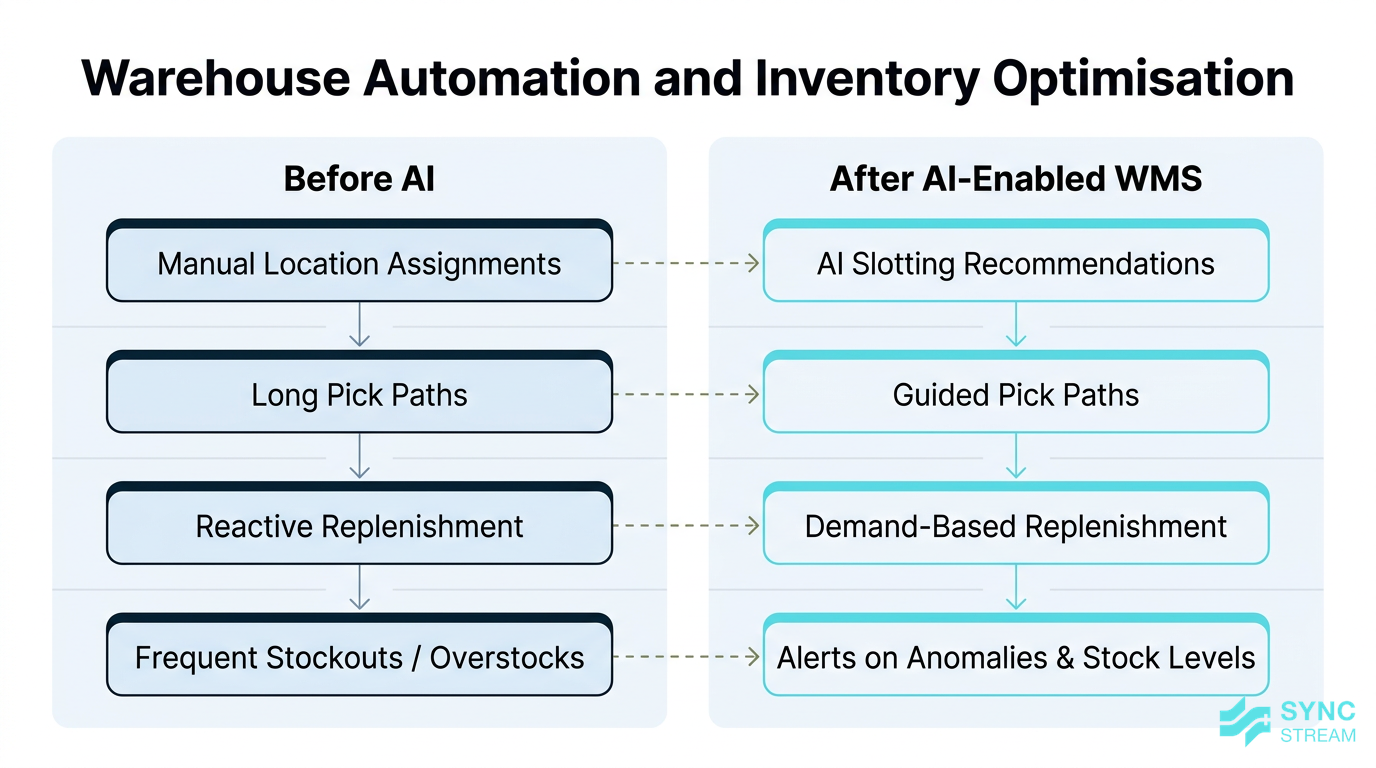
Comparison of manual versus AI-assisted warehouse slotting, picking, and replenishment.
Route optimisation and last-mile delivery
AI-powered routing tools take into account:
- Real-time and historical traffic data.
- Weather and road conditions.
- Order constraints like delivery windows, priority customers, and special handling.
- Vehicle constraints such as capacity, height/weight limits, and equipment.
- Driver hours and fatigue rules.
The system then generates routes that better balance:
- Kilometres driven.
- Service levels and time windows.
- Driver utilisation and fatigue management.
In the Australian context, these tools can differentiate between:
- Long-haul runs between cities or into regional areas, where fuel savings and arrival reliability are critical.
- Metro runs dealing with urban congestion, school zones, and tight access.
At a network level, AI can also help combine key consumer goods and orders at the warehouse so:
- Fewer vehicles need to be on the road.
- Loads are better consolidated.
- Last-mile routes become more efficient.
SMBs can realistically expect improvements such as:
- Shorter delivery windows that you can actually meet.
- Fewer kilometres driven per day or per stop.
- Higher on-time performance with fewer missed or late deliveries.
- Less driver overtime, especially on routes that were previously planned manually.
To make implementation concrete:
- Prepare routing data
- Inputs: Last 1–3 months of runs showing stops, times, kilometres, and vehicle types; customer delivery windows; driver shift rules.
- Action: Export this data from your TMS or telematics and clean obvious errors (duplicate stops, bad addresses).
- Expected output: A usable dataset you can load into a routing tool for testing.
- Configure and test routes
- Inputs: Clean dataset, your vehicle profiles, customer priorities, and fatigue rules.
- Action:
- Configure an AI routing tool with your constraints.
- Generate proposed routes for a typical day.
- Sit down with dispatchers and a few drivers to compare the AI plan to how they’d normally run it.
- Expected output: Adjusted settings that reflect real-world access issues and a set of pilot routes that everyone agrees to trial.
- Run a controlled pilot
- Inputs: Agreed pilot region or lane, selected vehicles and drivers, AI-generated routes.
- Action: Run the pilot for at least 4–6 weeks, track kilometres, fuel, on-time arrival, and overtime.
- Expected output: Measured changes in cost per stop and on-time rates, plus driver feedback on practicality.
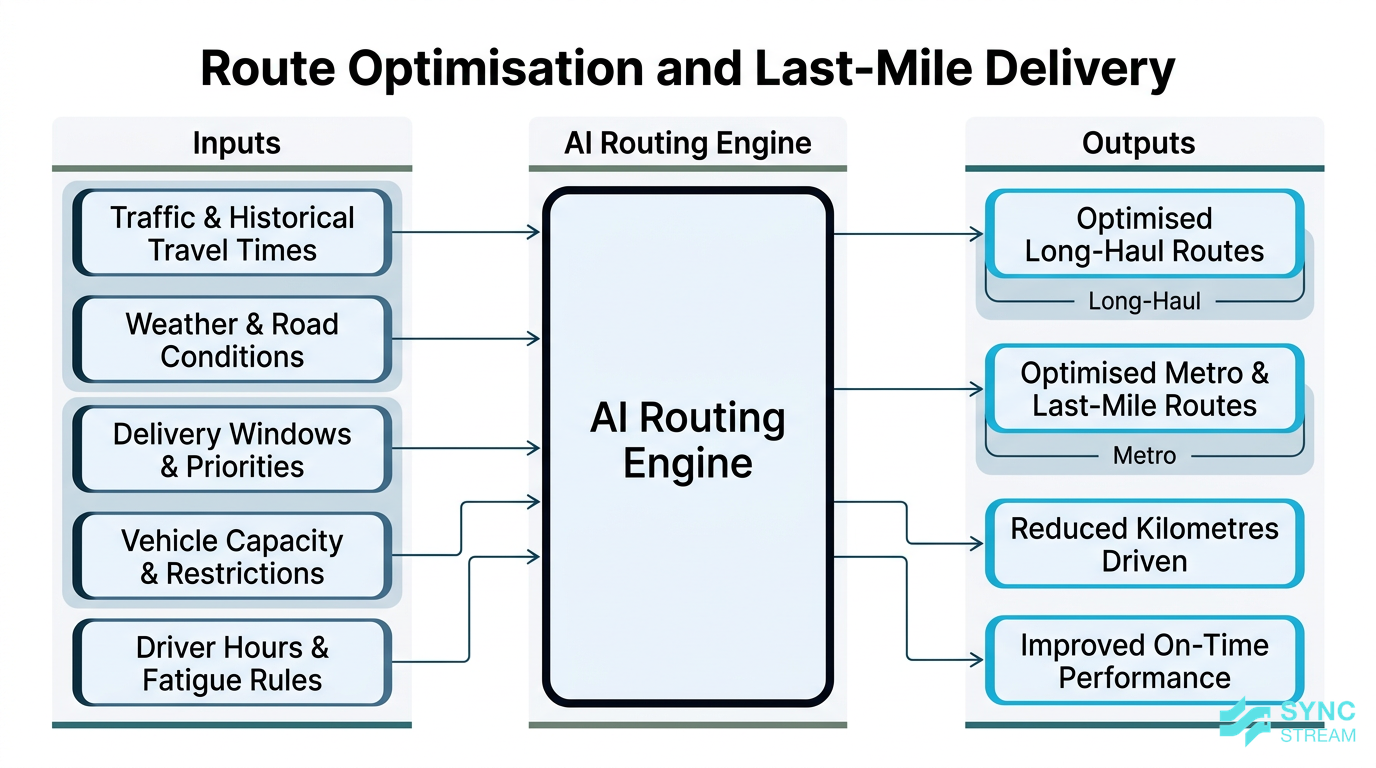
How AI ingests constraints to generate efficient long-haul and metro delivery routes.
Predictive maintenance and fleet health
Predictive maintenance applies AI to data you often already collect, such as:
- Vehicle telemetry (engine parameters, fault codes, fuel use).
- Servicing logs and previous breakdowns.
- Tyre and brake wear patterns.
- Fuel efficiency trends that might indicate emerging mechanical issues or driving behaviour changes.
By analysing this data, AI tools can flag:
- Vehicles that are drifting away from normal performance.
- Components that are likely to fail soon.
- Units that should be prioritised for workshop time.
This reduces:
- Unplanned downtime and emergency repairs.
- Tow costs and the disruption of a vehicle stranded on the side of the road.
- Knock-on effects for customers and delivery schedules.
It also supports more efficient planning of:
- Workshop utilisation, avoiding everyone wanting the same slot.
- Parts ordering, so critical items are on hand before a vehicle comes in.
Most Australian fleets already use some form of telematics/IVMS. Predictive maintenance layers on top of these systems, using their data feeds. The quality of predictions improves when you also factor in driver behaviour data—harsh braking, speeding, idling—because it directly affects wear and tear.
To move from theory to practice:
- Aggregate maintenance data
- Inputs: Telematics exports (fault codes, odometer, fuel use), service history from your workshop system or spreadsheets, and any inspection reports.
- Action: Combine these into a single view per vehicle (even in Excel), ensuring dates and odometer readings line up.
- Expected output: A basic fleet health dataset showing how issues and services relate over time.
- Define alert thresholds and priorities
- Inputs: Fleet manager knowledge of common failures, manufacturer service intervals, and cost of downtime per vehicle type.
- Action:
- Work with a provider or internal analyst to set rules and train models (for example, “flag units where fuel use has risen 10% without route change”).
- Configure how alerts appear—email, dashboard, or maintenance queue.
- Expected output: A prioritised list of vehicles needing attention, sorted by risk and impact.
- Integrate with workshop planning
- Inputs: Alert list, booked jobs, available workshop slots, and parts lead times.
- Action: Schedule predictive jobs alongside regular services, and track whether flagged issues would likely have caused breakdowns if ignored.
- Expected output: Smoother workshop workload, fewer road-side events, and clearer evidence of savings.
Real-time tracking and supply chain visibility
Real-time tracking is now an expectation, not a luxury. AI-enhanced visibility platforms aggregate:
- GPS data from vehicles or handhelds.
- Scan events at depots, hubs, and customer locations.
- External data like major traffic incidents or weather alerts.
AI then adds value by:
- Spotting anomalies, such as a consignment that hasn’t moved when it should have, or a vehicle that’s significantly off-route.
- Predicting likely delays and escalating them to dispatch or customer service.
- Automatically triggering remedial actions, like re-allocating a stop or notifying a key customer.
For SMB owners and directors, this translates into:
- A single operational view from depot to final delivery, instead of jumping between systems.
- Faster response to issues before they become customer complaints.
- Better data for service-level reporting and tender responses.
A practical rollout often looks like:
- Connect existing GPS and scan data into one visibility tool.
- Define what counts as an exception (late scans, off-route, long dwell times).
- Set up auto-alerts to dispatch and, where appropriate, directly to customers.
- Review a weekly “exceptions report” to refine rules and reduce noise.
Implementation strategy for SMB operators
Prioritising high-impact use cases
The best way to start with AI is not by chasing a specific technology, but by mapping your pain points.
- List your biggest operational issues—examples:
- Fuel cost per kilometre.
- Missed or late ETAs.
- Stock inaccuracies or lost items.
- Driver shortages or high overtime.
- Frequent breakdowns or workshop bottlenecks.
- Rank them by financial impact and customer impact.
- Identify which issues are data-rich (you already have telematics, WMS, or ERP data).
- Shortlist two or three use cases where:
- You can access the required data without major IT projects.
- Operators can clearly see how AI suggestions link to daily work.
- You can measure before/after performance within a few months.
For most Australian SMB logistics businesses, common starter use cases are:
- Route optimisation to reduce kilometres, fuel, and overtime.
- Basic predictive maintenance using existing telematics data.
- Improved tracking and notifications to cut inbound customer calls.
A simple back-of-the-envelope ROI check helps build a business case before you look at tools. For example:
- If you spend $100,000 per month on fuel, a realistic 5–10% saving is $5,000–$10,000 per month.
- If your on-time performance improves and reduces penalty charges or lost contracts, estimate the avoided cost or protected revenue.
You don’t need precise modelling at this stage—just enough to see where AI can move the needle.
Practical rollout process for AI projects
A structured rollout process keeps AI projects grounded and manageable:
- Define the problem and success metrics
- Inputs: Current performance data (fuel per km, on-time delivery, breakdowns, pick rates) and business targets.
- Action: Convert a pain point into a clear goal, such as “Reduce fuel per kilometre by 8%” or “Cut missed ETAs by 30% on metro runs,” and agree on how you’ll measure it.
- Expected output: A short problem statement and metric baseline everyone can refer to.
- Audit available data
- Inputs: GPS/telematics exports, WMS and ERP reports, spreadsheets, customer address lists, service logs.
- Action:
- Check that timestamps, addresses, and identifiers (vehicle IDs, consignment numbers) are consistent.
- Note obvious gaps (missing scans, incorrect suburbs) and quick fixes.
- Expected output: A simple data map showing what you can use now and what needs cleaning.
- Shortlist vendors or platforms
- Inputs: Your prioritised use cases, data map, and budget range.
- Action:
- Evaluate tools that already support your type of operation (linehaul, PUD, warehousing).
- Ask for references from similar Australian fleets and proof-of-concept demos using your data if possible.
- Expected output: One preferred solution plus a fallback option, both with clear integration paths.
- Run a limited pilot
- Inputs: Selected depot or region, subset of vehicles, defined timeframe (usually 8–12 weeks).
- Action:
- Configure the system for that scope only.
- Train dispatchers and drivers.
- Track the defined success metrics weekly.
- Expected output: Evidence of impact (or lack of it), user feedback, and a list of tuning changes.
- Refine and scale
- Inputs: Pilot results, user feedback, and updated configuration.
- Action:
- Adjust rules, parameters, or workflows.
- Decide whether to roll out to more depots, more vehicles, or additional use cases.
- Expected output: A phased rollout plan, updated documentation, and ownership assigned inside your team.
When selecting technology, prioritise cloud-based, API-friendly solutions that:
- Integrate with your existing TMS, WMS, accounting, and telematics platforms.
- Allow gradual adoption, not a risky overnight changeover.
- Make it easy to export your data so you’re not locked in.
Realistic pilot scopes for SMBs typically look like:
- One depot or region for 8–12 weeks.
- A defined set of key customers or lanes.
- Dedicated internal owner (operations or fleet manager) plus a small group of drivers and dispatchers for feedback.
Involving drivers and dispatchers from the start is crucial—they see the edge cases and can explain where the AI’s suggestions need real-world adjustment.
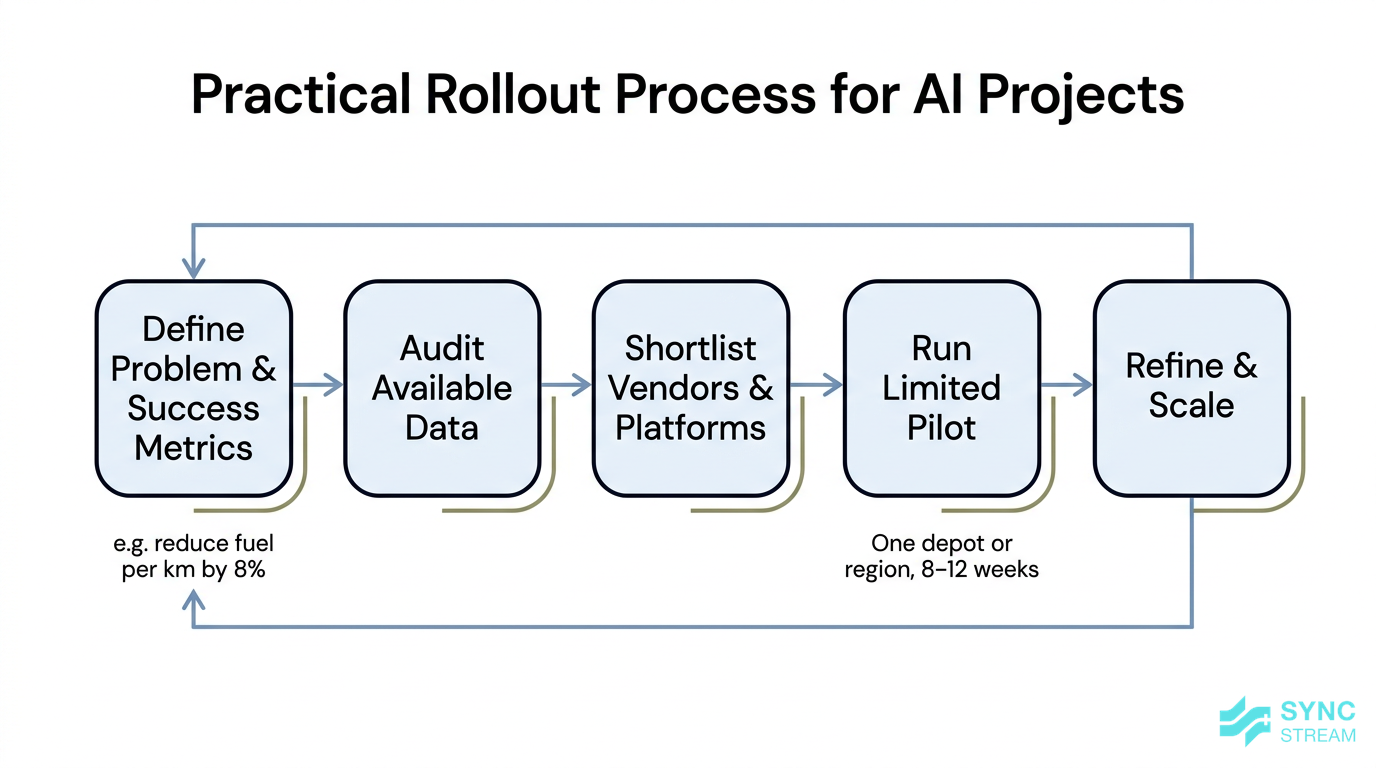
Five-stage implementation roadmap from defining the problem to scaling AI in logistics operations.
Data, skills, and change management
To get useful results from AI, you need some basic data foundations, such as:
- Clean order data (correct SKUs, quantities, and dates).
- Consistent addresses (standardised formats, correct suburbs/postcodes).
- A history of telematics and scan data for key vehicles and lanes.
Simple steps to improve data quality include:
- Standardising how addresses are captured and validated.
- Cleaning customer lists periodically.
- Ensuring drivers and warehouse staff follow clear scanning and data entry procedures.
You do not need deep in-house AI expertise to start. What you do need is:
- Strong process knowledge inside the business—people who understand how jobs are actually done.
- Clear ownership of metrics and workflows.
- Solid partnerships with solution providers who understand logistics operations.
Human factors can make or break AI projects. Focus on:
- Training dispatchers and planners to interpret and adjust AI recommendations.
- Empowering drivers to give feedback when routes or ETAs are unrealistic.
- Communicating clearly that AI is there to support, not replace jobs—by reducing fatigue, admin, and surprises.
- Aligning incentives and KPIs (for example, rewarding safe and efficient driving, not just speed).
Comparing solution options
Off-the-shelf tools vs custom solutions
When considering AI in your logistics operation, you’ll often be choosing between:
- Off-the-shelf SaaS tools – ready-made logistics platforms with AI features.
- Custom or heavily customised solutions – built specifically for your workflows.
Off-the-shelf SaaS tools typically offer:
- Faster deployment and lower upfront cost.
- Standardised features for routing, tracking, and warehouse optimisation.
- Regular updates and maintenance handled by the provider.
Custom or heavily customised solutions can provide:
- Workflows tailored closely to your unique processes or industry niche.
- Deeper integration with unusual legacy systems.
- Greater control over specific algorithms or business logic.
For most Australian SMBs, it’s usually best to start with off-the-shelf tools that integrate with your existing TMS/WMS/telematics. You can then selectively customise or build additional layers once you have real-world experience and data.
Key considerations when comparing options include:
- Data ownership and exportability – can you get your data out easily if you change vendors?
- Ability to configure business rules (service levels, customer priorities, fatigue rules).
- How easily the system can integrate with your other tools without creating manual double handling.
- The risk of vendor lock-in if everything is proprietary and closed.
In-house capability vs external partners
Another decision is how much you handle internally versus relying on external partners.
Building in-house capability (hiring or upskilling staff) means:
- More control over day-to-day configuration and small changes.
- Faster iteration once your team is experienced.
- Long-term capability embedded in your business.
Relying on external providers or managed services offers:
- Access to specialised skills in implementation, integration, and analytics.
- Faster initial rollout and reduced learning curve.
- Help navigating vendor selection and architecture decisions.
For most SMBs, a blended approach works best:
- Keep process ownership and performance reporting internal—your team defines what “good” looks like.
- Use external partners for the initial implementation, configuration, and integrations.
- Lean on external expertise for more advanced analytics or when extending into new AI use cases.
When evaluating partners, look for:
- Demonstrated experience with Australian logistics and fleet operations.
- Strong support responsiveness and clarity on who does what.
- Willingness to work within your existing systems and adapt solutions as you grow.
Sync Stream, for example, focuses specifically on implementing AI and automation on top of the systems you already use—CRMs, accounting, operations tools, telematics, and databases—so you maintain control over your data and infrastructure.
Budget levels and ROI expectations
Budget and ROI expectations should match SMB realities.
Typical patterns include:
- Per-vehicle or per-user SaaS pricing for routing, tracking, and maintenance tools.
- Modest implementation and integration fees to connect systems and configure workflows.
- Occasional project work when extending to new depots or adding new automation.
Payback periods for common use cases like route optimisation or predictive maintenance are often measured in months rather than years, especially when fuel savings, reduced overtime, and fewer breakdowns are considered together.
To track ROI effectively:
- Establish baseline metrics before implementation, such as:
- Fuel per kilometre.
- On-time delivery rate.
- Unplanned breakdowns per month.
- Pick rate per hour in the warehouse.
- Implement the AI-enabled solution in a defined scope.
- Review the same metrics after 8–12 weeks and again after 6 months.
- Adjust routes, rules, or training based on what the data shows.
This data-driven approach helps you decide where to double down, where to scale back, and where the next AI investment should be.
Challenges and operational realities
Data quality and integration hurdles
AI systems are only as good as the data they receive. Common challenges include:
- Inconsistent address formats leading to routing and ETA errors.
- Missing or incorrect timestamps on scans and deliveries.
- Fragmented systems—separate TMS, WMS, accounting, telematics—that don’t talk to each other.
These issues limit AI performance and can produce recommendations that don’t match real-world conditions.
Practical, low-cost remedies include:
- Standardising data entry procedures for addresses and customer details.
- Cleaning customer address lists and validating them periodically.
- Where possible, consolidating key systems or at least ensuring robust integrations.
Testing integrations thoroughly is critical. Allow some time for data flows to stabilise and models to learn before fully judging results. Early weeks are often about ironing out connection and data-quality issues.
Workforce acceptance and safety considerations
Drivers, warehouse staff, and dispatchers may feel threatened or overly monitored by new AI tools, especially if they involve tracking behaviour or changing routes.
If this isn’t handled well, adoption will suffer.
Good practice includes:
- Transparent communication about what data is collected and how it will be used.
- Emphasising how AI can improve safety—reducing fatigue, avoiding breakdowns, and smoothing workloads.
- Highlighting that human operators still have the final say and can override AI suggestions.
In the Australian regulatory context, you also need to consider:
- Fatigue management rules and how route optimisation respects required breaks.
- Chain of responsibility, ensuring accountabilities are clear even when AI tools are involved.
- Making sure AI-driven decisions don’t push drivers into unsafe or non-compliant behaviour.
Aligning AI initiatives with safety and compliance goals makes it easier for staff to support the change.
Over-automation and unrealistic expectations
There’s a risk of aiming for “fully autonomous” operations when most SMB environments—especially mixed freight, variable volumes, and complex access—aren’t ready for that level of automation.
It’s important to recognise that:
- AI outputs are probabilistic, not perfect. They provide the best guess based on data, not a guarantee.
- Human judgement is still essential for exceptions, unusual customers, or local knowledge.
- Rules and models need ongoing tuning as conditions, customers, and fleets change.
View AI as a tool for incremental improvement, not a silver bullet. Plan for:
- Ongoing costs for data storage, software subscriptions, and integrations.
- Training and retraining staff.
- Periodic reviews of algorithms, thresholds, and workflows.
This mindset helps avoid disappointment and keeps AI investments anchored to real, measurable business outcomes.
Conclusion
AI in the logistics industry is no longer a distant concept reserved for global giants. For Australian SMB fleet and logistics operators, it is increasingly a practical toolkit for cutting fuel and labour costs, improving customer experience, and building a more resilient, scalable operation.
By focusing on high-impact areas like warehouse optimisation, route planning, predictive maintenance, and real-time visibility—and by starting with your existing systems and data—you can capture meaningful gains within months, not years.
The key is to start small, measure carefully, involve your people, and choose solutions and partners who understand both logistics operations and the Australian context.
If you’d like to explore where AI and automation can create the most value in your logistics workflows—using the systems you already have—Sync Stream can help you scope and implement projects with clear commercial outcomes and fully documented workflows.
FAQ
Q1: Do I need to replace my existing TMS or WMS to use AI in my logistics business?
Not necessarily. Many AI capabilities—such as route optimisation, predictive maintenance, and enhanced tracking—can be added on top of your existing TMS, WMS, and telematics through integrations or cloud add-ons. The priority is choosing tools that connect cleanly with what you already use.
Q2: How much data do I need before AI becomes useful?
You don’t need years of history, but you do need consistent, reliable data. A few months of clean telematics, order, and scan data is often enough to start pilot projects. As you run the system, it continues to learn and improve from new data.
Q3: Is AI only worth it for large fleets?
No. Smaller fleets can benefit significantly from better routing, fewer breakdowns, and improved visibility, especially when operating over long distances or in congested metros. Because many tools are priced per vehicle or per user, they can scale down as well as up.
Q4: How long does it take to see benefits from AI-enabled routing or tracking?
Many SMBs see early improvements within an 8–12 week pilot, particularly in fuel efficiency, on-time performance, and reduced customer enquiry calls. Deeper optimisation and forecasting accuracy continue to improve over time as more data is collected.
Q5: Will AI increase monitoring of drivers, and how should we handle that?
AI often uses driver and vehicle data to improve safety and efficiency, which can feel like increased monitoring. Being transparent about what’s collected, why it’s needed, and how it improves safety and reduces fatigue is crucial. Involving drivers in reviewing reports and setting fair KPIs also helps build trust.
Q6: What if my data is messy or spread across different systems?
That’s common in SMB logistics. Start by standardising key data fields (especially addresses), cleaning customer lists, and integrating your most important systems. Many AI projects begin with a data tidy-up phase; the improvements you make there will pay off across the whole business, not just in AI initiatives.
Q7: How can a partner like Sync Stream support AI adoption in my logistics business?
Sync Stream works alongside your team to identify high-friction processes, design AI and automation workflows on top of your existing systems, and implement them using structured orchestration tools. Every workflow is documented for maintainability, and every project is scoped against a clear business case and ROI, so you end up with reliable, auditable systems rather than experimental tech.