

Introduction
If you are comparing AI outsourcing companies, you’ve probably seen everything from cheap offshore offers to premium local consulting rates. For a small or medium Australian business, the gap between a $20,000 build and an $80,000 build is the difference between experimenting and betting the farm.
This guide unpacks how AI outsourcing actually works for Australian SMBs, with a focus on costs, outsourcing models (offshore, hybrid, local), risk, and data security. You’ll see where the money really goes, what different models look like in practice, and how to structure a project so you get measurable ROI instead of another sunk cost.
Throughout, we’ll reference how an implementation‑focused partner like Sync Stream approaches AI and automation inside existing systems, so you can benchmark other providers against a practical, risk‑aware model.
What is AI outsourcing?
Defining AI outsourcing for SMBs
For SMBs, AI outsourcing simply means contracting external specialists to plan, build, deploy, and maintain AI solutions instead of hiring a full in‑house team.
Rather than employing data scientists, ML engineers, integration specialists, and product owners on Australian salaries, you:
- Define the business problem (for example, slow quoting, manual data entry, or inconsistent customer responses).
- Input: A clearly described operational problem and examples of where it shows up.
- Action: Capture 3–5 recent real cases (emails, tickets, invoices) that illustrate the issue.
- Expected output: A short problem statement with concrete examples and rough estimates of time or cost impact.
- Engage an AI outsourcing partner to design and build a solution.
- Input: Problem statement, access to relevant systems (read‑only where possible), and any existing reports.
- Action: Run a structured discovery session where the partner maps the process, systems, and data involved.
- Expected output: A proposed approach, rough cost bands, and initial risk and data considerations.
- Keep ownership of your data, systems, and outcomes while the partner delivers the technical heavy lifting.
- Input: Agreed scope, access controls, and roles/responsibilities.
- Action: Ensure contracts state you retain data and system ownership, and that work is done inside your chosen platforms where practical.
- Expected output: A signed agreement that protects your IP and sets clear expectations on access, security, and handover.
Typical AI and automation use cases for Australian SMBs include:
- Customer service chatbots and voice agents to handle FAQs, triage queries, and route complex issues to humans.
- Lead scoring and qualification inside your CRM so sales teams focus on the most likely converters.
- Demand forecasting and scheduling for inventory, field service jobs, or delivery runs.
- Document processing such as extracting data from invoices, purchase orders, and safety forms.
- Basic generative AI tools like email and report drafting that are embedded into existing workflows.
This is different from generic IT outsourcing:
- The skill sets are more specialised (data science, ML, orchestration, security).
- Solutions are heavily data‑dependent—how your data is stored, cleaned, and governed directly affects outcomes.
- Work must stay tightly aligned with your business strategy and compliance obligations, not just “keep the lights on” IT.
An implementation‑first firm like Sync Stream also focuses on workflow design and documentation so the system is reliable day‑to‑day and not a black‑box experiment.
Core outsourcing models: offshore, hybrid, local
There are three broad AI outsourcing models Australian SMBs will encounter:
- Offshore: Delivery teams are primarily based in lower‑cost countries (e.g., Indonesia, Vietnam, Philippines). Work is usually done remotely, often through an Australian intermediary or directly with an offshore firm.
- Local / onshore: Australian firms with teams physically based in Australia. You pay local rates for discovery, design, build, and support.
- Hybrid: An Australian lead (strategy, architecture, stakeholder engagement) combined with offshore delivery capability for parts of the build.
From an SMB perspective, the usual pros and cons look like this:
- Offshore
- Pros: Lowest hourly rates, potentially fast scaling of team size.
- Cons: Time‑zone friction, cultural and communication gaps, more complex data residency and governance.
- Local / onshore
- Pros: Strongest alignment on regulation, culture, and communication; easier to handle sensitive data; simpler contracts and governance.
- Cons: Highest hourly rates and project costs.
- Hybrid
- Pros: Local leadership for discovery, design, and compliance; offshore delivery to reduce costs while keeping governance anchored in Australia.
- Cons: Requires a mature lead partner to coordinate effectively; not all hybrid providers are transparent about who does what.
The rest of this article compares these models on cost, risk, data security, and suitability for different SMB situations, so you can choose a structure that fits your budget and risk appetite.
Why it matters for Australian SMBs
AI as a competitiveness and efficiency lever
For Australian SMBs in sectors like construction, maintenance, logistics, or retail, AI is not about “innovation theatre”. It’s a way to:
- Reduce manual work: Automate data entry, invoice matching, job creation in your field service system, or triaging customer emails and calls.
- Improve decision‑making: Forecast demand, identify at‑risk customers, or highlight jobs likely to run over budget or schedule.
Because few SMBs can attract or afford a full in‑house AI team at Australian salary levels, outsourcing becomes the primary way to access this capability.
When you start with well‑chosen projects—say, auto‑classifying 80% of incoming support tickets or reducing quote turnaround time by 30%—you can see measurable ROI quickly. But if you:
- Pick a vendor who over‑engineers the solution,
- Chase shiny generative AI ideas without clean data,
- Or commit to a large fixed‑price project without clarity,
you can burn a year’s technology budget with little to show for it. That’s why model choice and implementation approach matter as much as the tools.
Budget realities and talent constraints
In Australia, local AI work typically ranges from about AUD $120 to $600 per hour, depending on seniority and specialisation:
- Junior AI/automation developers: ~$120–$180/hr
- Mid‑level: ~$180–$300/hr
- Senior: ~$300–$450/hr
- Generative AI specialists: ~$350–$600/hr
Hiring these skills in‑house means not just salary, but super, overheads, and providing enough work to retain them. For most SMBs, that’s unrealistic.
There’s also a shortage of experienced AI practitioners in Australia, which:
- Pushes rates up.
- Extends hiring timelines (months, not weeks).
- Increases the risk of hiring generalist developers who “learn on your project”.
Outsourcing allows you to “rent” high‑end expertise only when it matters most:
- Local experts handle strategy, architecture, integration into your systems, and governance.
- More routine build tasks or front‑end work can be handled by lower‑cost or offshore resources.
Partners like Sync Stream lean heavily on this model—using senior expertise where design and risk decisions are made, then executing repeatable patterns efficiently.
Regulatory and data obligations in Australia
Even when you outsource, you remain legally responsible for customer data and how AI systems use it.
Key considerations include:
- Australian Privacy Principles (APPs) and state‑based privacy laws.
- Industry‑specific rules, such as those in finance, healthcare, and education.
- Emerging guidance around automated decision‑making, explainability, and record‑keeping.
Where your data is stored and processed matters:
- Are training and inference happening onshore or offshore?
- Which cloud regions are used?
- Who has access to raw data vs anonymised samples?
This is a major reason why choosing between offshore, hybrid, and local models is about more than headline cost—especially if you handle sensitive data like health information, financial records, or student data. A local or hybrid partner that works inside your existing CRM, accounting, or operations tools (like Sync Stream does) can help you keep data residency and access under tighter control.
Key components / features
Typical services AI outsourcing companies provide
Most AI outsourcing companies for SMBs group their services into a few buckets:
- Strategy and roadmapping: Clarifying which processes to automate first, what success looks like, and how AI fits your broader operations and compliance obligations.
- Data engineering: Cleaning, restructuring, and integrating data from CRMs, job management tools, accounting platforms, and spreadsheets into a usable form.
- Model development and AI assistants: Choosing and configuring appropriate models (often pre‑built or API‑based), building AI agents or chatbots, and tuning them for your data and workflows.
- Integration with existing systems: Connecting AI components into tools like Xero, MYOB, Salesforce, simPRO, or custom databases using workflow orchestration platforms such as n8n.
- Ongoing monitoring and optimisation: Tracking performance, handling model drift, monitoring error rates, and implementing improvements.
A good partner will push back on generic “let’s add a chatbot” ideas and instead help you identify the right problems to automate—those with clear business value and feasible data.
In practice, the bulk of real work is often data preparation and integration, not clever model training. Partners like Sync Stream specialise in that “unseen” layer: turning messy operations into robust, documented workflows that AI can safely plug into.
Cost drivers and pricing structures
Pricing for AI outsourcing typically combines hourly rates and project‑based estimates.
Common Australian project bands are:
- Basic AI projects (AUD $10,000–$30,000): Narrowly scoped, low‑risk automations—e.g., routing and tagging support tickets, simple invoice extraction into your accounting system.
- Moderate complexity (AUD $30,000–$100,000): Multi‑step workflows, integrations with several systems, or more sophisticated AI assistants.
- Advanced solutions (AUD $100,000+): Complex optimisation, custom models, high integration and regulatory demands.
Key factors that push costs up or down:
- Project complexity – Number of systems involved, number of user types, decision points, and exception paths.
- Required seniority – Heavily regulated or high‑risk projects need more senior architects and security specialists.
- Custom vs off‑the‑shelf components – Leveraging existing models/APIs and orchestration tools reduces build time compared to fully custom models.
- Integration scope – The more you connect into core systems (CRM, finance, operations, data warehouse), the more effort is required but the higher the potential ROI.
- Industry and compliance – Finance, healthcare, or government‑adjacent work usually requires additional design, testing, and documentation.
A crucial cost driver is data preparation, which often consumes 20–40% of the total budget for:
- Data cleansing and deduplication.
- Labelling or annotation (where required).
- Designing and implementing data pipelines.
On top of build costs, you should plan for:
- Cloud and infrastructure: Model hosting, storage, API usage.
- Licences: For orchestration tools, data platforms, and third‑party AI services.
- Maintenance and support: Bug fixes, monitoring, and incremental improvements.
Implementation‑focused partners will help you forecast these total‑cost‑of‑ownership elements upfront rather than quoting only “build hours”.
Industry-specific patterns and budgets
AI costs vary by industry due to domain complexity, data volume, and regulation. Broad Australian ranges for larger projects often look like:
- Mining: ~AUD $150,000–$2,000,000
- Finance: ~AUD $300,000–$2,000,000
- Healthcare: ~AUD $200,000–$1,500,000
- Retail: ~AUD $100,000–$800,000
- Education: ~AUD $50,000–$500,000
SMB projects usually sit at the lower end of these bands, but regulated sectors like finance and healthcare still skew higher because of governance and verification demands.
A few concrete examples:
- Retail SMB (e‑commerce + physical store): A project to forecast demand, personalise offers, and automate basic customer support may fall in the $30,000–$80,000 range for an SMB, depending on integration with POS, e‑commerce, and CRM. Less regulation, but heavy integration and data work.
- Education provider (RTO or private college): Automating student inquiry handling, enrolment workflows, and basic risk alerts could land around $20,000–$60,000. Compliance with education standards and privacy rules matters, but risk tolerance is often higher than in finance.
- Healthcare clinic network: Even small implementations (e.g., intake form triage, follow‑up reminders) can lean towards the $40,000–100,000 mark because of stricter privacy, data residency, and audit requirements.
Partners like Sync Stream typically start at the narrow, operational end of these ranges—automating specific admin and workflow bottlenecks first, then iterating once value is proven.
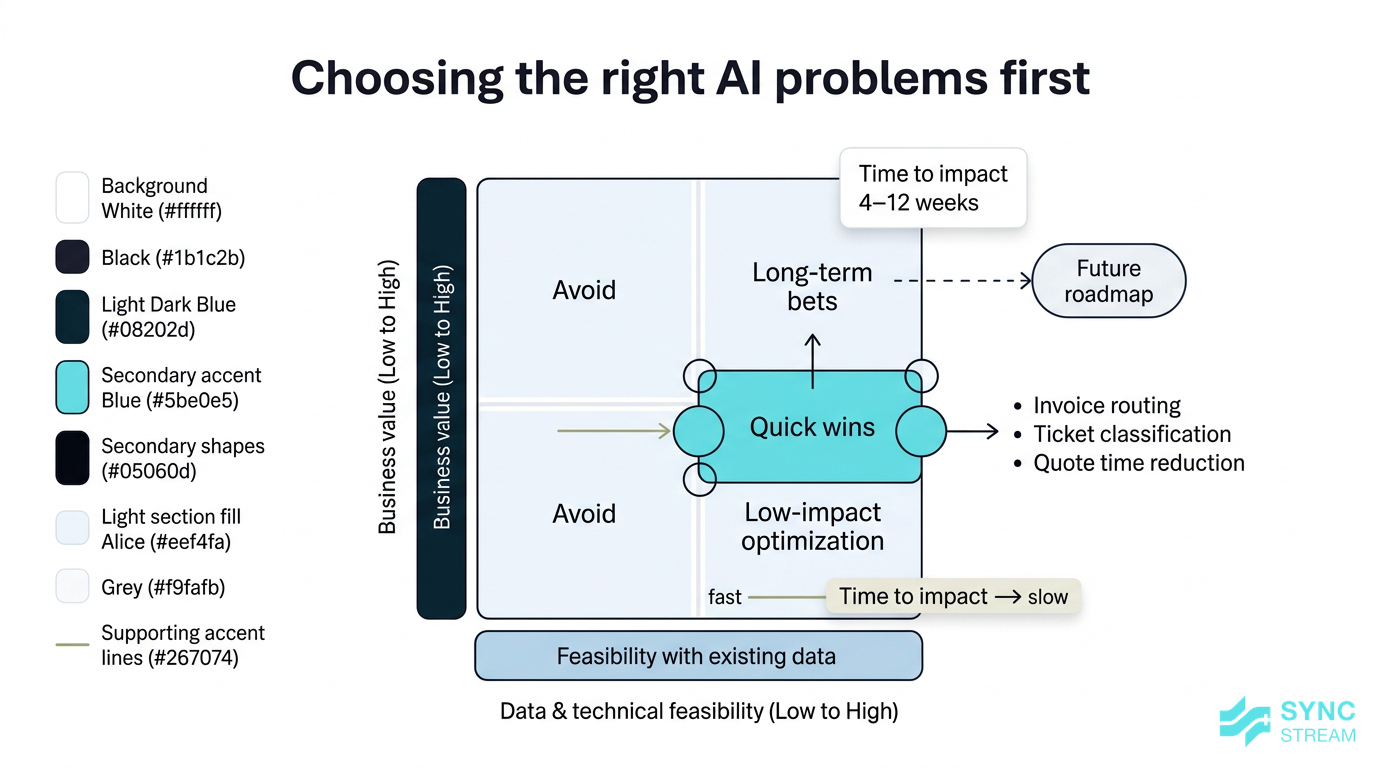
Matrix for choosing initial AI automation use cases based on business value, feasibility, and time to impact.
Implementation strategy
Choosing the right AI problems first
The most important decision is what you choose to automate first.
Aim for narrow, well‑defined use cases tied to clear outcomes, for example:
- Reduce average call or ticket handling time by 20%.
- Automatically classify and route 80% of incoming invoices or support emails.
- Cut quote preparation time from 2 days to 2 hours.
To choose good starting points:
- Map your friction points
- Input: List of your core processes (sales, operations, finance, customer service) and current pain points.
- Action: For each process, note where delays, manual double‑handling, or frequent errors occur; capture simple metrics (e.g., average handling time, error rate).
- Expected output: A shortlist of 5–10 high‑friction steps across the business.
- Check data readiness
- Input: For each shortlisted step, identify which systems hold the relevant data (e.g., CRM, job system, accounting, email).
- Action: With read‑only access where possible, confirm data exists in a structured form (fields, tables) and isn’t spread only across PDFs or free‑text emails.
- Expected output: A feasibility rating (low/medium/high) for each candidate use case.
- Estimate business value
- Input: Approximate volumes (tickets per week, invoices per month), average handling time, and staff hourly cost.
- Action: Roughly quantify the time and cost that could be saved or revenue protected if the step were automated or assisted.
- Expected output: A simple ranking of use cases by potential dollar impact.
Avoid jumping straight into ambitious, data‑hungry generative AI projects—like fully automated proposal writing or complex multi‑language bots—if your data quality, security, and governance are still immature. Start with:
- Repeatable workflows.
- Clearly defined inputs and outputs.
- Measurable financial impact.
A simple prioritisation lens you can use is:
- Business value: High vs low impact if it works.
- Feasibility with existing data: Data clean and accessible vs messy and manual.
- Time to impact: Can you see results in 4–12 weeks vs needing a year.
Pick 1–3 use cases that score well on all three.
Phased engagement with an outsourcing partner
A structured, phased approach reduces risk and keeps spend under control. A typical sequence is:
- Discovery and assessment
- Inputs: Problem statement, access to key stakeholders, read‑only access to systems, sample data.
- Actions:
- Run workshops to walk through current processes step‑by‑step.
- Map systems and integrations involved.
- Assess data availability, quality, and regulatory constraints.
- Expected outputs: Documented current‑state process, success metrics, risk register, and 1–3 prioritised solution options with ballpark costs.
- Pilot or proof‑of‑concept (PoC)
- Inputs: Agreed pilot scope, test data, non‑production environment or sandbox access.
- Actions:
- Design a minimal solution targeting a subset of users or volume.
- Implement workflows and integrations in a test or staging environment.
- Define acceptance criteria (performance, accuracy, stability).
- Expected outputs: Working prototype, architecture overview, pilot results vs acceptance criteria, updated cost and rollout plan.
- Limited rollout
- Inputs: Successful pilot, feedback from pilot users, production environment access.
- Actions:
- Deploy to one site, team, or product line.
- Capture edge cases and refine business rules.
- Train staff and update SOPs.
- Expected outputs: Stable production use for a limited group, updated documentation, training materials, and refined ROI estimates.
- Full deployment
- Inputs: Validated solution, agreed rollout plan, confirmed support arrangements.
- Actions:
- Roll out to all relevant teams or geographies.
- Implement monitoring, alerting, and backup procedures.
- Finalise access controls and governance routines.
- Expected outputs: Organisation‑wide deployment with documented operating procedures and clear ownership.
- Operate and optimise
- Inputs: Production metrics, user feedback, incident logs.
- Actions:
- Review performance at agreed intervals.
- Address issues, adjust thresholds, and refine logic.
- Prioritise and deliver incremental enhancements.
- Expected outputs: Regular performance reports, improvement roadmap, and a stable support and change‑management process.
Keep early phases small and time‑boxed. Validate ROI with a pilot before you sign a multi‑year engagement. Partners like Sync Stream typically scope engagements tightly around specific workflows and success metrics, then expand only once those are achieved.
Building a minimal in-house capability
Even if you outsource most of the work, you should retain internal ownership and capability.
Key steps:
- Appoint an internal product owner or project sponsor
- Inputs: Clear role description and time allocation.
- Actions:
- Nominate a person who understands the process and has authority to make decisions.
- Make them the single point of contact for the vendor and internal teams.
- Expected outputs: Named owner responsible for outcomes, approvals, and communication.
- Upskill a small group in data literacy and AI basics
- Inputs: Short training resources (internal or external), examples from your own data and workflows.
- Actions:
- Run brief sessions covering how data flows through your systems, basic AI concepts, and privacy/security basics.
- Encourage questions about limitations and risks, not just benefits.
- Expected outputs: A small internal group able to ask informed questions and spot unrealistic proposals.
- Insist on documentation and transparency
- Inputs: Vendor templates or your own standards for process maps, configuration docs, and access lists.
- Actions:
- Require up‑to‑date diagrams of workflows and integrations.
- Ensure configurations in tools like n8n are exported or otherwise accessible if needed.
- Keep a record of which models/APIs are in use and for what purpose.
- Expected outputs: A documentation pack you can use to onboard new staff, audit behaviour, or switch providers if required.
Documented systems make it far easier to switch providers or bring more work in‑house later. This is a core principle behind how Sync Stream works: every workflow is documented to reduce vendor lock‑in and ensure long‑term maintainability.
Options comparison
Cost: offshore vs hybrid vs local
From a pure rate perspective, offshore delivery can be much cheaper than Australian teams.
Typical local Australian AI rates:
- ~AUD $120–$600/hr, depending on seniority and specialisation.
Indicative offshore AI development rates in countries commonly used by Australian firms:
- Indonesia, Vietnam, Philippines: roughly USD $15–$55/hr across junior to senior roles.
In practice, this can mean 50–70% lower hourly costs for offshore work compared with fully local teams, even after accounting for currency.
Translating this into realistic SMB scenarios:
- A local pilot project might cost $50,000–$80,000 for a moderate‑complexity workflow automation, including discovery, build, and initial support.
- A similar scope delivered primarily offshore could be quoted at $20,000–$40,000, depending on complexity and how much senior design input is included.
However, lower hourly rates don’t automatically mean lower total cost. Rework due to miscommunication, underestimated data work, or poor integration can erase savings.
This is where hybrid models can be attractive:
- Keep local leadership for discovery, design, architecture, and governance.
- Push well‑specified build tasks to offshore teams, often achieving 50–70% savings on those components.
Partners like Sync Stream effectively operate as the local implementation and governance layer. Even when other delivery resources are involved, the business case, architecture, and integration into your existing systems are managed locally, helping you capture savings without losing control.

Framework linking Australian privacy and industry regulations to AI outsourcing data residency and governance decisions.
Data security and compliance considerations
Each outsourcing model handles data security and compliance differently, and this should weigh heavily for Australian SMBs.
- Local / onshore providers
- More likely to host data in Australian cloud regions and understand APPs and sector‑specific rules.
- Easier to conduct audits, review security practices, and ensure incident responses line up with local expectations.
- Offshore providers
- Data may move across borders, sometimes through multiple jurisdictions.
- You’ll need stronger contract terms on data residency, encryption, access controls, and subcontracting.
- Breach notification and legal recourse can be more complex.
- Hybrid models
- Often allow sensitive datasets to remain within Australia, while anonymised or synthetic data is used offshore where appropriate.
- Local leads can align technical design with your privacy impact assessments and industry rules.
Regardless of model, SMBs should insist on:
- Clear data‑handling policies – Where data is stored, how long, who can access it, and how it’s encrypted.
- Breach notification clauses – Timelines and responsibilities if something goes wrong.
- Access control and logging – Role‑based access, audit trails, and regular reviews.
- Options for keeping sensitive datasets onshore – For example, processing health or financial data only through Australian cloud regions or within your existing systems.
Sync Stream’s approach—working inside your current CRMs, accounting platforms, and operational tools—naturally supports tighter control over data residency and access, which you can use as a benchmark when assessing other AI outsourcing companies.
Communication, culture, and long-term fit
Cost and security are only part of the equation. Communication, culture, and long‑term alignment often determine whether a project succeeds.
- Time zones:
- Local teams can join workshops and incident calls during your workday.
- Offshore teams may require early‑morning or late‑evening calls; urgent issues can span multiple days.
- Language and cultural alignment:
- Local providers typically understand Australian customers, staff, and regulatory expectations.
- Offshore teams can be highly capable, but subtle miscommunications may lead to rework, especially around process nuances and risk tolerance.
- Collaboration practices: Before committing, discuss:
- Meeting cadence and who will attend.
- Documentation standards and tools.
- How prototypes are shared and reviewed.
- How changes and priorities are decided.
Long‑term success depends on alignment with your risk appetite and way of working, not just the lowest rate. A partner that:
- Understands your industry,
- Designs within your existing systems and constraints,
- And is willing to say “no” to low‑value ideas,
is usually worth more than a cheaper vendor who simply takes orders.
Common pitfalls
Underestimating scope and hidden costs
Many SMBs focus on the headline build quote and underestimate the full scope.
Areas often missed include:
- Data preparation (20–40% of budget) – Cleaning and restructuring data from email, spreadsheets, and legacy systems.
- Integration work – Connecting AI components to CRMs, accounting tools, job management systems, and internal databases.
- Infrastructure and cloud – Ongoing costs for AI APIs, compute, storage, and monitoring tools.
- Support and enhancements – Bug fixes, minor feature tweaks, and process changes post‑go‑live.
- Internal change management – Training staff, updating SOPs, managing role changes.
Use a simple total‑cost‑of‑ownership checklist when comparing proposals:
- Build and configuration hours
- Data preparation and pipelines
- Cloud and infrastructure usage
- Licences and third‑party APIs
- Ongoing support and maintenance
- Internal training and change management
Be cautious of fixed‑price quotes with vague scope. If requirements are not nailed down, you may face:
- Frequent change requests and extra fees.
- Delays as edge cases emerge late.
- Cut‑down functionality to keep within the original price.
Implementation‑driven partners will scope tightly, define assumptions clearly, and surface these costs early.
Weak governance and vendor oversight
Problems arise when no one inside the business truly owns the AI project. Common symptoms:
- Misaligned priorities between operations, IT, and the vendor.
- Accumulating technical debt—quick fixes instead of robust solutions.
- Models and workflows that no one understands well enough to trust or adjust.
To avoid this:
- Set clear KPIs and success metrics – For example, time saved per job, reduction in error rates, or improved response times.
- Define decision rights – Who can approve scope changes, accept deliverables, or pause the project.
- Create a regular review cadence – Monthly or fortnightly sessions to review progress, performance metrics, incidents, and upcoming changes.
Over‑delegating to a vendor without internal oversight can lead to black‑box systems that staff don’t trust or adopt. Partners like Sync Stream typically involve operational leaders throughout design and roll‑out so that governance is shared, not outsourced.
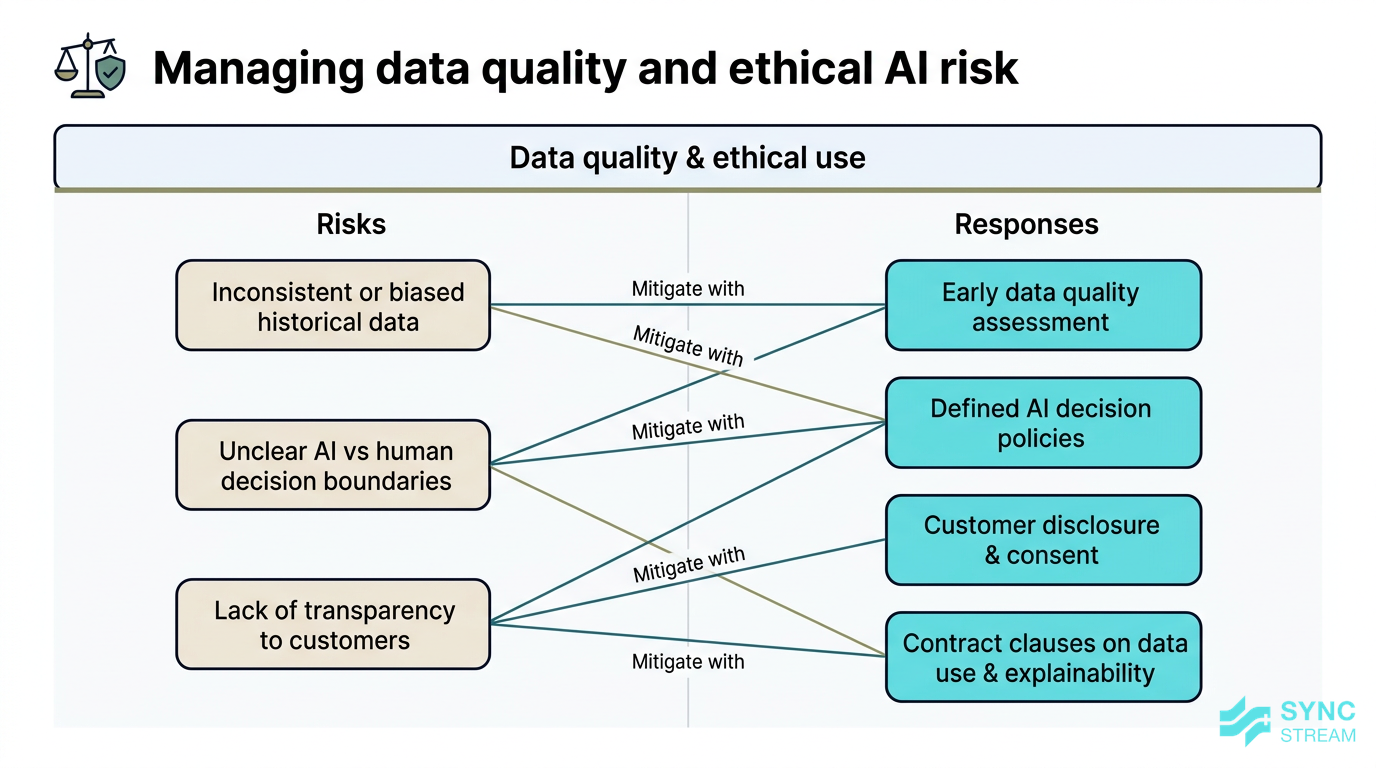
Overview of key data quality and ethical AI risks for SMBs and practical mitigation measures.
Ignoring data quality and ethical use
No matter how skilled your AI outsourcing company is, bad or biased data will produce unreliable outputs.
Key risks:
- Inconsistent or incomplete historical records.
- Bias in past decisions (e.g., which customers received discounts or approvals).
- Lack of clarity on when AI is allowed to make vs suggest decisions.
SMBs should think carefully about fairness and transparency, especially in:
- Hiring and HR processes.
- Credit or lending decisions.
- Healthcare triage or prioritisation.
Practical steps:
- Assess data quality early – Ask your provider to highlight gaps and risks instead of promising perfect accuracy.
- Be transparent with customers – Let them know when AI is used, particularly if it affects decisions about them.
- Include contract clauses about:
- How your data can and cannot be used (no unauthorised reuse or training of unrelated models).
- Requirements for model explainability where relevant.
- Clear incident‑response processes for data or model failures.
A grounded partner will address these topics upfront and design systems that support audits and explanations, not just speed.
Conclusion
For Australian SMBs, engaging AI outsourcing companies is often the only practical way to access advanced automation and decision‑support capabilities without building an expensive in‑house team. But choosing between offshore, hybrid, and local models isn’t just about chasing the lowest rate.
You need to weigh cost, regulatory obligations, data security, communication, and long‑term fit—and start with well‑defined problems that can show ROI quickly. A phased approach, minimal in‑house capability, and strong governance turn AI from a risky experiment into a dependable part of your operations.
Sync Stream specialises in implementing AI and automation on top of the systems you already use, with an emphasis on documented workflows, operational reliability, and clear commercial outcomes. If you’re evaluating AI outsourcing companies and want to compare options against a practical, implementation‑focused model, reach out to Sync Stream to scope a small, high‑impact project first—then scale from there.
FAQ
What is AI outsourcing in simple terms?
AI outsourcing means hiring external specialists to design, build, and maintain AI and automation solutions for your business instead of employing a permanent in‑house AI team. You keep ownership of your data and systems, while the provider handles the technical work.
How much does an AI project cost for an Australian SMB?
Basic projects often start around AUD $10,000–$30,000, with more involved, multi‑system automations ranging from $30,000–$100,000+ depending on complexity, data work, and compliance requirements. Ongoing cloud, licence, and support costs should also be budgeted.
Are offshore AI outsourcing companies safe for Australian data?
They can be, but you must pay close attention to where data is stored and processed, encryption, access controls, and contract terms for breach notification and data use. For sensitive data, many SMBs prefer local or hybrid models that keep critical datasets within Australia.
What’s the difference between local, offshore, and hybrid AI outsourcing?
Local models use Australian teams at Australian rates and usually provide the strongest alignment with regulations and culture. Offshore models use lower‑cost teams overseas, often reducing hourly rates by 50–70% but increasing communication and compliance complexity. Hybrid models combine local leadership with offshore delivery to balance cost savings with governance.
How do I choose the right AI use case to start with?
Look for narrow, repeatable processes with clear outcomes and decent data—such as invoice processing, ticket routing, or automating common customer queries. Prioritise use cases by business value, feasibility with existing data, and time to impact.
Do I still need internal expertise if I outsource AI?
Yes. You should appoint an internal owner for each project, upskill a few staff in data and AI basics, and insist on thorough documentation. This ensures you can govern the system, avoid vendor lock‑in, and switch providers or bring work in‑house later if needed.
How does Sync Stream fit into the AI outsourcing landscape?
Sync Stream is an Australian implementation partner focused on practical AI and automation inside existing business systems. We prioritise clear business cases, documented workflows, and long‑term reliability rather than hype or one‑off experiments, making us a benchmark for SMBs comparing AI outsourcing options.