

Introduction
If you run a small or medium business in Australia, you’ve probably been told you “need AI” — by software vendors, board members, or even your competitors.
But when you start looking for help, you quickly run into a new problem: what exactly does an artificial intelligence agency do in practice, and how is it different from your IT provider, CRM consultant, or accountant?
This article breaks down what an AI agency actually delivers day to day, how they typically work with Australian SMBs, where they add real value, and how to compare different options. We’ll also clear up common myths so you can decide whether you need advisory support, hands‑on implementation, or both.
Throughout, we’ll anchor the discussion in the realities of Australian businesses and show how implementation‑led partners like Sync Stream approach AI and automation work on top of your existing systems.
What is an Artificial Intelligence Agency
Defining an AI agency in plain terms
In plain language, an artificial intelligence agency is a specialist partner that helps businesses plan, build, and embed AI into day‑to‑day operations.
They don’t just "code bots" or play with new tools. A good AI agency:
- Understands your business model, margins, and operational constraints.
- Identifies where AI and automation can remove friction and errors.
- Designs and implements workflows, assistants, and integrations that your team can rely on.
This is very different from generic IT support or a traditional digital agency:
- IT support typically focuses on keeping networks, devices, and software running — backups, security patches, user accounts, hardware.
- Digital agencies usually focus on websites, branding, and marketing campaigns — ads, content, SEO, social media.
- AI agencies focus on data, automation, decision support, and generative AI to drive concrete business outcomes like faster quoting, fewer admin errors, or better demand forecasting.
In the Australian context, the ecosystem is now substantial, with hundreds of AI‑related firms and strong federal support via initiatives like the National AI Plan and the National Artificial Intelligence Centre (NAIC). Many of these firms position themselves as agencies that package consulting + implementation + ongoing optimisation rather than pure software or pure strategy.
An implementation‑oriented partner such as Sync Stream leans heavily into this “plan, build, embed” model: scoping solutions around ROI, working inside your current CRMs and accounting platforms, and documenting everything so you’re not locked into a single vendor.
How AI agencies typically work with SMBs
For Australian SMBs, AI engagements are usually tight and focused, not grand “AI transformation” programs.
A typical engagement flow looks like this:
- Discovery & use‑case identification
- Inputs: Owner/manager interviews, frontline staff input, current KPIs (response times, error rates, backlog volumes).
- Action: The artificial intelligence agency runs short workshops and interviews to understand how work actually gets done and where delays or errors appear. Together, you shortlist 1–3 high‑value problems such as:
- Customer enquiries piling up.
- Slow quote creation.
- Manual invoicing and reconciliations.
- Time‑consuming reporting.
- Expected output: A simple list of prioritised use cases with basic estimates of impact (e.g., hours per week, risk, customer impact).
- Data and systems assessment
- Inputs: Access (read‑only where possible) to CRMs, accounting platforms (Xero, MYOB), job management systems, email, and key spreadsheets.
- Action: The agency reviews how data is stored, what integrations exist, and any compliance requirements, then checks basic data quality and access constraints.
- Expected output: A short assessment outlining system dependencies, data readiness, and any blockers that must be fixed before implementation.
- Solution design
- Inputs: Prioritised use‑case list, systems assessment, business constraints (budget, timelines, risk appetite).
- Action: The agency sketches an end‑to‑end workflow for each chosen use case, defining:
- Which steps are automated.
- Where AI models are used.
- How information flows between systems.
- Where humans review, approve, or override.
- Expected output: A practical design document or diagram plus a short scope summary that can be costed and scheduled.
- Pilot / MVP build
- Inputs: Approved solution design, access to relevant tools and APIs, sample data and test scenarios from your team.
- Action: Instead of changing everything at once, the agency builds a small, self‑contained solution — for example:
- An AI‑enabled triage for customer emails.
- An assistant that drafts quotes inside your existing system.
- An automation that prepares weekly performance reports. They configure workflows, connect systems, and validate results with real but limited data.
- Expected output: A working pilot used by a small group, with agreed success metrics and a defined test period.
- Rollout & change management
- Inputs: Successful pilot results, refined workflows, feedback from pilot users.
- Action: The agency extends the solution to more staff, branches, or use cases. They:
- Deliver training sessions.
- Update SOPs and checklists.
- Set guardrails so staff know what AI can and cannot do.
- Expected output: The workflow becomes part of normal operations, with staff trained and documented processes updated.
- Monitoring & optimisation
- Inputs: Live usage data, KPIs (response times, error rates, throughput, margin impact), user feedback.
- Action: The agency tracks performance, investigates issues, and refines prompts, rules, and integrations.
- Expected output: Stable, reliable performance with incremental improvements and a clear view of ROI over time.
For SMBs, the important point is scope: good agencies keep things centred on a few high‑value use cases rather than abstract transformation programs. And they should speak business language first, technical second — discussing “cutting admin time on quoting by 40%” instead of “deploying a state‑of‑the‑art LLM.”
Partners like Sync Stream will also emphasise working within your existing tools — CRMs, accounting systems, operations software, and communication platforms — so your team doesn’t need to adopt a whole new tech stack just to get value from AI.
Why AI Agencies Matter for Australian SMBs
The opportunity for local businesses
AI is no longer experimental in Australia. Across recent studies, a majority of Australian businesses report using AI in some form, and generative AI tools are now common in day‑to‑day work.
For small and medium businesses, the opportunity is less about “cutting‑edge innovation” and more about doing everyday work better:
- Reducing manual admin: Automating data entry, document handling, email triage, job allocations, or invoice processing.
- Improving customer response times: Using AI‑assisted routing and drafting so customer enquiries, RFQs, and support tickets are answered faster, even outside normal hours.
- Better forecasting and planning: Turning the data you already have — jobs, sales, stock, invoices, service calls — into more accurate forecasts and margin visibility.
- Unlocking underused data: Many SMBs have years of information in CRMs, accounting platforms, and spreadsheets that never gets analysed. AI can surface patterns and exceptions in ways that are practical and accessible.
In sectors like trades, logistics, warehousing, and professional services, early adopters are already using these capabilities to outperform peers on both cost and service — often without adding headcount. They handle more work with the same team, make fewer errors, and give customers faster answers.
Implementation‑led agencies such as Sync Stream are specifically focused on this operational layer: turning high‑friction processes into reliable, documented workflows that protect margin while lifting service quality.
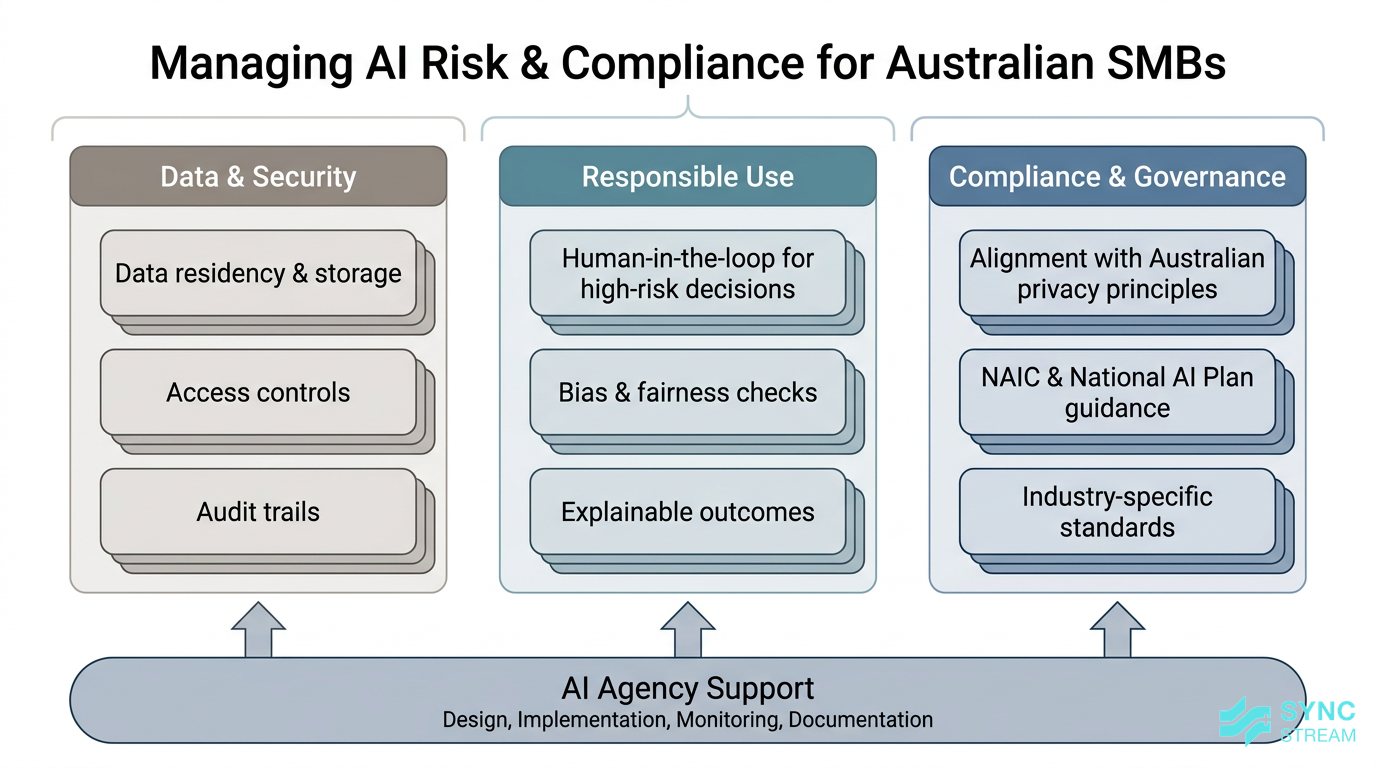
A simple governance framework showing how an AI agency manages data, risk, and compliance for Australian SMBs.
Navigating complexity, risk, and regulation
AI is powerful but not risk‑free. It frequently touches:
- Customer and employee data
- Financial records and commercial information
- Safety‑critical or compliance‑sensitive workflows in industries like construction, logistics, or healthcare
A capable AI agency helps you avoid misuse and reputational damage by:
- Designing workflows that keep sensitive data inside your existing systems where possible.
- Applying access controls and audit trails so you can see who did what and when.
- Ensuring humans stay in the loop for high‑risk or high‑value decisions.
In Australia, the National AI Plan and the National Artificial Intelligence Centre (NAIC) both emphasise responsible adoption. An agency that understands this landscape will align solutions with emerging guidance, privacy expectations, and consumer protections.
Key issues an AI agency should help you manage include:
- Data security: How data is stored, where models run, and what external services can access.
- Bias and fairness: Avoiding workflows that systematically disadvantage particular groups or give inconsistent outcomes.
- Explainability: Being able to explain how decisions or recommendations are generated — especially important for finance, HR, and compliance.
- Privacy and consumer expectations: Staying aligned with Australian privacy principles and what your customers would reasonably expect.
- Vendor lock‑in: Avoiding over‑dependence on a single platform or provider by documenting workflows and designing with portability in mind — something implementation partners like Sync Stream treat as a core deliverable.
When an SMB should consider AI help
You don’t need an AI agency just because everyone is talking about AI. But there are clear triggers that suggest it’s time to get help:
- Overwhelmed manual workflows: Staff constantly re‑keying data, chasing paperwork, or struggling to keep up with emails.
- Growing customer base without the ability to hire quickly: Demand is rising, but adding headcount is slow or too expensive.
- Lots of unused data: Years of jobs, invoices, or service history that never gets analysed or used to improve decisions.
- Pressure from the board or owners to “do something with AI”: But no one has time to figure out what that should actually mean.
Different situations call for different types of help:
- Advisory‑focused support is useful when you need:
- Clarity on which processes to tackle first.
- A roadmap and basic governance framework.
- Board‑level input on risks, opportunities, and investment levels.
- Implementation‑focused support is critical when you are ready to:
- Build chatbots or voice agents for customer enquiries.
- Automate workflows across your CRM, accounting, and operations tools.
- Deploy forecasting models or custom tools for specific tasks.
Often, SMBs need both — a short, sharp advisory phase that quickly flows into concrete builds. Throughout, it helps to avoid vague goals like “we need AI” and instead frame outcomes such as:
- “Cut support response times by 30%.”
- “Reduce invoice processing errors by half.”
- “Free two days per week of manager time from reporting.”
A good agency will help you refine and quantify these outcomes, then design solutions to meet them.
Key Components and Services
Strategic advisory and AI roadmapping
Strategic advisory is about answering three questions:
- Where does AI and automation actually make sense in your business?
- What is the potential return on investment?
- In what order should you tackle the opportunities?
In practice, advisory work usually includes:
- Reviewing key processes end‑to‑end (lead to quote, quote to cash, service scheduling, compliance reporting).
- Mapping out AI and automation opportunities in each process.
- Estimating potential ROI in terms of time saved, error reduction, and margin impact.
- Sequencing initiatives into a realistic roadmap that fits your cash flow and staffing.
For SMBs, this roadmap is typically a 3–12‑month plan, not a multi‑year enterprise transformation. You want tangible gains within a quarter or two, with the option to expand if results are strong.
Example:
During a review, an agency might discover that:
- Automating invoice processing (data extraction, coding, and approvals) could save 10–15 hours per week and reduce errors.
- Implementing lead qualification using AI‑assisted scoring in your CRM could help sales focus on the best opportunities.
These initiatives might deliver a faster payoff than chasing “advanced” predictive models that require more data, more change management, and longer lead times. Advisory helps you see that clearly before you invest.
Partners like Sync Stream use this advisory phase to ensure recommended initiatives are technically feasible inside your current systems and can be implemented without disrupting day‑to‑day operations.
Implementation, integration, and custom builds
Once you know what to build, the agency’s role shifts to implementation and integration.
Core implementation services often include:
- Setting up generative AI tools in controlled ways (for example, drafting emails, reports, or responses using your own templates and data).
- Building internal AI assistants or agents to help staff with repetitive cognitive tasks — summarising documents, preparing quotes, or pulling data from multiple systems.
- Integrating AI with CRM/ERP/accounting tools so that insights and automations live where your team already works.
- Automating document and email workflows, such as onboarding packs, contract reviews, or standard responses.
For most SMBs, the resulting systems are best thought of as AI‑enabled workflows rather than big‑bang custom algorithms. For example:
- AI triages support tickets into HubSpot and tags urgency.
- An automation reads incoming purchase orders from email, checks stock in your inventory system, and drafts confirmations.
- An assistant inside your operations tool suggests the most efficient job routing based on current data.
The integration into existing systems is critical. If AI sits off to the side in a separate portal, adoption collapses. Implementation‑led agencies like Sync Stream therefore:
- Work inside CRMs, accounting systems, and operations tools you already use.
- Design for real‑world constraints such as API limits, user permissions, and existing data structures.
- Treat change management — training staff, updating SOPs, and documenting workflows — as a core part of the project rather than an afterthought.
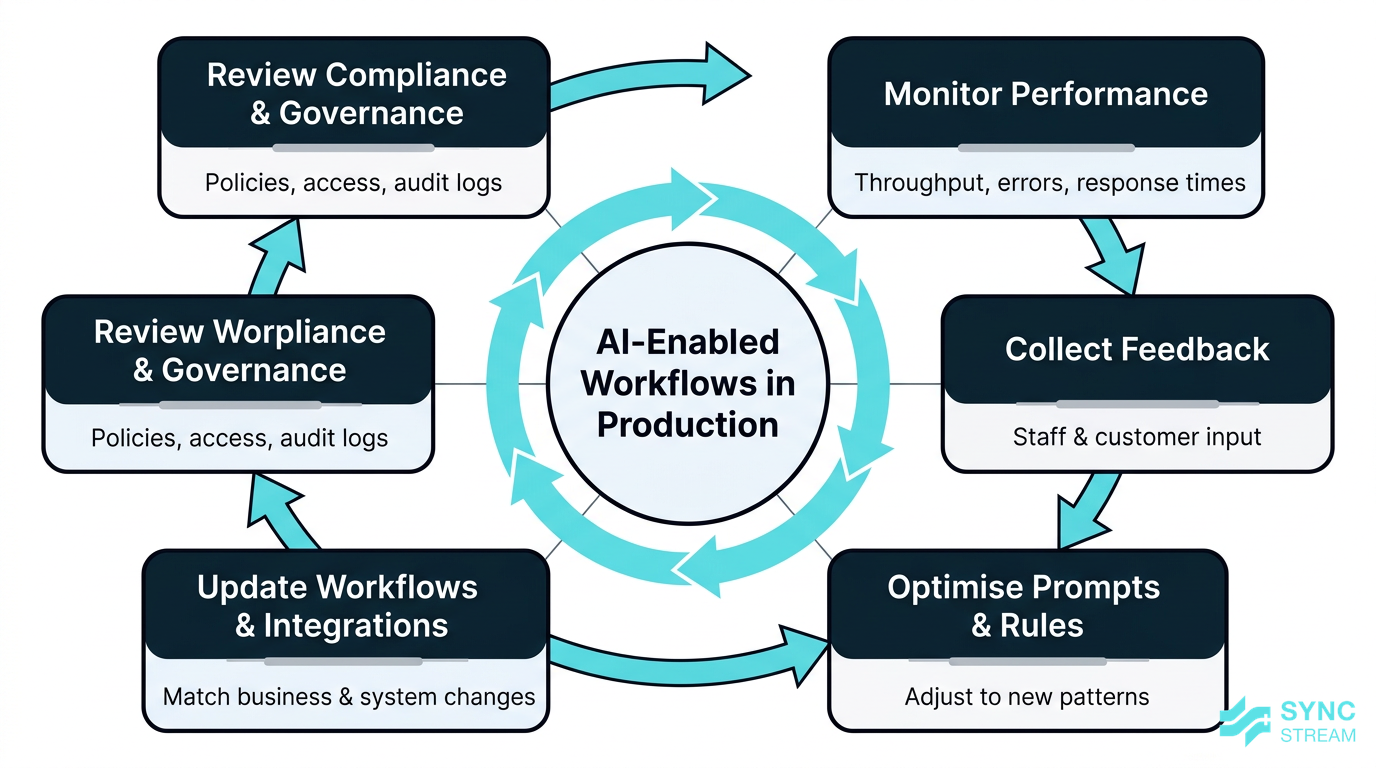
The continuous cycle of monitoring, optimisation, and governance that keeps AI-enabled workflows reliable over time.
Ongoing optimisation, support, and compliance
AI systems are not “set and forget.” Over time, your business rules change, data patterns shift, and AI models evolve. Without ongoing care, performance will drift.
Ongoing optimisation typically covers:
- Monitoring key metrics (throughput, error rates, response times, escalation rates).
- Updating prompts and rules as your business changes.
- Retraining or reconfiguring models when performance drops or new options become available.
- Adjusting automations when upstream systems (like your CRM) are updated.
For SMBs, it rarely makes sense to hire a full‑time in‑house AI team. Instead, many benefit from light‑touch retainers or periodic reviews with an agency that:
- Knows your systems and workflows.
- Can step in quickly when something breaks or needs tuning.
- Provides quarterly reviews to identify new optimisation opportunities.
Compliance and governance should also be part of this ongoing support. A capable agency will help you with:
- Clear documentation of what each AI workflow does, where it runs, and what data it touches.
- Defined model boundaries — what AI is and isn’t allowed to decide autonomously.
- Access controls so only the right people can trigger certain automations or access sensitive outputs.
- Alignment with Australian best‑practice resources such as NAIC guidance and industry‑specific standards.
For example, Sync Stream ensures every workflow is fully documented to support audits, reduce vendor lock‑in, and give you confidence about how AI is operating inside your business.
Implementation Strategy for Australian SMBs
Clarifying objectives and use cases first
The most common mistake is starting with tools — “Should we use this AI platform or that one?” — instead of starting with problems and outcomes.
A more effective approach for Australian SMBs is:
- Identify 1–3 concrete problems, such as:
- Customer service backlog and slow response times.
- Quote creation delays causing lost opportunities.
- Manual reporting eating hours at month‑end.
- Quantify the potential value:
- How many hours per week does this process take?
- What does that time cost in wages or missed opportunities?
- What is the impact of errors or delays on margin or customer satisfaction?
Even rough estimates (e.g., “10 hours per week of senior time at $X per hour”) can help prioritise.
- Express the opportunity in dollar terms where possible:
- Time saved × hourly cost.
- Fewer write‑offs due to errors.
- Extra jobs you could complete with the same team.
- Involve frontline staff early:
- Ask the people who do the work where they get stuck.
- Validate that proposed changes will actually help.
- Build buy‑in so adoption is smoother after rollout.
An AI agency can facilitate these discussions, but the insights come from your team. Implementation‑focused partners like Sync Stream will usually insist on this clarity before proposing specific tools.
From idea to pilot to rollout (numbered process)
A practical way to move from idea to impact is to follow a clear, staged process. A good AI agency will guide you through something like the following:
- Discovery
- Inputs: Key stakeholders, existing process maps (if any), current performance metrics.
- Action: Run workshops and interviews to understand processes, pain points, and business goals. Map out potential AI and automation use cases.
- Expected output: A prioritised list of candidate use cases with context and rough impact estimates.
- Data and systems check
- Inputs: Access to CRMs, accounting platforms, operations tools, and sample data.
- Action: Review data structures, integration options, and constraints (API limits, permissions, compliance).
- Expected output: A feasibility summary for each use case, highlighting quick wins vs items that need groundwork.
- Solution design
- Inputs: Agreed priorities, feasibility findings, budget and timeline constraints.
- Action: Design specific workflows, assistants, or automations. Define:
- Which systems are involved.
- Where AI is used.
- What human checks are required.
- Success metrics and rollout plan.
- Expected output: A concise design pack and implementation plan that can be signed off.
- Pilot / MVP (4–8 weeks where possible)
- Inputs: Approved design, pilot scope (team, site, or process subset), test data.
- Action: Build a limited version of the solution, connect it to live systems in a controlled way, and support the pilot team as they use it in real work.
- Expected output: A functioning pilot with measured performance against agreed success criteria.
- Training
- Inputs: Finalised workflow, pilot learnings, training materials.
- Action: Train staff on the new process, explain what AI is doing, and update SOPs and checklists.
- Expected output: Confident users who know when to rely on the system, when to escalate, and how to report issues.
- Scale‑up / rollout
- Inputs: Stable pilot, refined documentation, rollout schedule.
- Action: Extend to more users, branches, or use cases. Monitor closely and fine‑tune where needed.
- Expected output: Broad adoption of the new workflow with minimal disruption to day‑to‑day operations.
- Review and iterate
- Inputs: Post‑implementation metrics, user feedback, any incidents or edge cases.
- Action: Compare outcomes to targets, adjust workflows or prompts, and update the roadmap with next priorities.
- Expected output: A clear view of ROI and a list of next improvements or additional use cases.
A good agency will push for small pilots with tight success criteria before broader rollout. This limits risk and cost while giving you confidence that a particular approach actually works in your environment.
Working effectively with an AI agency
To get the most from an AI engagement, SMBs should treat the agency as a partner, not just a vendor. That means setting up the relationship for success from day one.
Key practices include:
- Nominate clear decision‑makers: Someone who can approve scope, make trade‑offs, and resolve internal disagreements.
- Provide timely feedback: Pilots and early builds only succeed if your team actually uses them and reports back.
- Ensure access to data and systems: Secure but practical access to CRMs, accounting tools, and operations platforms is essential.
- Be open to process change: Sometimes the right answer is to simplify a process before automating it.
It’s also smart to prepare a set of questions to ask potential AI agencies, such as:
- What experience do you have with businesses like ours (industry, size, systems)?
- How do you approach data security and privacy in the Australian context?
- How is intellectual property handled — who owns what is built?
- What happens if we decide to part ways — how is handover managed and what documentation will we receive?
From the outset, set expectations around:
- Communication cadence: Weekly stand‑ups during build, then monthly or quarterly reviews.
- Reporting: Clear metrics and simple reports on performance (e.g., hours saved, response times, error rates).
- Success measures: Shared understanding of what “good” looks like and how it will be tracked.
Implementation‑focused partners like Sync Stream typically formalise these expectations in the scoping phase, so everyone is aligned on outcomes, responsibilities, and how changes will be managed.
Comparing AI Agency Options
Advisory‑only vs implementation‑led partners
As you compare options, you’ll notice two broad models:
- Advisory‑only agencies
- Focus on strategy, audits, risk frameworks, and high‑level recommendations.
- Produce roadmaps, policies, and governance structures.
- Often engage at board or executive level.
- Implementation‑led agencies
- Design and build actual solutions: automations, AI assistants, integrations, and workflows.
- Typically combine light advisory with hands‑on delivery.
- Engage closely with operations, finance, and frontline teams.
When to choose which:
- Advisory‑only is suitable when you are at very early exploration stage, need to align a board or group of owners, or must establish a risk and governance framework before doing anything.
- Implementation‑led is more appropriate when you have clear use cases, operational pain, and a desire to move from talk to working systems relatively quickly.
Many SMBs benefit from a hybrid model, but it’s important to confirm that the same partner can move seamlessly from advice into delivery. Otherwise you risk being handed off to a third party that has to relearn your business from scratch.
Sync Stream positions squarely on the implementation‑led end of this spectrum — with enough advisory capability to shape a pragmatic roadmap, then a strong focus on actually building and documenting the workflows that roadmap describes.
Niche specialists vs generalist providers
Another choice is between niche specialists and generalist providers.
- Niche specialists typically focus on a particular industry (e.g., retail, healthcare, trades, marketing automation) or a narrow set of tools.
- Pros:
- Deep understanding of your industry’s systems, terminology, and regulations.
- Faster time‑to‑value because they’ve solved similar problems before.
- Cons:
- May be less flexible outside their standard patterns or platforms.
- Innovation may be constrained by the niche.
- Generalist providers work across sectors and toolsets.
- Pros:
- Broader perspective and cross‑industry ideas.
- More comfortable integrating with a wide range of platforms — from Xero and MYOB through to HubSpot, Salesforce, Shopify, or sector‑specific tools.
- Cons:
- May need more time to learn your specific regulations or legacy systems.
When selecting, consider factors such as:
- Industry knowledge: Have they worked with construction, field services, logistics, or whatever sector you operate in?
- Location and time zone: For Australian SMBs, being in or near your time zone can make a big difference to communication.
- Integration expertise: Can they work effectively with your core platforms (Xero, MYOB, HubSpot, job management tools, inventory systems, etc.)?
Sync Stream operates as a generalist in terms of tools but with a strong focus on service and operations‑heavy businesses such as construction, trades, maintenance, and logistics — combining cross‑industry technical depth with a clear understanding of operational realities.
Local Australian partners vs global vendors
You’ll also encounter a mix of local Australian partners and global vendors or platforms with built‑in AI features.
Benefits of choosing an Australian‑based AI partner include:
- Understanding of local regulations and expectations around privacy, workplace law, and consumer protections.
- Easier communication across time zones, including the option for in‑person workshops and on‑site visits where needed.
- Alignment with government initiatives such as the National AI Plan and NAIC guidance, which shape best practice in the local context.
- Clarity on data residency and where sensitive information is stored or processed.
Global vendors and platforms can provide powerful AI capabilities, but they typically:
- Focus on generic features that may not fit Australian SMB workflows out of the box.
- Offer limited support for bespoke integrations across your specific toolset.
- Are less attuned to local compliance nuances and contractual expectations under Australian law.
When weighing options, consider:
- Support responsiveness and how quickly you can speak to a real person who understands your setup.
- Contractual protections under Australian law, including data handling and liability.
- The ability to collaborate in real time and, where useful, run in‑person sessions.
Local implementation partners such as Sync Stream often work on top of global platforms, combining their capabilities with tailored workflows inside your existing Australian business systems.
Misconceptions and Common Mistakes
Myths about what AI agencies actually do
Several myths can get in the way of productive conversations with AI agencies:
- “They just sell chatbots.” While customer‑facing bots are one use case, a serious agency spends more time on back‑office workflows, integrations, and decision support than on novelty chat interfaces.
- “AI is only for large enterprises.” In reality, many of the highest‑ROI use cases are in small and medium businesses that have lots of repetitive admin and limited ability to keep adding staff.
- “You can set and forget AI systems.” AI needs monitoring, tuning, and governance like any other operational system. Business rules change, data changes, and models evolve.
Another common fear is that AI will automatically replace staff. In practice, SMBs that adopt AI well usually:
- Automate routine, repetitive tasks.
- Redeploy staff to higher‑value activities like customer relationships, quality control, or process improvement.
- Create more interesting roles, with people overseeing and improving workflows rather than just pushing data around.
Agencies that focus on implementation and operational reliability, such as Sync Stream, explicitly design systems to support staff and protect margins rather than to hollow out teams.
Overbuying tools and underinvesting in process
A widespread mistake is to sign up for multiple AI‑branded tools — often encouraged by software vendors — without a clear workflow design or change plan.
This leads to:
- Shelfware: tools that barely get used.
- Confusion: staff unsure which tool to use for what.
- Fragmentation: data scattered across yet more systems.
A more sustainable approach is:
- Streamline the underlying process first. Map the steps, remove unnecessary hand‑offs, and standardise where possible.
- Select the minimum toolset needed. Often you can extend existing platforms (like your CRM or accounting system) rather than buying something new.
- Integrate tools into daily operations. Make sure automations run where work already happens and are documented in SOPs.
For example, documenting a sales or service process might reveal that a simple automation between your website forms, CRM, and quoting tool — with some light AI to enrich and prioritise leads — delivers most of the value you were hoping to get from a more complex (and expensive) AI platform.
Implementation‑led agencies like Sync Stream specialise in this kind of process‑first, tools‑second approach.

The three foundational pillars—data quality, governance, and people—that underpin reliable AI use in SMBs.
Ignoring data quality, governance, and people
Many SMBs have:
- Inconsistent data entry across teams or branches.
- Duplicate customer records in different systems.
- Important information stored in email threads or personal spreadsheets.
If you roll out AI on top of this messy data, you risk bad decisions, unreliable outputs, and low trust from staff.
A responsible AI agency will help you:
- Improve data quality where it matters most for your chosen use cases.
- Define governance: who can use which AI systems, with what data, under what rules.
- Provide training so staff understand both the capabilities and limits of AI.
Without clear policies and communication, employees may start using ad‑hoc AI tools on their own — pasting sensitive data into public services or bypassing official workflows. This creates real security and compliance risks.
By contrast, a structured engagement with an agency like Sync Stream includes documentation, guardrails, and training that channel experimentation into safe, approved systems.
Conclusion
AI is already part of how many Australian businesses operate, but the real opportunity for SMBs lies in practical, well‑designed workflows rather than chasing the latest hype.
An artificial intelligence agency can help you:
- Clarify where AI and automation can genuinely improve your operations.
- Design and implement solutions inside your existing systems.
- Manage risk, governance, and ongoing optimisation so gains are durable.
As you evaluate options, think less about labels and more about fit:
- Do they understand businesses like yours and talk in commercial terms?
- Can they move from advisory conversations into real, working implementations?
- Will they document workflows, minimise lock‑in, and support you over time?
If you’re an Australian SMB with high‑friction processes and pressure to do more with the same team, now is the time to explore targeted AI and automation.
Ready to see what this could look like in your own CRM, accounting, or operations tools? Sync Stream designs and implements AI‑enabled workflows on top of your existing systems, with clear business cases, documentation, and operational reliability at the core.
FAQ
What does an artificial intelligence agency actually do for an SMB?
An AI agency helps you identify high‑value use cases, then designs and implements AI‑enabled workflows, assistants, and integrations inside your existing systems. They also provide training, documentation, and ongoing optimisation so solutions stay reliable as your business evolves.
How is an AI agency different from my IT provider or digital agency?
IT providers focus on infrastructure and support; digital agencies focus on marketing and creative. An AI agency focuses on data, automation, decision support, and generative AI tied directly to operational outcomes like faster quoting, fewer admin errors, and better margin visibility.
When is the right time for a small or medium business to engage an AI agency?
It’s worth talking to an agency when manual workflows are straining your team, you have growing demand without the ability to keep hiring, or you’re under pressure to “do something with AI” but lack internal capacity to design and implement solutions.
Do I need advisory help, implementation help, or both?
If you’re unclear where to start, a short advisory engagement can help prioritise use cases and define a roadmap. Once you have clear targets, you’ll need implementation support to actually build, integrate, and embed solutions. Many SMBs benefit from working with a partner who can do both.
Is AI only suitable for large enterprises with big budgets?
No. Some of the best returns come from relatively small, focused projects in SMBs — for example, automating invoice processing, quote preparation, or reporting. These can often be delivered within weeks using your existing tools, with investment sized to your cash flow.
How long does it take to see value from an AI project?
For well‑scoped SMB projects, pilots often run for 4–8 weeks, with early benefits visible soon after rollout. Larger or more complex initiatives may take longer, but the aim should be to achieve tangible wins within a quarter.
What should I ask an AI agency before engaging them?
Ask about their experience with businesses like yours, how they handle security and privacy in Australia, what documentation and handover you receive, and how they measure success. Also clarify whether they work inside your existing systems and how they avoid locking you into specific tools.
Will AI replace my staff?
AI is more likely to change roles than eliminate them outright. In most SMBs, AI is used to automate repetitive tasks so staff can focus on customer relationships, quality, and higher‑value work. A responsible agency will design systems to support and augment your team, not replace them wholesale.