
Introduction
If you run a small or medium business in Australia, you are probably being pitched by artificial intelligence consulting companies, software vendors, and automation specialists claiming they can transform your operations.
The reality on the ground is more practical: you want fewer manual errors, faster turnaround times, clearer visibility on jobs and cash flow, and tools your team will actually use. And you want to know which type of partner can help you get there without burning budget on slide decks.
This guide walks through the differences between AI consulting firms and automation implementation agencies, the main service and pricing models you’ll encounter, and how to assess a provider’s real delivery capability—not just their marketing. It’s written for Australian SMB owners and directors who want tangible operational outcomes from AI and automation.
What AI consulting companies do
Defining AI consulting for SMBs
For most SMBs, AI consulting simply means bringing in expert help to identify, design, and embed AI and automation to solve concrete business problems.
Instead of talking about abstract "transformation", good consultants focus on questions like:
- How do we reduce manual admin in finance, scheduling, or customer service?
- Where are errors costing us rework or write-offs?
- How can we use data to improve forecasting or margins?
- Can we personalise quotes, follow-ups, or service updates without adding headcount?
Typical scope for an SMB engagement with an AI consulting company includes:
- Discovery workshops with owners and key staff to map processes and pain points.
- Opportunity assessment to shortlist use cases with the best ROI.
- Data assessment to understand where your data sits, how clean it is, and what’s feasible.
- Solution design: high-level architecture, process changes, and which systems are involved.
- Vendor and tool selection (e.g., which workflow platform, CRM add-ons, or AI services).
- Oversight of implementation, coordinating internal IT and external builders.
- Training and enablement so staff know how to use and support the new workflows.
Capabilities vary a lot, from strategy boutiques to niche technical specialists, which is why it helps to be clear on what you actually need.
Consultants vs automation implementation agencies
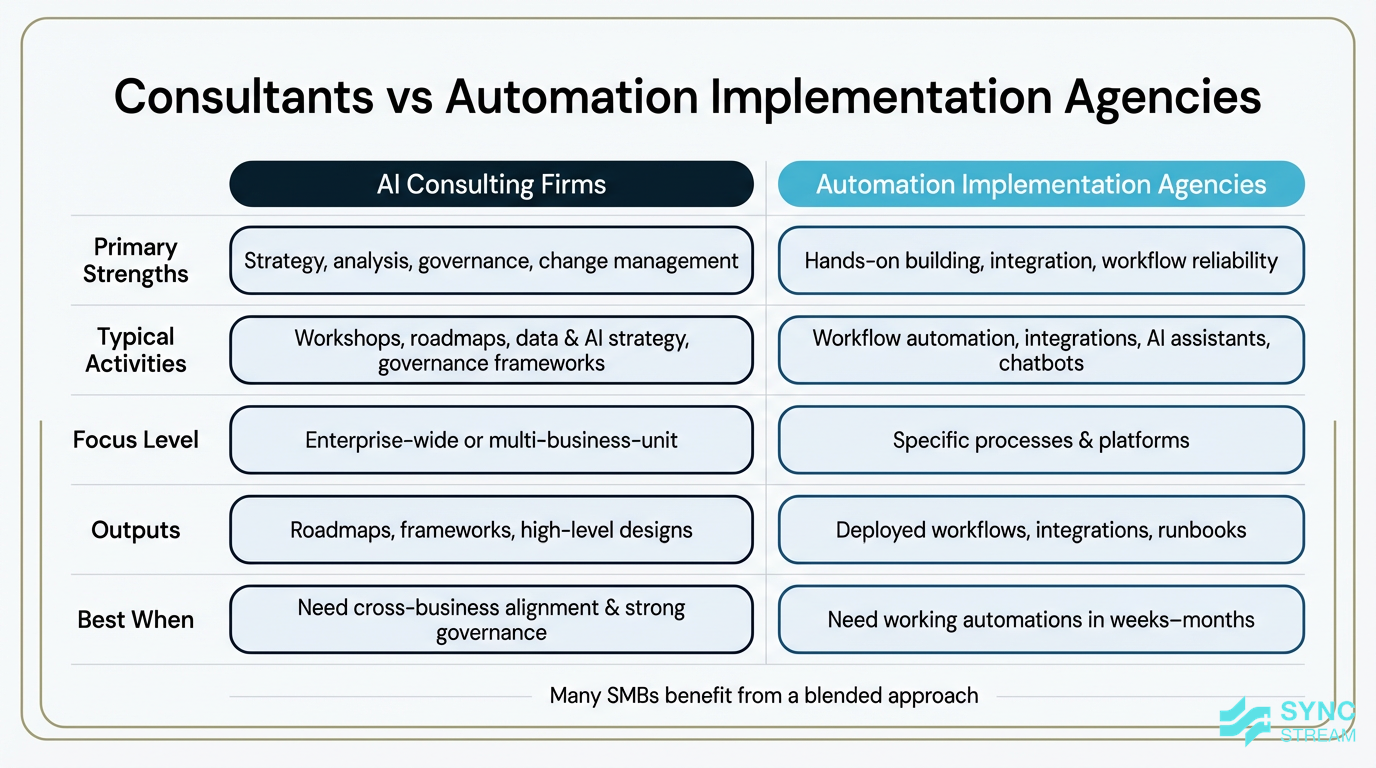
Broadly, you’ll encounter two types of partners:
- AI consulting firms
- Strengths: strategy, analysis, stakeholder workshops, governance, and change management.
- Often lighter on hands-on building and integration.
- Automation implementation agencies
- Strengths: actually building and integrating workflows using tools like workflow orchestrators (e.g., n8n), RPA, APIs, low-code/no-code, and CRM/ERP automation.
- Often more focused on specific processes and platforms than enterprise-wide strategy.
Concrete examples:
- An AI consulting firm might:
- Run a series of workshops and deliver a 12–24 month AI roadmap for your business.
- Design a data strategy for how finance, operations, and sales data will be integrated.
- Develop a governance framework for AI use in a regulated environment.
- An automation implementation agency like Sync Stream might:
- Build an invoicing automation that pulls job data from your field app, generates invoices in Xero or MYOB, and emails customers automatically.
- Create CRM workflows in HubSpot or Dynamics to chase quotes, follow up leads, and update status without manual entry.
- Implement an AI assistant that summarises job notes or customer emails directly inside your existing tools.
Many SMBs actually need a blend of thinking and doing. A common hybrid model is:
- A consultant or strategy-led team runs discovery and design.
- An automation-focused team (often the same firm or a partner like Sync Stream) builds, integrates, and maintains the solutions.
When you talk to providers, always ask who will physically build and support the workflows after the strategy work is done—and confirm their experience with the systems you already use.
Why this matters for Australian SMBs
Snapshot of Australia’s AI services market
Those same government figures—around 544 AI companies with roughly 240 consulting-focused—highlight how crowded and confusing the market is for a business owner just trying to get a few key processes under control.
At the same time, several forces are pushing AI and automation up the agenda:
- Government initiatives and grants encouraging digital adoption.
- Competitive pressure, especially in trades, logistics, and professional services where faster quoting and response times win work.
- Rising labour costs and talent shortages, making it harder to scale with people alone.
For Australian businesses, there are also local considerations when selecting partners:
- Data residency: where your data is stored and processed (onshore vs offshore).
- Privacy law: compliance with the Privacy Act and Australian Privacy Principles (APPs).
- Industry regulators: ASIC, APRA, and sector-specific rules if you operate in regulated industries.
- The value of local domain expertise—a partner who understands GST, Australian employment practices, and how your industry actually works—versus purely offshore providers.
Any shortlist of artificial intelligence consulting companies should be filtered through these local lenses, not just global credentials.
Business problems external partners can solve

A hierarchy linking typical SMB business problems to AI and automation solutions and the operational outcomes they drive.
AI consulting firms and automation agencies add the most value where there is repeatable work and clear business impact, for example:
- Streamlining repetitive admin in finance, HR, dispatch, or customer service.
- Improving customer response times via triage, templates, and smart routing.
- Better demand and capacity forecasting using your existing operational data.
- Reducing errors in data entry, invoicing, compliance checks, and stock movements.
- Turning scattered data into usable insights for margin control and planning.
Their work is most effective when it starts from business outcomes, such as:
- "Cut quote turnaround time from 3 days to 24 hours."
- "Reduce invoice errors by half."
- "Increase revenue per employee by 10% without extra headcount."
Two quick mini-scenarios:
- Trade services business: A plumbing or electrical firm links its job management tool to accounting and scheduling. An automation partner like Sync Stream designs a workflow so new jobs auto-create tasks, update technician calendars, generate invoices, and send SMS updates—saving minutes on every job.
- Professional services firm: A legal or accounting practice uses an AI assistant to summarise long documents and emails and pre-populate file notes in their practice management system, so staff spend more time on higher-value work.
Core service models on offer
Typical engagement and delivery models
You’ll typically see four main service models:
- Strategy-only advisory
- What you receive: workshops, process maps, an AI/automation roadmap, high-level solution designs, and governance recommendations.
- Length: usually 4–6 weeks for SMB-scale work.
- Best when: you need clarity and alignment before committing to build.
- Project-based design + build
- What you receive: detailed solution design plus working automations in production for defined processes (e.g., quote-to-invoice, onboarding, job scheduling).
- Length: from a few weeks to several months, depending on scope and integrations.
- Best when: you want specific workflows automated with clear boundaries.
- End-to-end delivery (strategy, build, change, training)
- What you receive: discovery and roadmap through design, build, testing, training, and early support.
- Length: typically multi-month programs broken into phases.
- Best when: several processes or teams are in scope and you want one accountable partner.
- Ongoing “managed AI/automation” services
- What you receive: monitoring of automations, small enhancements, issue resolution, and periodic reviews of new opportunities.
- Length: ongoing retainer, usually month-to-month or 6–12 month terms.
- Best when: you already have automations in place and want them stable and improving.
When meeting providers, explain:
- What internal skills you already have (IT, analysts, process owners).
- Whether you want mostly strategy, mostly build, or an end-to-end approach.
Then ask them to shape their model accordingly.
How pricing usually works for SMBs
Pricing models you’re likely to see include:
- Time-and-materials (T&M) / day rates
- You pay for actual hours or days worked.
- Pros: flexible when scope is unclear; easy to adjust.
- Cons: harder to predict total cost; needs active oversight.
- Fixed-price packages
- Examples: "AI readiness assessment" or a defined workflow build.
- Pros: clearer cost for a well-defined outcome; easier for budgeting.
- Cons: tight scope; changes usually add cost.
- Retainers for ongoing optimisation and support
- A set monthly fee for monitoring, tweaks, and incremental improvements.
- Pros: predictable spend; keeps systems from drifting.
- Cons: you need enough work to justify the ongoing cost.
- Outcome-based or gainshare models (less common for SMBs)
- Fees linked to savings or revenue impact.
- Pros: shared risk and strong alignment.
- Cons: complex to measure and contract; usually for larger, very clear-cut use cases.
Indicative ranges for Australian SMB contexts (very general, not quotes):
- Discovery and assessment: often in the low five figures, depending on number of processes and sites.
- Smaller, well-bounded automation builds (one or two workflows integrating a few systems): often mid–five figures+, with complexity pushing costs upward.
When reviewing quotes from artificial intelligence consulting companies or automation agencies, look for:
- Clear scope and assumptions: what is in, what is out.
- Exclusions: software licences, infrastructure, data cleanup, and internal change effort.
- Milestone-based billing tied to tangible deliverables.
- A defined change process so you know how new ideas or scope increases will be handled.
Practical implementation approach with a partner
Confirming your use cases and data readiness
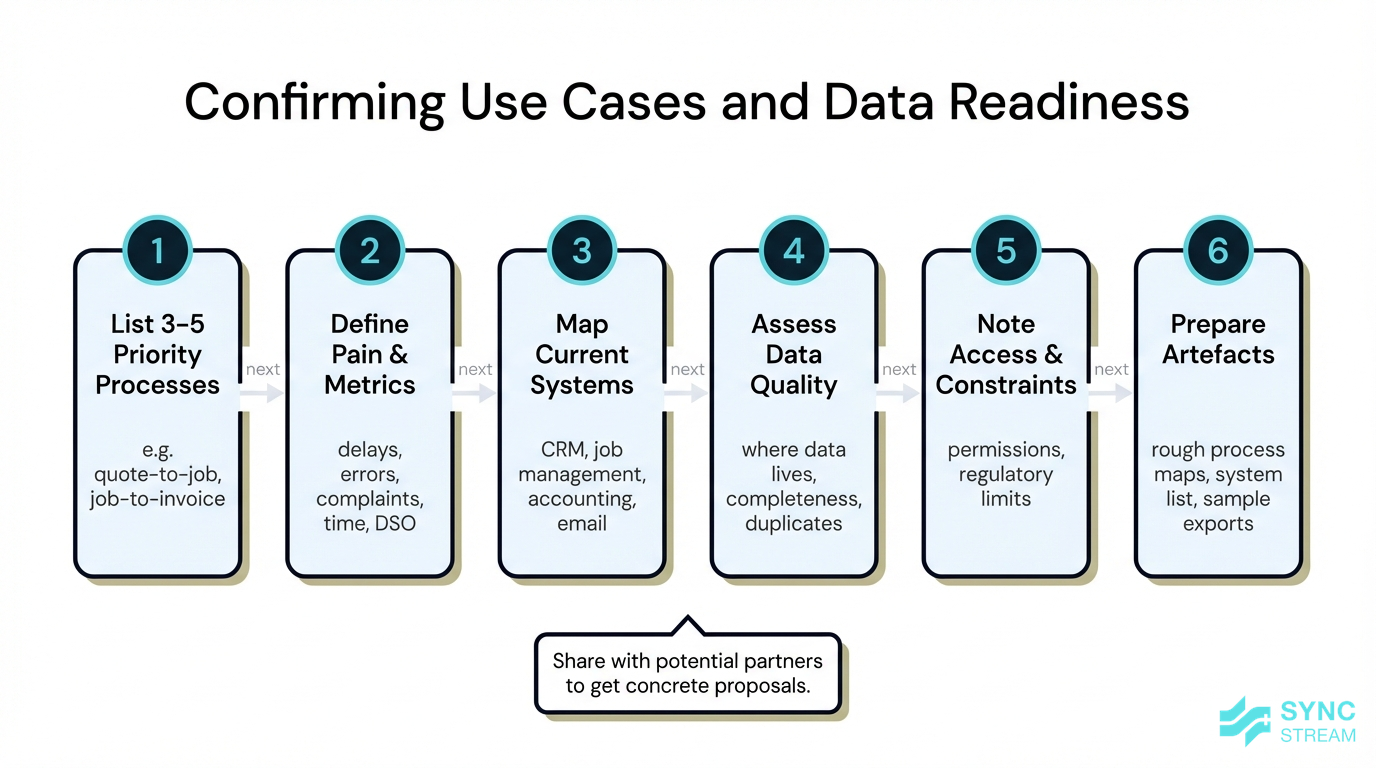
A step-by-step process for SMBs to clarify priority use cases and assess data readiness ahead of an AI or automation engagement.
Before you engage any partner, come in with 3–5 priority use cases, each tied to a clear metric. A simple, practical sequence:
- List 3–5 priority processes
- Inputs: knowledge of day-to-day operations.
- Action: write down processes such as "quote-to-job", "job-to-invoice", "customer support triage".
- Output: shortlist of processes you want to improve first.
- Define pain and metrics for each
- Inputs: complaints from staff/customers, reports, gut feel.
- Action: for each process, note main pain (delays, errors, overtime, rework) and 1–2 metrics (e.g., processing time, error rate, days sales outstanding).
- Output: 1-page summary linking pains to numbers.
- Map current systems involved
- Inputs: your app list and logins.
- Action: jot down which systems touch each process (CRM, job management, accounting, email, spreadsheets).
- Output: simple system map per process.
- Assess basic data quality
- Inputs: a few exports or screenshots.
- Action: check if key fields are filled in, how often there are duplicates or missing data.
- Output: short note: "data mostly clean / messy / paper-heavy".
- Note access and constraints
- Inputs: your security and compliance requirements.
- Action: record who can access what, any client or regulatory limits (e.g., data must stay in Australia).
- Output: a short constraints list to share with partners.
- Prepare artefacts
- Inputs: the notes above.
- Action: turn them into a simple pack: rough process maps, system list, sample exports with sensitive data removed.
- Output: a starter bundle you can send to potential partners so proposals are concrete, not generic.
Firms like Sync Stream can then move faster and give a more accurate proposal.
From discovery to rollout: an engagement sequence
A healthy engagement with an AI consulting or automation partner typically follows this sequence:
- Initial scoping call
- Inputs: your priority processes and metrics.
- Actions: discuss goals, constraints, and fit.
- Expected outputs: a brief summary of fit, proposed discovery scope, and indicative budget range.
- Paid discovery / assessment
- Inputs: access to process owners, sample data, system list.
- Actions: workshops, process walkthroughs, system and data review.
- Expected outputs: problem statements, success metrics, current-state process maps, and a prioritised opportunity list.
- Solution design and prioritised backlog
- Inputs: discovery findings and constraints.
- Actions: design target workflows and architecture, clarify security and governance.
- Expected outputs: simple diagrams, clear workflow descriptions, and a prioritised backlog of automations/features.
- Pilot or proof-of-concept (POC)
- Inputs: agreed scope for a narrow but meaningful slice.
- Actions: build a small solution using real (or realistic) data; run it with a subset of users.
- Expected outputs: working pilot plus short results summary against your metrics.
- Full build and integration
- Inputs: validated pilot design and backlog.
- Actions: expand coverage, harden integrations and error handling, tune performance.
- Expected outputs: production-ready workflows, integrated with your systems, and updated process documentation.
- Testing and training
- Inputs: nearly finished solution and test cases.
- Actions: run structured tests, fix issues, train staff in how the new workflows operate.
- Expected outputs: test results, user guides, and trained staff who can use the system.
- Go-live plus post-launch optimisation
- Inputs: sign-off from key stakeholders.
- Actions: deploy to production, monitor closely, adjust based on real usage.
- Expected outputs: stable live workflows and a short improvement backlog for the next phase.
Key checkpoint decisions:
- After discovery: has the partner understood your business and produced usable artefacts in plain language?
- After pilot: did you see enough real-world benefit to justify scale-up, and did the team communicate and document well?
Partners like Sync Stream put strong emphasis on documentation and maintainability at each stage, so you avoid dependence on a single vendor or developer.
Comparing your partner options
When to prefer an AI consulting firm
A more traditional AI consulting company is often the better fit when:
- You’re planning a complex, multi-year transformation across several business units.
- Regulatory or governance concerns (privacy, ethics, auditability) are the main bottleneck.
- You need a cross-business-unit strategy and strong leadership alignment before you touch systems.
- The biggest issues are change management and stakeholder buy-in, not technology.
In these cases, look for consulting partners with:
- Deep industry expertise in your sector and size band, not just enterprise stories.
- Proven frameworks for AI and data strategy you can see in sample deliverables.
- Strong facilitation and communication skills with non-technical executives.
- Robust risk, privacy, and ethical AI practices aligned to Australian regulations.
Always verify that they have concrete case studies with similar-sized Australian clients, not just global logos, and that there is a clear, tested way for their strategy work to flow into real implementation.
When an automation-focused agency is a better fit
An automation implementation agency is often ideal when:
- You have clearly defined repetitive processes that chew up staff time.
- Your priority is quick-win productivity gains, not a long strategy phase.
- You want something working in weeks or a few months, even if the bigger picture evolves later.
Traits of strong automation partners include:
- Deep proficiency with specific platforms such as workflow tools (e.g., n8n), CRM/ERP automation, and integration platforms.
- Solid integration experience with common Australian SMB systems (Xero, MYOB, Reckon, HubSpot, Salesforce, Microsoft 365, job management tools, etc.).
- A track record of deploying and supporting live automations—not just prototypes.
- Clear documentation so workflows are understandable and maintainable.
Many Australian SMBs benefit from starting with an automation-heavy partner like Sync Stream to deliver tangible early wins, then layering a broader AI and analytics strategy on top once value is proven and internal buy-in grows.
Issues to watch when choosing providers
Common mistakes SMBs make in selection
Frequent pitfalls when choosing artificial intelligence consulting companies or automation partners include:
- Choosing based on brand or size alone, rather than fit for your scale and systems.
- Being swayed by glossy "AI labs" or innovation centres without checking real delivery.
- Buying a big roadmap or strategy without reserving budget to implement it.
- Underestimating the internal time required from subject-matter experts and process owners.
To avoid these traps, assess:
- Expertise in your specific industry and business model.
- Ability to provide or coordinate end-to-end service.
- Client portfolio and detailed case studies, ideally including Australian SMBs.
- Adherence to Australian privacy law and ethical AI guidelines.
- A clear plan to move from pilot to stable operations and support, not just a one-off project.
Insist that any proposal includes a path from experiment to production and ongoing support so you don’t end up with impressive demos that never make it into daily operations.
How to look beyond slide decks and demos

A practical evaluation flow showing how SMBs can look past marketing materials to assess real delivery capability.
To properly assess a provider’s real capability, move beyond sales material with a simple evaluation flow:
- Request real system walkthroughs Ask for a live or recorded tour of solutions they’ve built (with data masked), not just slide screenshots.
- Review actual deliverables Look at examples of roadmaps, process documentation, training materials, and runbooks. Check if you could understand and use them in your business.
- Speak to reference clients Talk to 1–2 clients of similar size and industry about reliability, communication, and support.
- Probe the delivery team Ask who will actually do the work, what similar projects they’ve delivered, and how they handle issues.
- Test via a small paid pilot or discovery Use this as a low-risk test drive of communication, responsiveness, and documentation quality.
- Agree success metrics and what happens if they’re missed Clarify how outcomes will be measured, how often you’ll review progress, and how the approach changes if results aren’t on track.
Providers like Sync Stream welcome this approach because it focuses on practical, maintainable implementation over hype.
Conclusion
Choosing between artificial intelligence consulting companies and automation implementation agencies comes down to your stage, priorities, and internal capacity.
If you need cross-business alignment, governance, and a long-term roadmap, a strategy-led consulting firm may be the right starting point—as long as you have a clear path to implementation. If your priority is to see real workflows automated inside your CRM, accounting, or operations tools in the near term, an automation-focused partner is often the better choice.
Whichever route you take, anchor everything in business outcomes, data reality, and delivery capability. Ask to see how ideas turn into working systems, how they will be supported, and how results will be measured.
If you’re an Australian SMB that wants to move from AI talk to reliable, documented automations inside your existing systems, Sync Stream can help you scope, build, and support those workflows with clear commercial intent.
FAQ
How do I know if my business is ready to work with an AI or automation partner?
You’re ready when you can name a few specific processes that are causing pain (e.g., invoicing, scheduling, customer queries) and you have basic digital systems in place (CRM, accounting, job management). You don’t need perfect data—good partners will help—but you do need leadership commitment and a willingness to adjust processes.
Do I need a full AI strategy before I start automating anything?
Not always. Many Australian SMBs get better results by starting with a few well-chosen, high-impact automations and using the learnings to shape a broader strategy later. A lightweight roadmap focused on the next 6–12 months is usually enough.
What internal resources will my team need to commit?
Expect to involve a business owner or senior manager as sponsor, plus process owners from finance, operations, or customer service. They’ll need to join workshops, review designs, and test solutions. The better access your partner has to the people who understand day-to-day work, the more effective the outcomes.
Can automation and AI work with my existing systems, or do I need to replace them?
Most modern automation approaches, including those used by Sync Stream, are designed to sit on top of your current systems via APIs, integrations, and workflow tools. In many cases you can achieve significant gains without changing core platforms. Replacement is only necessary when your existing tools can’t support required processes or integrations.
How long does it usually take to see value from an AI or automation project?
For well-scoped, process-focused work, SMBs often see tangible benefits within a few weeks to a few months of starting a project—particularly if you begin with a narrow, high-impact use case. Larger, cross-business programs take longer, but you should still look for staged delivery with value at each phase.
Is AI safe from a privacy and compliance perspective for Australian SMBs?
It can be, provided you and your partner design systems with privacy and compliance in mind from the start. That includes understanding where data is stored, applying the Privacy Act and APPs, limiting access appropriately, and documenting how AI outputs are used in decisions. Work with partners who are comfortable discussing these topics in plain language and tailoring solutions to your industry’s regulatory requirements.