

Introduction
Running vehicles in Australia has never been more complex or expensive. Fuel prices jump around, wages and compliance demands keep rising, and customers still expect fast, accurate deliveries with real-time updates.
That’s where artificial intelligence in fleet management is starting to make a real dent. Not as some futuristic robot system, but as a layer of smart software that quietly learns from your existing fleet data and helps you make better day-to-day decisions.
In this article, we’ll break down what AI actually means for small and medium fleet operators in plain language, how it fits into your current systems, the main use cases (like predictive maintenance and route optimisation), and what an implementation plan looks like for an Australian fleet. We’ll also look at different technology options, hidden challenges, and how to approach ROI so you’re investing with clear commercial outcomes in mind.
What is artificial intelligence in fleet management
Core definition in plain language
In fleet management, artificial intelligence is simply software that learns from your vehicle and job data to spot patterns, make predictions, and automate parts of the decision-making.
Instead of a human reading reports and manually deciding what to do, AI looks at data streams such as:
- GPS locations and trip history
- Engine diagnostics and fault codes
- Fuel card transactions and consumption
- Maintenance records and workshop notes
- Driver behaviour data like speeding, harsh braking, or idling
From there, it can answer questions like:
- Which vehicles are most likely to break down next month?
- What’s the most efficient way to run tomorrow’s jobs?
- Which drivers need coaching around fatigue or harsh driving events?
Traditional fleet management leans heavily on manual spreadsheets, static rules ("service every 10,000 km"), and basic telematics reports that someone has to interpret. AI-driven approaches use pattern recognition and forecasting to move from reactive to proactive:
- Instead of waiting for a van to fail, predict the issue based on data and schedule it into the workshop.
- Instead of planning runs by feel, generate routes that factor traffic, delivery windows, and load constraints.
- Instead of scanning through long exception reports, push only the highest-risk alerts to managers.
For an Australian SMB, that might look like:
- A plumbing company predicting which utes will need new tyres in the next month based on wear patterns and driving profiles.
- A regional courier reshuffling delivery runs automatically when the M1 snarls up or there’s a crash on the Pacific Motorway.
- A construction supplier getting automatic warnings that a particular truck’s brake performance has deteriorated faster than expected.
How AI fits into fleet systems
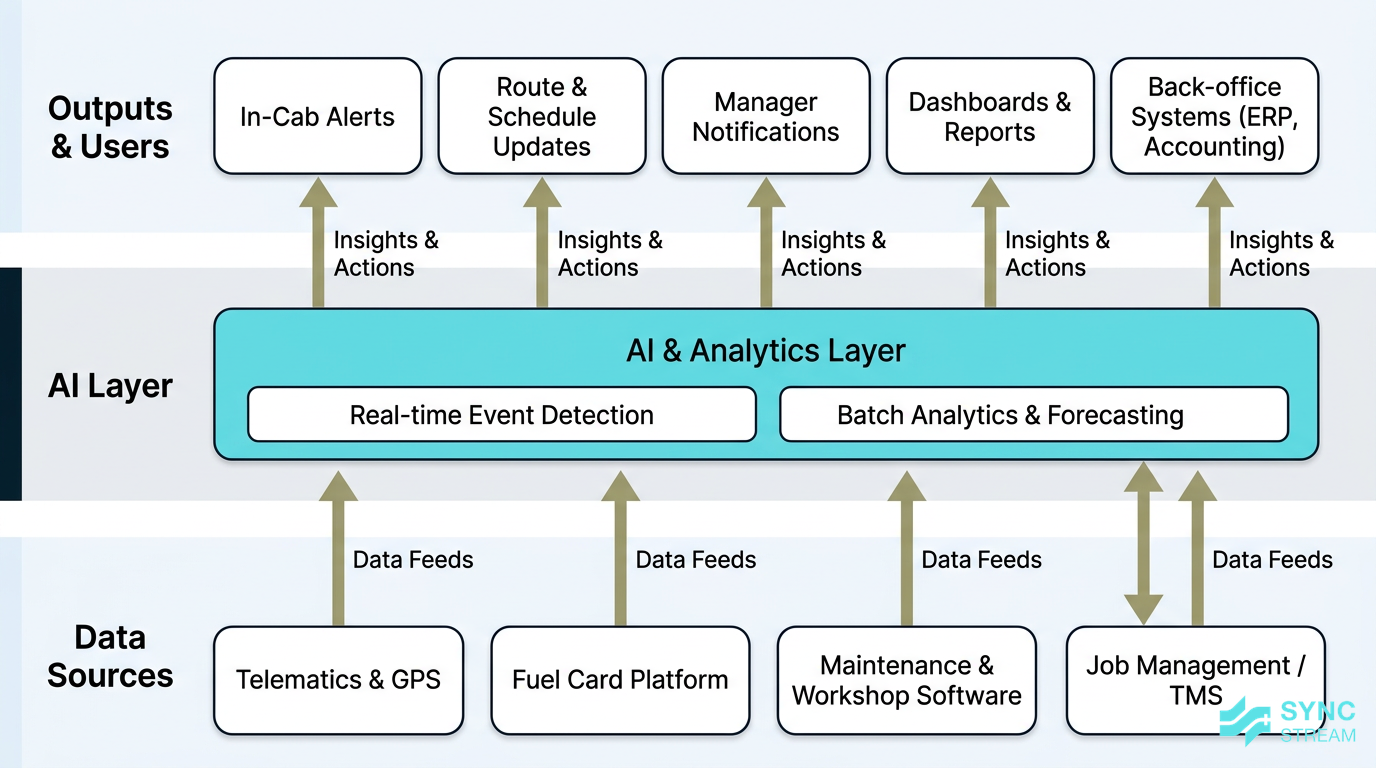
AI rarely replaces your existing fleet tech. Instead, it usually sits on top of systems you already run:
- Telematics and GPS tracking units in vehicles
- Fuel card platforms
- Maintenance and workshop software
- Job management, dispatch or transport management systems
The typical data flow looks like this:
- Data generation (inputs). Vehicles and drivers create data as they drive, refuel, and complete jobs.
- Data capture (action). Telematics units, fuel cards and mobile apps collect this data and send it to cloud platforms.
- AI analysis (action). AI models process the data in real time for safety or routing decisions, and in batches for things like monthly maintenance risk scoring.
- Operational outputs (expected output). The AI sends results back into your tools as in-cab alerts, updated routes, manager notifications, dashboards, or scheduled reports.
Because many modern fleet platforms now have AI features baked in, there’s a good chance your business already has access to some of this capability without a huge IT project. Often, the real opportunity is to:
- Switch relevant features on
- Fine-tune thresholds and rules
- Integrate outputs with your other systems so they become part of consistent workflows rather than isolated widgets
Main AI use cases in fleets
At a high level, artificial intelligence in fleet management clusters into a few core application areas:
- Predictive maintenance and asset health Example: predicting which vans are likely to have battery or brake issues in the next few weeks so you can book them into the workshop without impacting key runs.
- Route and load optimisation Example: automatically creating efficient runs for 50+ metro deliveries that respect customer time windows and adjust when there’s an accident on a major road.
- Driver safety and coaching Example: AI dashcams detecting phone use or fatigue and giving in-cab alerts, while sending short clips back to supervisors for coaching conversations.
- Fuel and emissions optimisation Example: spotting idling hotspots, inefficient routes, or aggressive driving patterns that waste fuel, and recommending changes to routes or driver behaviour.
- Compliance automation Example: checking driver hours and break records against NHVR rules automatically, or flagging vehicles that are overdue for inspections.
- Back-office forecasting and planning Example: forecasting how many vehicles you actually need during peak periods, or modelling what happens to cost and emissions if you introduce EVs in metro areas.
Across all of these, the goal is better decisions and smoother workflows — not replacing drivers, dispatchers or managers. AI reduces noise, highlights risks, and automates repetitive checks so your team can focus on exceptions and customer service.
Why it matters for Australian SMBs
Cost, margins and fuel pressures
Most Australian fleets run on tight margins. Fuel, wages, insurance, and vehicle costs keep creeping up, while customers resist price rises.
AI can help squeeze more value out of every vehicle and every litre of fuel:
- Fewer breakdowns: Predictive maintenance lets you deal with issues in the workshop instead of on the side of the road with an emergency call-out.
- Less fuel burned: Route optimisation, smoother driving, and reduced idling cut fuel usage across the fleet.
- Fewer kilometres driven: Smarter routing and consolidation of jobs reduce dead runs and backtracking.
- Less overtime: Better planning, fewer delays, and more predictable days reduce overtime blowouts.
- Higher utilisation per asset: Understanding which vehicles are under- or over-used lets you rebalance or even trim the fleet.
Real-world examples in Australia suggest meaningful impact. Predicting battery failures alone has reduced on-call replacements by around 20–25% in some fleets — for a 30-vehicle operation, that’s a noticeable cut in emergency costs and disruption. Route optimisation platforms like Adiona’s FlexOps have driven fuel savings in the thousands of litres by improving planning and drop sequences.
For SMBs, even a 5–10% improvement across a few of these cost lines can be the difference between a tough year and a solid one.
Customer expectations and DIFOT performance
Customer expectations have shifted. Whether you’re delivering parcels, concrete, or spare parts, Australian customers now expect:
- Accurate ETAs (and updates when things change)
- Real-time or near-real-time tracking links
- High delivery-in-full, on-time (DIFOT) performance
AI-supported planning and routing mean SMBs can offer “big player” service levels without building large planning teams.
Using Adiona FlexOps as an example:
- Courier operators have hit 99.5% DIFOT
- Planning time dropped by around 80%
- Over 3,000 litres of fuel saved on a single project
The same logic applies to:
- Couriers: Tighter windows, more drops per run, and fewer missed deliveries.
- Construction supplies: Concrete, steel, and materials arriving when the crew is ready, not hours early or late.
- Field services: Electricians, HVAC technicians, and plumbers arriving in a sensible, predictable order instead of mad cross-town dashes.
- Regional logistics: More reliable linehaul and last-mile, which can win or retain key regional contracts.
Safety, compliance and risk exposure
Australia’s WHS framework and NHVR requirements place a clear duty of care on employers operating vehicles. AI safety tools directly support that obligation.
Key benefits include:
- Lower crash rates: AI-enabled dashcams and telematics can identify distracted driving, fatigue, tailgating, and harsh events in real time, reducing incidents.
- Insurance outcomes: Fewer crashes and better documented incident histories can support insurance negotiations and claims handling.
- Stronger compliance posture: Automated checks on driver hours, breaks, maintenance schedules, and inspection records reduce the risk of breaches and fines.
There’s also a reputational and people side:
- Investing in AI safety tech sends a clear message to staff and customers that you take safety seriously.
- Drivers are better protected in disputes if footage and data can exonerate them.
- A safer, more predictable working environment helps with retention in a tight labour market.
Key components and AI features
Predictive maintenance and asset health
Predictive maintenance uses AI models to analyse data such as:
- Engine diagnostics and fault codes (OBD data)
- Sensor readings (temperature, tyre pressure where available)
- Historical workshop records and parts replacements
- Odometer, load profiles, and driving conditions
By learning what a vehicle’s data looks like before a failure, the AI can predict similar failures early. For example, battery failure prediction models deployed in fleets have cut on-call replacements by 20–25%, because batteries are swapped out during scheduled downtime instead of after they strand a driver.
For a small fleet, that means:
- Fewer cancelled jobs or rescheduled runs
- Less disruption for customers
- Lower emergency roadside and towing costs
In day-to-day use, managers typically see:
- Risk scores per vehicle (e.g., low / medium / high likelihood of specific failures)
- Recommended maintenance windows that fit planned work schedules
- Alerts when patterns deviate from normal, such as a truck consistently running hotter on a particular route or load.
The end result is a more planned, less chaotic workshop schedule and longer vehicle life.
Intelligent routing, loads and fuel optimisation
Routing and load optimisation is one of the most visible applications of artificial intelligence in fleet management.
AI-powered routing engines can:
- Ingest real-time traffic and road conditions
- Consider delivery or service time windows
- Factor in vehicle constraints (capacity, height, weight, ADR restrictions)
- Respect driver shift limits and depot cut-off times
They then generate runs that minimise distance, time, or cost — and keep adjusting as conditions change.
The FlexOps example illustrates what’s possible:
- 99.5% DIFOT by aligning routes with real-world conditions and constraints
- 80% reduction in planning time, freeing planners from manual street-by-street work
- 3,000+ litres of fuel saved through smarter routing and consolidation
Other optimisation features that matter in Australian cities and regions include:
- Smarter job sequencing, reducing backtracking and congested right turns across busy arterials.
- Load balancing across vehicles to avoid sending half-empty trucks while others are overloaded.
- Avoiding congestion-prone roads and known choke points in areas like Sydney, Melbourne or Brisbane at peak times.

How AI-driven improvements in maintenance, routing and safety translate into lower fuel, breakdown and labour costs for SMB fleets.
Driver behaviour, safety and coaching
AI-powered dashcams and telematics devices operate as always-on safety partners for drivers. They can detect:
- Distracted driving (phone use, eyes off the road)
- Fatigue indicators (frequent yawning or micro-sleeps in some systems)
- Tailgating and unsafe following distances
- Harsh braking, cornering, and acceleration
- Speeding relative to posted limits
Fleet Complete’s AI dual-facing cameras are one example in the Australian market. They combine in-cab alerts (warning drivers in real time when behaviour becomes unsafe) with event clips sent to managers.
The real power comes when fleets use this data for coaching, not just punishment:
- Regular safety reviews highlight trends, not just single events.
- Short clips provide a neutral starting point for coaching conversations.
- Training can target the specific issues each driver faces, like late braking or long daytime drives without adequate breaks.
This shifts safety from reactive (responding after an incident) to proactive (reducing risk factors week by week), building a stronger safety culture over time.
Compliance, reporting and forecasting
AI is also well suited to the paperwork and pattern-spotting side of fleet management.
Compliance and reporting use cases include:
- Automated log and record checking for driver hours, breaks, and work diaries.
- Monitoring pre-start checks and defect reports, flagging missing or inconsistent entries.
- Tracking maintenance intervals and inspections against regulatory requirements.
AI-driven analytics dashboards can surface patterns such as:
- Routes that consistently push drivers close to fatigue limits.
- Depots or regions where vehicles are underutilised or always overbooked.
- Times of day or week when incident rates spike.
Emerging forecasting use cases include:
- Right-sizing the fleet, estimating how many vehicles you’ll need during peak vs quiet periods.
- Modelling EV adoption, comparing total cost of ownership and emissions between ICE and EV options on different routes.
- Scenario planning, such as the impact of new depots, different delivery windows, or subcontractor mixes.
Implementation strategy for Australian fleets
Clarify business goals and data readiness
A practical AI implementation should start with a simple, structured workflow:
- Set clear objectives
- Inputs: current cost base, service levels, incident history.
- Action: choose 1–3 measurable goals, such as “cut fuel use by 10% within 12 months”, “reduce unplanned breakdowns by 50%”, or “lift DIFOT from 94% to 98%”.
- Expected output: a short list of agreed objectives to guide every decision.
- Map your current systems
- Inputs: list of tools in use across telematics, GPS, job management, fuel cards, maintenance, spreadsheets.
- Action: document what each system does, who uses it, and what data it holds.
- Expected output: a simple system map showing where key fleet data lives.
- Audit data quality and coverage
- Inputs: sample datasets from telematics, fuel, maintenance, and driver records.
- Action: check for gaps (missing vehicles, shared logins), inconsistencies (different IDs per system), and coverage (which vehicles lack devices).
- Expected output: a brief data quality summary and a list of fixes (e.g. standardise IDs, add devices).
- Identify 1–2 high-impact use cases
- Inputs: objectives, system map, data audit.
- Action: select the use cases most likely to hit your goals, usually a mix of routing + safety or predictive maintenance + compliance.
- Expected output: a ranked list of 1–2 AI use cases for phase one.
- Define success metrics and baselines
- Inputs: historical KPIs such as fuel per 100 km, breakdown frequency, DIFOT, overtime hours.
- Action: record current values and agree on targets and timeframes.
- Expected output: a baseline KPI sheet for measuring AI impact.
- Prioritise a phased roadmap
- Inputs: chosen use cases, budget, operational constraints.
- Action: assign what will be delivered in the next 3, 6, and 12 months, including pilots and integrations.
- Expected output: a simple roadmap with timelines, owners, and dependencies.
Choosing tools, vendors and integrations
When evaluating AI-enabled fleet platforms and telematics providers in Australia, focus on practical fit rather than buzzwords.
Key considerations:
- Local support and ANZ-specific features. Ensure mapping, address data, and compliance modules are tuned for Australian and New Zealand conditions.
- Integration capability. Your fleet system should connect to your accounting, ERP, dispatch/job management, fuel card platforms, and workshop software to avoid double handling.
- Transparent pricing. Understand hardware vs software costs, data fees, and what features are included vs extra.
- Explainable outputs. Favour systems that show why an alert or route decision was made, not black boxes.
- Good mobile experience for drivers. Simple, reliable driver apps and in-cab interfaces reduce friction and resistance.
- Data ownership and access. Confirm you retain ownership of your data and can export it or integrate it with other tools.
- Scalability. Make sure the solution can grow from a 10–50 vehicle fleet to 100+ without major rework.
Rolling out, training and continuous improvement
A structured rollout helps you capture value quickly while managing risk and driver concerns:
- Pilot with a small group
- Inputs: chosen depot, 5–20 vehicles, selected drivers and dispatchers.
- Action: deploy AI-enabled devices and software to this group only.
- Expected output: a contained test environment with clear scope.
- Refine settings and alerts
- Inputs: pilot data, user feedback.
- Action: adjust alert thresholds, routing rules, report frequency, and notification channels to reduce noise.
- Expected output: a tuned configuration that surfaces only actionable events.
- Train drivers and dispatchers
- Inputs: finalised settings, training materials, example scenarios.
- Action: run short, practical sessions covering how alerts work, what data is collected, and how it will be used.
- Expected output: users who can operate the tools confidently and know what to expect.
- Set clear privacy and camera policies
- Inputs: legal requirements, HR policies, vendor capabilities.
- Action: document where cameras point, how long footage is stored, who can access it, and disciplinary/coaching processes.
- Expected output: a policy you can share with drivers and include in onboarding.
- Expand fleet-wide in stages
- Inputs: pilot learnings, rollout plan.
- Action: deploy to additional depots or vehicle groups in waves, monitoring adoption and issues at each step.
- Expected output: full-fleet coverage with manageable disruption.
- Review monthly and adjust
- Inputs: KPI reports, incident logs, user feedback.
- Action: hold monthly reviews to modify thresholds, tweak routes, and update coaching programs.
- Expected output: steadily improving performance and user buy-in.
Change management is critical. Drivers need to understand what’s in it for them: safer journeys, support when incidents occur, and more predictable days. Regular communication and feedback loops will make or break adoption.
Comparing AI options and approaches
All-in-one platforms vs modular add-ons
When adopting artificial intelligence in fleet management, you’ll generally face a choice between:
- All-in-one platforms: Full-stack systems that combine telematics, routing, maintenance, compliance, and cameras with integrated AI features.
- Modular add-ons: Adding AI components such as route optimisation engines, dashcams, or analytics layers to your existing telematics or dispatch systems.
Trade-offs include:
- Cost: All-in-one platforms can carry higher per-vehicle fees but reduce integration work. Modular setups may be cheaper upfront but involve more effort to connect systems.
- Flexibility: All-in-one means one vendor’s roadmap; modular lets you pick best-of-breed components and swap them as needs change.
- Implementation speed: A single platform can be faster to roll out; modular projects may require more integration and testing.
- Vendor lock-in: Consolidation increases reliance on one provider; modular approaches can reduce lock-in if integrations are robust.
As a rule of thumb:
- 10–50 vehicle fleets often prefer simpler, more integrated solutions that reduce admin overhead, even if not every feature is perfect.
- 200+ vehicle operations may lean toward best-of-breed modular architectures, especially if they have more complex requirements and internal IT capability.
The right answer depends on your must-have capabilities and whether you prefer consolidating vendors or maintaining a connected mix of tools.
On-vehicle devices, cloud software and hybrids
AI can run in different places within your architecture:
- Cloud-centric AI: Data from basic GPS or telematics units is sent to a cloud platform where AI handles routing, analytics, and forecasting.
- On-vehicle or edge AI: Smarter devices like AI dashcams process video and behaviour on the device itself, enabling real-time alerts even with poor connectivity.
Implications for Australian fleets include:
- Responsiveness: Edge AI supports instant in-cab feedback, while cloud AI may be seconds to minutes behind depending on connectivity.
- Regional coverage: In regional or remote areas with patchy mobile data, on-device processing ensures safety features still work, with data syncing later.
- Hardware upgrade cycles: Advanced edge devices might require higher upfront spend and eventual replacement to stay current.
In practice, many SMBs end up with a hybrid setup:
- AI-enabled cameras and telematics units in vehicles
- Cloud-based route optimisation, compliance checking, and analytics running over those data feeds
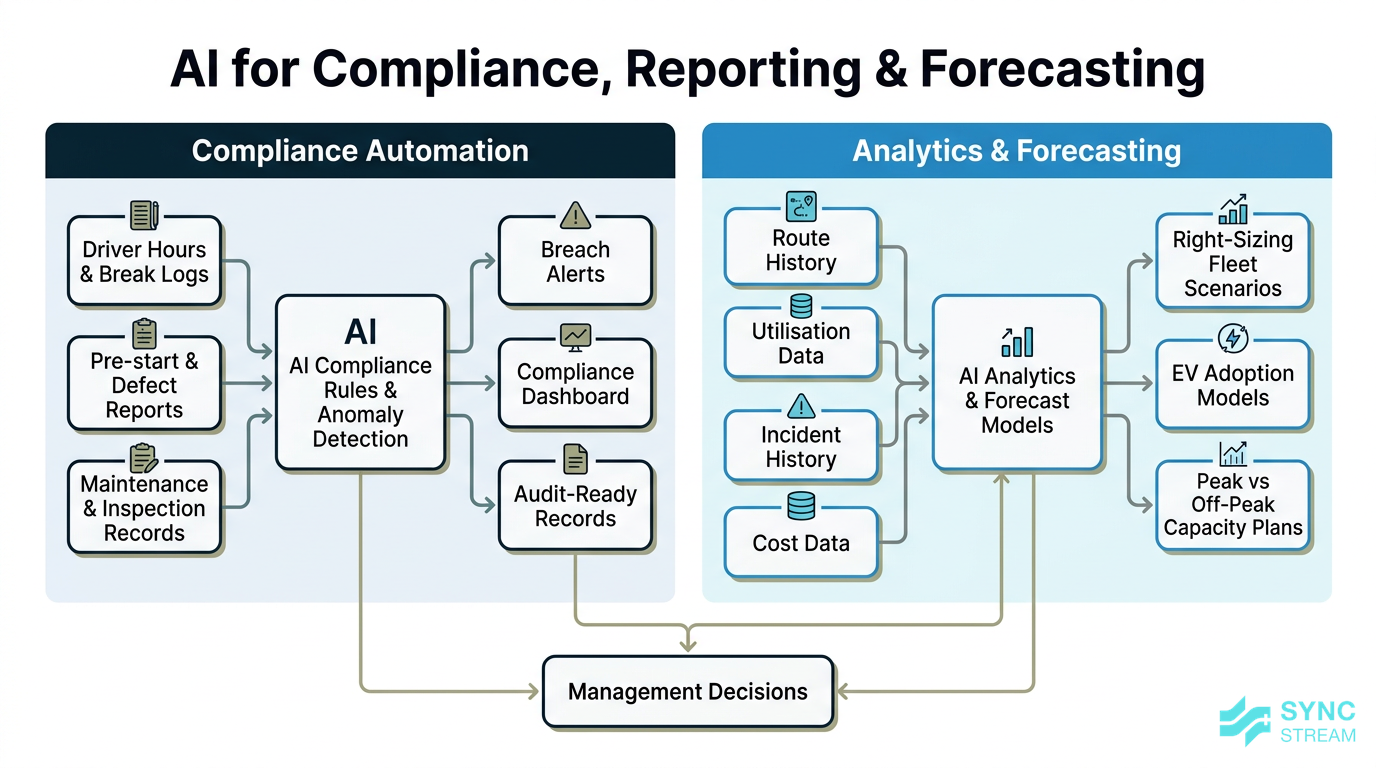
AI-driven checks on logs, inspections and routes feeding compliance dashboards and longer-term forecasting insights.
Build vs buy for AI capabilities
For most Australian SMB fleets, it makes more sense to buy proven AI-equipped products than to try building custom AI models from scratch.
Reasons include:
- Specialist vendors have already invested heavily in models, data pipelines, and edge devices.
- Internal IT and data science capacity is typically limited in smaller organisations.
- Time-to-value is faster with off-the-shelf systems that can be configured in weeks, not built over months or years.
There are exceptions. Partnering with a specialist consultancy like Sync Stream can make sense when:
- You have unique route constraints (e.g. complex multi-stop, multi-vehicle operations with unusual rules) that generic routing engines can’t handle.
- You operate complex multi-depot or multi-brand networks and need bespoke optimisation workflows or analytics across several systems.
- You want AI assistants for planners or dispatchers that work across your CRM, operations tools, and communication platforms.
In these cases, Sync Stream works on top of your existing systems, designing workflows and AI agents that deliver clear commercial outcomes while keeping your data, infrastructure, and documentation in your hands.
Key considerations when weighing build vs buy:
- Total cost of ownership (licences, hardware, integration, support)
- Internal capability to maintain custom models and data pipelines
- Time-to-value and payback periods
- Long-term maintainability and avoiding deep vendor or developer lock-in
Hidden challenges and constraints
Data quality, privacy and compliance concerns
AI is only as good as the data feeding it. Common data issues that undermine AI accuracy and trust include:
- Missing or inconsistent odometer readings
- Drivers sharing logins or cards
- Uncalibrated or faulty sensors
- Vehicles without telematics coverage
Before leaning heavily on AI recommendations, it’s worth cleaning up these basics and standardising processes.
Privacy is another key consideration in Australia. Drivers and staff reasonably want to know:
- When and where cameras are recording
- How long footage and telematics data are kept
- Who can access these records and for what purposes
To stay aligned with Australian privacy expectations and legislation, fleets should:
- Develop simple, clear policies on in-cab camera use and data retention
- Explain why data is collected (safety, compliance, efficiency) and how it will and won’t be used
- Ensure data is secured appropriately, with access limited to authorised roles
Good communication here goes a long way toward building trust.
Cultural acceptance and driver trust
Even the best AI tools will fail if drivers don’t trust them. Common pushbacks include concerns about:
- Feeling "spied on" by cameras and tracking
- Being unfairly punished for one-off events
- Increased workload from new apps and checks
To avoid these issues:
- Frame AI as a safety and support tool, not a surveillance system. Highlight how footage and data can protect drivers from false claims and help optimise routes.
- Involve drivers in decisions about alert levels, coaching approaches, and how data is used.
- Use incentives and recognition, such as safe driving rewards or recognition in team meetings, instead of relying solely on penalties.
When drivers see tangible benefits — like incidents where footage clears them or routes that shorten their day — acceptance grows quickly.

Linking AI investments in fleets to realistic ROI metrics, ramp-up periods and vendor evaluation.
Budget, ROI expectations and vendor promises
AI projects can be derailed by unrealistic expectations. Savings don’t appear overnight; teams need time to adapt, and models need data to learn your operation.
A more realistic approach is to:
- Expect a ramp-up period of a few months as users embed new workflows and enough data accumulates.
- Calculate ROI in concrete terms relevant to your fleet:
- Fewer breakdown-related call-outs and tow jobs
- Reduced litres of fuel per 100 km
- Lower insurance premiums over time
- Less overtime and weekend work
- Longer vehicle life and higher resale values
- Scrutinise marketing claims. Ask vendors for:
- Pilot programs or proof-of-concept results
- References from similar Australian fleets
- Clear success metrics and reporting for your context
This disciplined approach aligns well with how Sync Stream scopes projects: every system is tied to a defined business case and ROI, with workflows documented for long-term reliability.
Conclusion
Artificial intelligence in fleet management is no longer a future concept — it’s already reshaping how Australian SMB fleets plan routes, maintain vehicles, manage safety, and keep customers informed.
When implemented thoughtfully, AI can:
- Protect margins by reducing fuel burn, breakdowns and overtime
- Lift DIFOT and customer satisfaction to "big player" levels
- Strengthen safety, compliance, and duty-of-care outcomes
- Give managers clearer visibility and better forecasting for growth
The key is to start with clear business goals, audit your data and systems, choose tools that integrate with what you already use, and roll out changes in controlled phases with strong communication to drivers.
If you’re considering where to begin — or you’re hitting limitations with off-the-shelf platforms — Sync Stream can help you design and implement AI-driven workflows on top of your existing systems, with commercial outcomes and operational reliability front and centre.
FAQ
1. What is artificial intelligence in fleet management in simple terms?
It’s software that learns from your fleet data — GPS, engine, fuel, maintenance, and driver behaviour — to predict issues, optimise routes, and automate checks so managers and drivers can focus on the important exceptions instead of manual admin.
2. Do I need to replace all my existing fleet systems to use AI?
Usually not. Most AI tools sit on top of your existing telematics, fuel cards, and maintenance systems. Many modern platforms already have AI features built in that can be configured and integrated without a complete system replacement.
3. How quickly will I see ROI from AI in my fleet?
Most fleets see early wins within a few months, especially around routing and safety alerts. Bigger, more measurable ROI on fuel, breakdowns, and insurance typically shows up over 6–12 months as data builds and teams adjust to new workflows.
4. Will AI replace my dispatchers or drivers?
No. The current role of AI in fleet management is to assist people, not replace them. It handles repetitive calculations and monitoring, while humans make judgement calls, manage customers, and handle exceptions.
5. How does AI help with compliance in Australia?
AI can automatically check driving hours, breaks, vehicle inspections, and maintenance intervals against your policies and regulatory requirements, flagging anomalies so you can address them before they become breaches or fines.
6. What about driver privacy with AI dashcams and tracking?
Privacy is managed through clear policies and secure systems: define where cameras point, how footage is used, who can access it, and how long it’s stored. Communicating this transparently helps drivers understand the safety and protection benefits.
7. Is AI worthwhile for smaller fleets, say 10–20 vehicles?
Yes, especially where vehicles are heavily utilised or operate in congested metro areas. Even modest improvements in routing, fuel efficiency, and safety for a 10–20 vehicle fleet can repay the investment when measured over a year or more.
8. How does Sync Stream fit into an AI fleet project?
Sync Stream works as an implementation partner. We design and deploy AI and automation workflows on top of your existing CRMs, operations tools, accounting systems, and telematics — focusing on high-friction processes like routing, maintenance scheduling, and compliance so you get documented, reliable systems with clear commercial outcomes.