

Introduction
Fire testing and compliance companies in Australia sit under intense regulatory and commercial pressure, yet much of the work is still bogged down in emails, spreadsheets, and manual data entry. Every service sheet, photo, and certificate has to line up with standards and be instantly defensible in an audit.
This is exactly where Fire testing and compliance companies AI adoption is starting to matter. When done properly, AI can read messy paperwork, extract the important details, check them against rules, and generate clean, standardised outputs.
This article explains, in practical terms, how Australian fire testing businesses can use AI to automate compliance documentation, certificate generation, and audit preparation—without ripping out existing systems or replacing experienced people.
AI in Fire Compliance Explained
What “AI” means in this context
In this context, "AI" simply means software that can learn patterns from examples instead of only following hard-coded rules. Instead of telling a system, "If the technician ticks this box, then write this sentence," you show it many past reports and it learns the typical wording and structure.
For compliance documentation, the key shift is that AI can:
- Read unstructured inputs such as PDFs, scanned service sheets, photos of tags, and even email chains from clients.
- Extract key data like asset IDs, locations, test results, dates, and technician names.
- Check this information against defined rules and standards, and then generate consistent, structured outputs.
Under the hood, this usually combines a few building blocks:
- OCR and document classification – Turning scans and photos into text, then working out what kind of document it is (AS 1851 service sheet, defect notice, hydrant test report, etc.).
- Natural language processing (NLP) – Understanding sentences and tables in reports and emails so the system can pull out and label the right fields.
- Predictive analytics – Spotting patterns over time, like which sites frequently miss tests or which asset types regularly fail, to support planning and risk management.
- Workflow automation/orchestration – Tools (such as n8n, which Sync Stream commonly uses) that move data between your job management system, asset register, storage, and email automatically so staff are not retyping information.
Traditional rules-based software is still important, but it struggles when inputs are messy, inconsistent, or free text. AI shines in these grey areas while still feeding into clear rules and approval steps.
How workflows change for fire firms
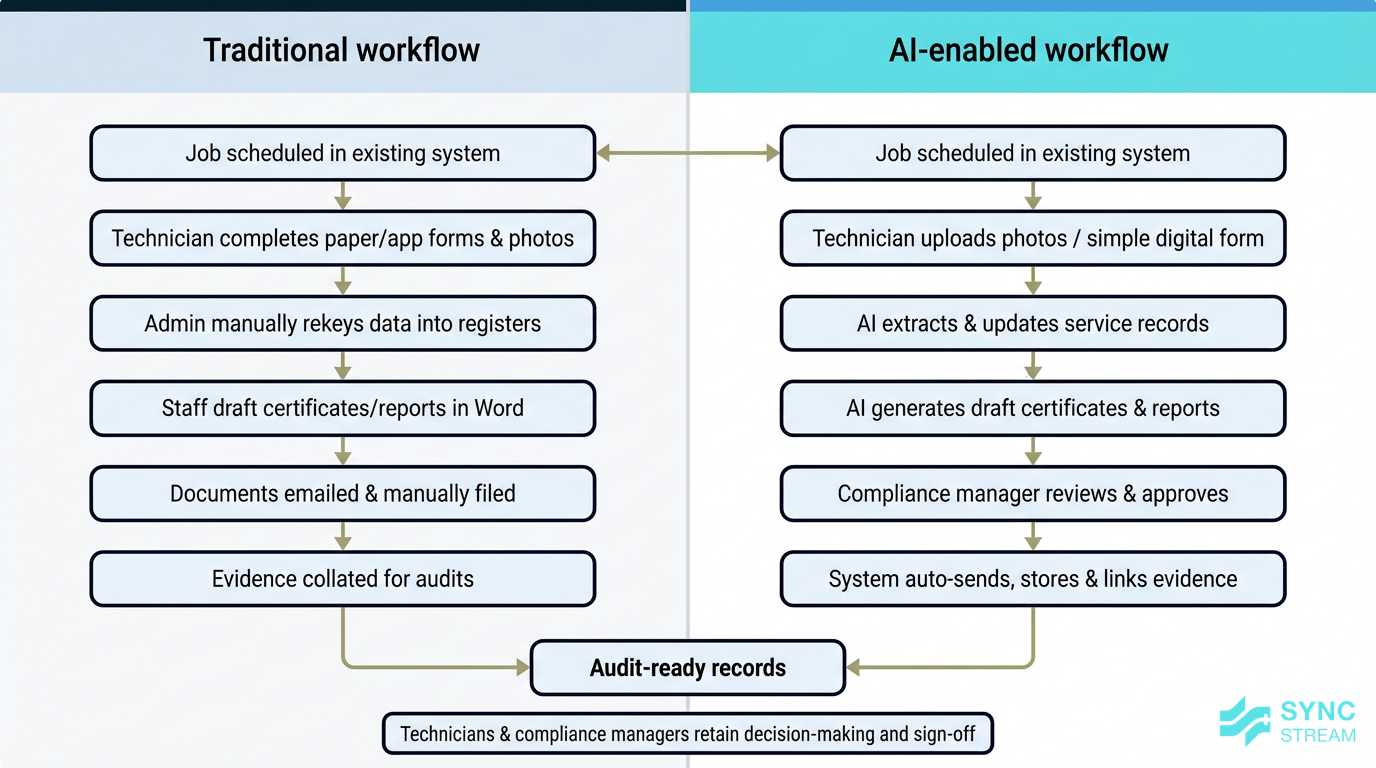
A typical current workflow for an Australian fire testing company might look like this:
- Jobs are scheduled in a job management or maintenance platform.
- A technician attends site with paper forms or a basic app, takes handwritten or typed notes, and snaps photos.
- After the visit, the technician or admin staff manually key data into registers or spreadsheets.
- Someone drafts a certificate or report in Word, copying and pasting from service sheets and previous templates.
- The report is emailed to the client and filed into a network drive, sometimes under slightly different naming conventions each time.
With AI-enabled workflows, the steps change less than you might expect, but the friction drops dramatically:
- The job is still created in your existing system.
- The technician uploads photos of tags and panels, fills out a simple digital form, or emails scans of a completed paper sheet.
- AI reads those inputs, extracts the key fields, and updates the AS 1851-aligned service records in your asset register or CMMS.
- The same structured data feeds a standardised certificate and test report template, which is auto-generated and queued for review.
- Once approved, the system automatically sends the report to the client, stores it in the correct folder or document management system, and links it to the relevant asset/site record for audit readiness.
AI here is not replacing technicians or compliance managers—it sits inside the systems you already use. Technicians still decide what passed or failed. Compliance managers still sign off on certificates. AI just removes the repeated retyping, copying, and hunting for files.
Imagine a technician servicing extinguishers and detectors across multiple floors:
- On site, they capture photos of each asset plate, record test results in a simple app, and add quick notes.
- As soon as they sync, AI recognises each asset, updates the AS 1851 service schedule records, and flags any fails that require rectification.
- A draft test report and certificate are auto-generated, complete with asset lists, test dates, and outcomes.
- All evidence—photos, notes, signatures—is automatically filed in an audit-ready repository linked to that building and service period.
By the time the technician leaves site, most of the documentation is already prepared, waiting only for a final human check.
Why It Matters for Aussie SMBs
Compliance pressures and Australian standards
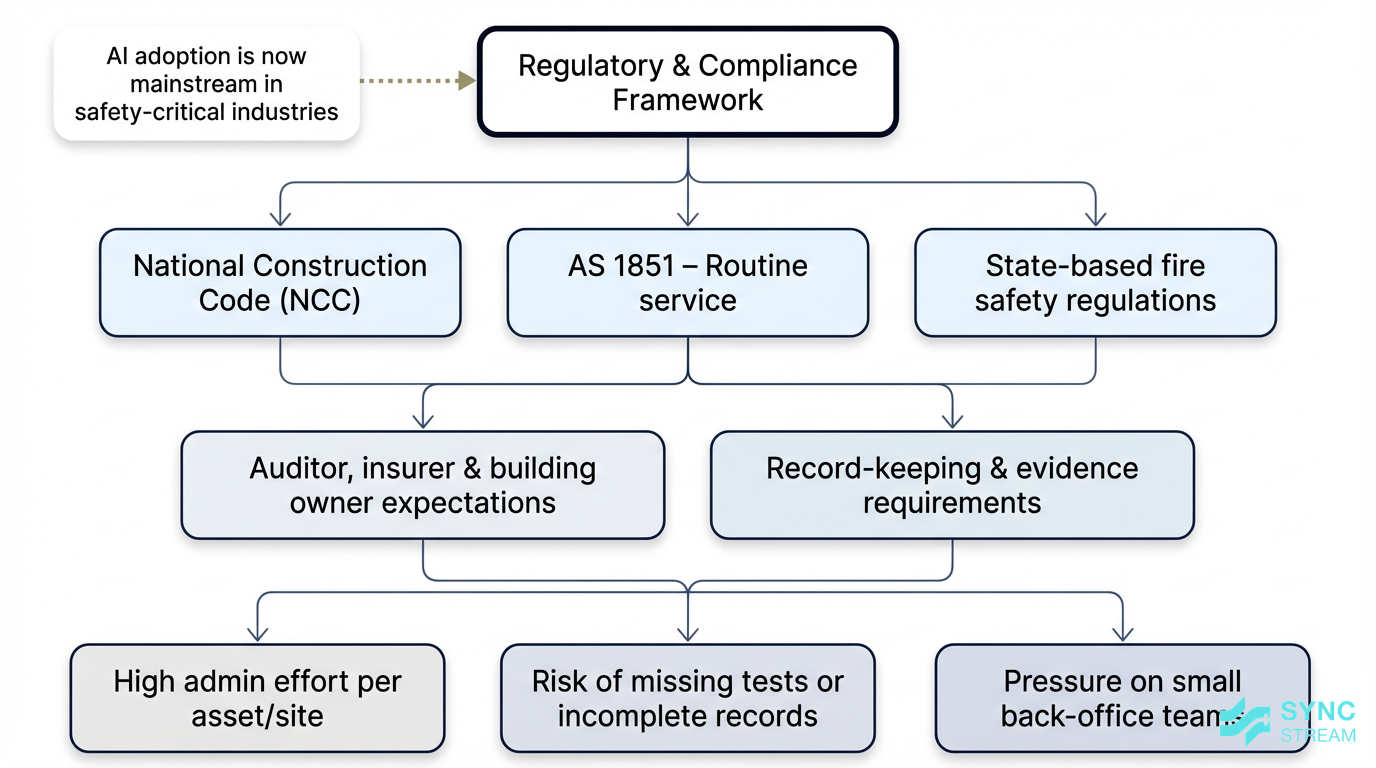
Hierarchy of Australian regulations and standards that shape fire compliance documentation requirements.
Fire protection providers operate within a dense regulatory framework: the National Construction Code (NCC), AS 1851 for routine service of fire protection systems and equipment, state-based building fire safety regulations, and specific record-keeping expectations from auditors, insurers, and building owners.
For smaller Australian providers, several issues recur:
- High admin effort per asset and per site, especially on multi-building portfolios.
- Records scattered across spreadsheets, PDFs on shared drives, and individual inboxes.
- Real risk of missing scheduled tests or ending up with incomplete or inconsistent service records.
- Limited back-office capacity to chase technicians for paperwork, fix formatting, and prepare audit packs.
At the same time, AI adoption is becoming mainstream across Australian safety-critical industries. Fire and safety businesses are using AI for hazard detection on worksites, logistics operators such as Linfox are using AI-powered proximity alerts, and the Australian Government has released formal "Guidance for AI Adoption" to support safe, responsible use.
This means AI in fire compliance is not a fringe experiment. It is a regulated, scrutinised shift that can directly support your ability to demonstrate compliance.
Operational gains for smaller providers
For SMBs, the immediate benefits tend to be operational rather than futuristic:
- Less time on paperwork per job – When service sheets and photos automatically populate registers and certificates, technicians and admin staff spend far less time retyping.
- Faster certificate turnaround – Reports can often be drafted automatically within minutes of job completion, instead of waiting days for paperwork to be processed.
- Fewer missing or incorrect records – Automated checks can highlight missing signatures, dates, or test outcomes before a job is closed.
- More billable technician time – With admin reduced, technicians can spend more time on-site and less time in the office.
AI-driven standardisation also means:
- Consistent document structure and wording across technicians, branches, and subcontractors.
- Easier onboarding of new staff who can follow clear templates.
- Smoother audits, because the format of evidence and certificates is predictable and complete.
Commercially, this creates competitive advantages: you can promise near real-time documentation, provide cleaner compliance evidence to insurers and regulators, and stand out to building owners who are under increasing pressure to demonstrate their own obligations are met.
Core AI Capabilities and Features
Smart document capture and data extraction
AI-based optical character recognition (OCR) and document understanding can ingest:
- Scanned AS 1851 service sheets and logbooks.
- Handwritten notes from site visits.
- Photos of tags, panels, and nameplates.
- Legacy PDFs of historical test reports.
From these, the system can pull out structured fields such as asset IDs, locations, test results, due dates, technician details, and client references.
Common use cases for fire testing and compliance companies include:
- Converting years of paper files into a searchable, filterable digital history.
- Auto-populating digital service records that align with AS 1851 schedules and client contracts.
- Reconciling onsite findings with existing asset registers and flagging discrepancies.
Accuracy is managed through safeguards such as:
- Confidence scores – The system rates how sure it is about each extracted field.
- Human-in-the-loop review – Low-confidence or critical fields (e.g., pass/fail status on high-risk assets) are sent to a human for confirmation.
- Automatic validation – Missing mandatory fields, impossible dates, or inconsistent results are flagged for compliance staff before anything is issued.
Automated certificates, reports, and registers
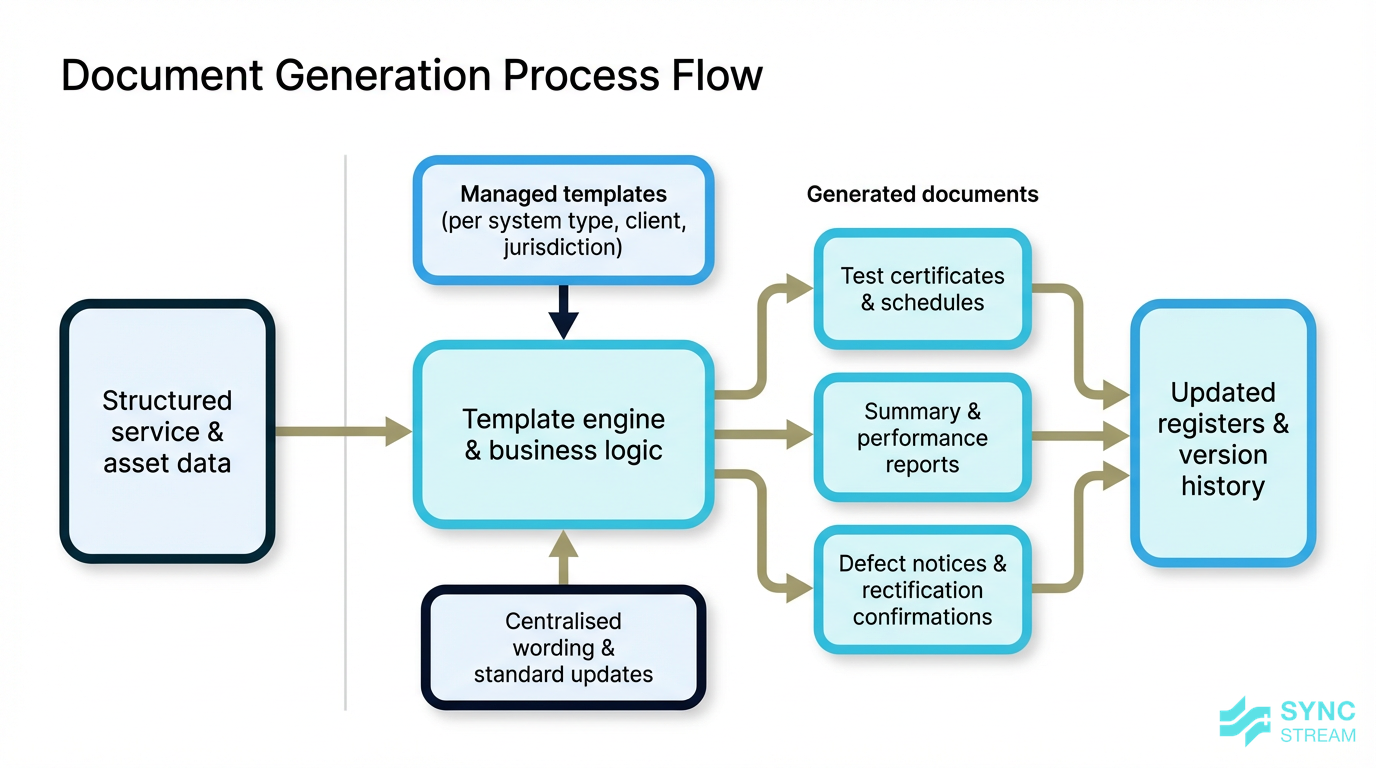
Process from structured service data into automated, standardised certificates, reports, and registers.
Once data is structured, templates can generate:
- Test certificates and schedules.
- System performance and summary reports.
- Defect notices and rectification confirmations.
- Updated asset and test registers.
Template logic can adjust wording and inclusions based on:
- System type (sprinklers, hydrants, extinguishers, alarms, detection systems, passive systems).
- Jurisdictional or client-specific reporting requirements.
- Branding and layout preferences.
- Contract clauses such as response times or defect categorisation.
The result is less manual drafting, fewer copy-paste errors, and a clear version history for every certificate or report issued. Language can be centrally managed so updates to reflect new Australian standards or NCC changes flow through to every new document automatically.
Analytics, alerts, and audit trails
With data cleaned and centralised, AI can surface patterns that are hard to see in spreadsheets:
- Recurring defects on specific asset models or at certain sites.
- High-risk buildings with repeated failures or overdue rectifications.
- Technicians or subcontractors whose work consistently requires follow-up.
From there, providers can move towards proactive compliance via:
- Automated alerts for upcoming tests due, overdue work, or gaps in mandatory records.
- Dashboards showing compliance status by site, client, or asset type in near real time.
For audits, AI-supported systems provide:
- Immutable logs of who changed what and when.
- Direct links between onsite evidence (photos, notes, signatures) and the final issued certificate.
- One-click retrieval of all records for a site, date range, or asset for insurers, regulators, or clients.
Implementing AI for Compliance
Map current processes and pain points
Stage 1: Map how work really happens today.
Start by documenting every step from inspection scheduling through to archiving records:
- List each step in the workflow: scheduling, conducting the inspection, capturing evidence, drafting reports, issuing certificates, storing records, and preparing for audits.
- For each step, note the systems used (job management, CMMS, spreadsheets, shared drives, email) and who is responsible.
- Capture the document types involved—service sheets, checklists, defect notices, quotes, certificates, audit packs.
Then identify where time and errors cluster:
- Manual data entry from paper or PDFs into registers.
- Drafting and reformatting certificates and reports.
- Tracking retests and rectifications across multiple systems.
- Consolidating records in a consistent format when an audit is announced.
Make this concrete with a short exercise:
- Inputs: Last 1–3 months of jobs, sample documents from each step, and a list of current systems.
- Action: Walk through 5–10 recent jobs end to end, marking where data is retyped, copied, or lost.
- Expected output: A simple process-and-data map showing steps, systems, documents, roles, and key regulatory obligations (for example, how AS 1851 requirements are currently evidenced).
This map becomes the blueprint for where Fire testing and compliance companies AI projects can target quick wins first.
Prioritise quick wins and run pilots
Stage 2: Choose focused pilots with clear outcomes.
Rather than attempting a full transformation, select one or two high-impact use cases to pilot, such as:
- Automatically extracting data from standardised AS 1851 service sheets for a specific system type.
- Auto-generating test certificates and summary reports for one major client or geographical region.
Design each pilot with:
- Inputs: Defined document types (for example, extinguisher service sheets and certificates), a target group of technicians/sites, and baseline metrics (current turnaround times, error rates, admin hours).
- Action: Configure AI extraction and templates for those documents, connect them to your existing systems, and run them alongside your current process for a fixed period (for example, 6–12 weeks).
- Expected output: Measured changes in time saved per job, error reduction, and certificate turnaround, plus feedback from technicians and compliance staff.
Leverage Australian guidance such as the national "Guidance for AI Adoption," which emphasises risk assessment, accountability, and continuous testing. Involve both field technicians and compliance staff so the system reflects real-world conditions and documentation standards.
Embed governance, training, and iteration
Stage 3: Make AI-supported workflows part of business-as-usual.
Once a pilot proves its value, focus on governance and change management:
- Define who owns AI-assisted processes, templates, and data quality.
- Set up routines to monitor accuracy, review exception queues, and refine extraction rules.
- Establish clear procedures for when and how staff override AI suggestions.
Turn this into a repeatable discipline:
- Inputs: Pilot results, updated process map, risk register, and any regulatory guidance relevant to your clients.
- Action: Assign process and template owners, document sign-off responsibilities, and formalise how issues (for example, extraction errors) are logged and resolved.
- Expected output: A lightweight AI governance checklist covering ownership, review cycles, audit logging, staff training, and alignment with standards like AS ISO/IEC 42001:2023.
For staff, emphasise that AI is an assistant, not a replacement. Provide training on new workflows, show how it reduces rework, and encourage feedback to improve templates, rules, and data capture practices as regulations and business needs evolve.
Choosing AI Solutions and Partners
Comparing tool types and integration paths
When evaluating options, Australian fire testing SMBs typically consider three paths:
- Specialist fire/compliance platforms with embedded AI – End-to-end systems that bundle job management, asset registers, and AI-driven documentation. Suitable if you are ready to consolidate onto one platform but may require migrating existing processes.
- Generic document AI tools configured for fire testing documents – Flexible services that can be trained on your forms, reports, and certificates, then connected into your current systems.
- Working with an AI implementation partner like Sync Stream – Tailoring AI and automation on top of your existing job management, CMMS, accounting, and storage systems, using orchestration tools such as n8n to avoid major system changes.
Key integration considerations for Australian SMBs include:
- Ability to connect with your current job management, CMMS, cloud storage, email, and accounting platforms.
- Data residency in Australia where required by contracts or internal policy.
- Security controls and certifications appropriate for handling client and building data.
- API availability to avoid manual imports/exports.
Evaluation criteria should include:
- Support for Australian standards terminology and reporting requirements.
- Strong audit logging and version control for certificates and reports.
- Ease of template management by non-technical staff.
- Pricing that matches SMB budgets (per user, per document, or per site) without locking you in.
- Access to local support or partners with domain experience in fire compliance.
Sync Stream’s approach is to design and implement AI and workflow automation inside your existing systems, scoped against clear business cases such as reducing certificate turnaround time or cutting admin hours per job, and to document every workflow so you maintain control over how the system operates.
Challenges and How to Avoid Them
Common issues, risks, and mitigations
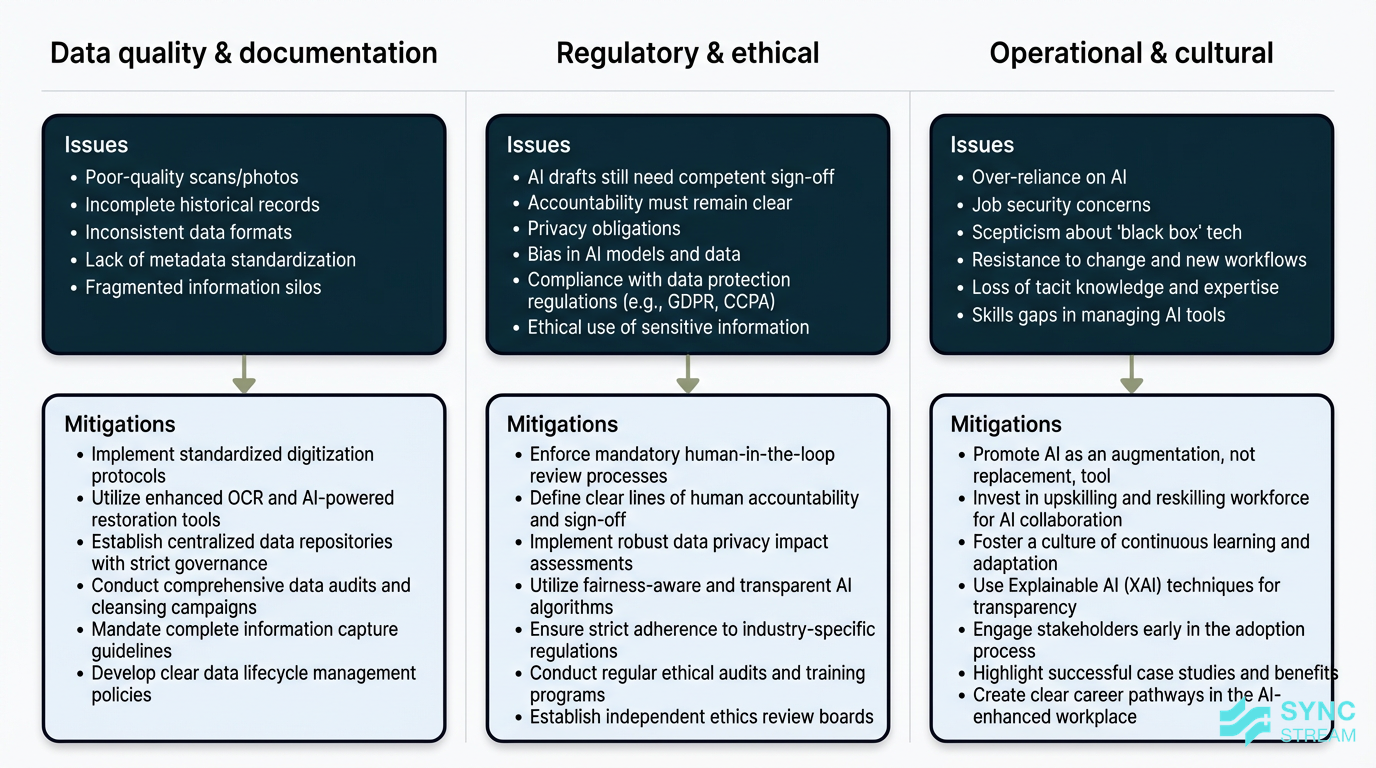
Structured view of data, regulatory, and operational risks in AI adoption with corresponding mitigations.
Several common challenges arise when fire testing and compliance companies adopt AI, and most can be mitigated with planning.
Data quality and documentation issues
- Poor-quality scans and photos make extraction harder and less reliable.
- Historical records may be incomplete or inconsistent across branches.
Mitigations:
- Set minimum scanning and photo standards (resolution, angles, lighting).
- Introduce controlled templates for service sheets and defect notices.
- Keep humans in the loop for critical documents and high-risk assets.
Regulatory and ethical considerations
- AI-generated outputs must still be checked by competent persons before certificates are issued.
- Accountability for sign-off must remain clear, even if AI drafts most of the content.
- Privacy obligations apply when processing client and building data.
Mitigations:
- Define who is responsible for reviewing and signing each document type.
- Ensure audit logs show who approved each certificate and when.
- Align practices with government AI guidance and your privacy obligations.
Operational and cultural challenges
- Over-reliance on AI without checks can introduce new risks.
- Staff may worry about job security or be sceptical about "black box" technology.
Mitigations:
- Be transparent about what AI does and does not do in your workflows.
- Provide clear procedures for overriding AI outputs.
- Involve technicians and compliance staff in the design and rollout so the system reflects their expertise.
Working with an implementation partner that focuses on operational reliability, like Sync Stream, can help structure these controls from the outset instead of retrofitting them later.
Conclusion
For Australian fire testing and compliance companies, AI offers a practical path to reduce paperwork, improve documentation quality, and face audits with confidence. By letting AI handle document capture, data extraction, and first-draft certificates, your team can focus on technical quality and client relationships.
The opportunity is not about replacing your existing job management or asset systems; it is about connecting them better and automating the high-friction steps in between. When aligned with standards such as AS 1851, NCC requirements, and Australian AI guidance, these systems can materially reduce admin burden and compliance risk. For Australian Fire testing and compliance companies AI initiatives that start with tightly scoped, well-governed pilots are the ones that typically deliver reliable ROI.
If you want to explore how AI and workflow automation could streamline your documentation, certificates, and audit preparation—using the systems you already rely on—Sync Stream can help you scope, implement, and document a solution with clear commercial outcomes.
FAQ
How can AI help with AS 1851 record-keeping specifically?
AI can read AS 1851 service sheets, extract fields like asset IDs, test dates, and outcomes, and automatically update your digital registers. It can also check for missing mandatory fields, flag overdue tests, and generate reports that align with AS 1851 schedules, while still leaving final sign-off to your competent persons.
Do we need to replace our job management or CMMS to use AI?
Not necessarily. Many Australian fire firms get value by layering AI and automation on top of existing systems. Using workflow tools and APIs, data can flow between your job management platform, asset register, and document storage without a full system replacement.
Is AI accurate enough for compliance documents?
Accuracy depends on input quality and how the system is configured. With clear templates, good-quality scans, and human-in-the-loop checks for low-confidence or high-risk items, AI can reach a reliability level suitable for drafting compliance documents while still requiring human review before issue.
What does an AI pilot usually look like for a fire testing company?
A typical pilot focuses on one or two document types—such as extinguisher service sheets and certificates—for a subset of technicians or sites. Over a set period, you measure time saved on data entry and drafting, error rates, and feedback from staff, then decide how to expand based on those results.
How do we ensure we meet regulatory and ethical expectations when using AI?
Follow government AI adoption guidance, keep clear lines of accountability for sign-off, and maintain thorough audit logs. Align your internal policies with standards like AS ISO/IEC 42001:2023, and ensure staff understand that AI supports their work rather than replacing professional judgement.
Why work with an implementation partner instead of doing it all in-house?
An implementation partner like Sync Stream brings experience in designing AI and automation workflows that fit real-world constraints—existing systems, limited internal IT capacity, and compliance obligations. This can reduce trial-and-error, improve reliability, and ensure every workflow is properly documented so you maintain long-term control.